Andrew Van Slyke migrated to Missouri from Illinois in the 1830s, before migrating to Texas, where he died in 1852. His son, John Harrison, returned to Missouri after his death.
In her book, Tuggle-Van Slyke Cousins, Betty Tuggle Bell wrote that “according to family legend, Andrew Van Slyke and his family came to Mo. with the Trail of Tears.” She proposes a theory that is connected to the removal of Indians from New York, however, a review of records suggest that his family did travel from Illinois to Missouri at the time of the Trail of Tears and that their route was aligned with portions of the Northern Route of the Trail of Tears.
Records
Andrew Vanslyker married Leta Norton in 1824, in Lawrence County, Illinois. By 1830, Andrew Vanslyke is living in Clark County, Illinois with his wife and two children. In 1831, he purchased land in a neighboring county, Cumberland. By 1840, however, he is recorded in the 1840 Census of Missouri, in Short Creek Township.
Migration Trails
The National Road
The National Road was the first federally funded road that connected Cumberland Maryland eventually with Vandalia, Illinois. It opened up the Interior Lowlands to migration in the early to mid 1800s, as it was built between 1811 and 1837. Today, it is mirrored by I-70 and US Route 40.
In its heyday, travel along on the National Road was crowded with Conestoga Wagons and stagecoaches. The section in Illinois was covered with clay.
Clark and Cumberland County, where records exist of Andrew’s residence, are near current day I-70, near the Indiana Border. They are about 140 miles northeast of St. Louis.
It is likely that Andrew used the National Road for his migration from New York, his birth state, to Illinois, and then from Illinois to St. Louis as he migrated into Missouri.
Trail of Tears
In 1830, the Federal Government passes the Indian Removal Act, in which the government forced the migration of Native Americans from their territories in the East to land in the West.
While the Trail of Tears typically refers to the removal of Cherokee Indians from their homelands to the Indian Territory of present-day Oklahoma, the Indian Removal Act oversaw the removal of many tribes, including the Choctaw, the Seminole, Chickasaw, Creeks, etc.
In 1838, President Van Buren ordered the removal of the Cherokee Nation through the use of force by the military. This removal caused the death of 6,000 Cherokees as they made their way overland under the force of federal guns.
Northern Route
The Northern Route of the Trail of Tears arches into Missouri. It forced the Cherokees from northern Georgia through Tennessee and Kentucky into the southern tip of Illinois before crossing in Missouri.
Once in Missouri, the route traveled northwest to Rolla, MO before following the ridge of the Ozark Mountains to Springfield and turning south in Arkansas before going into Oklahoma.
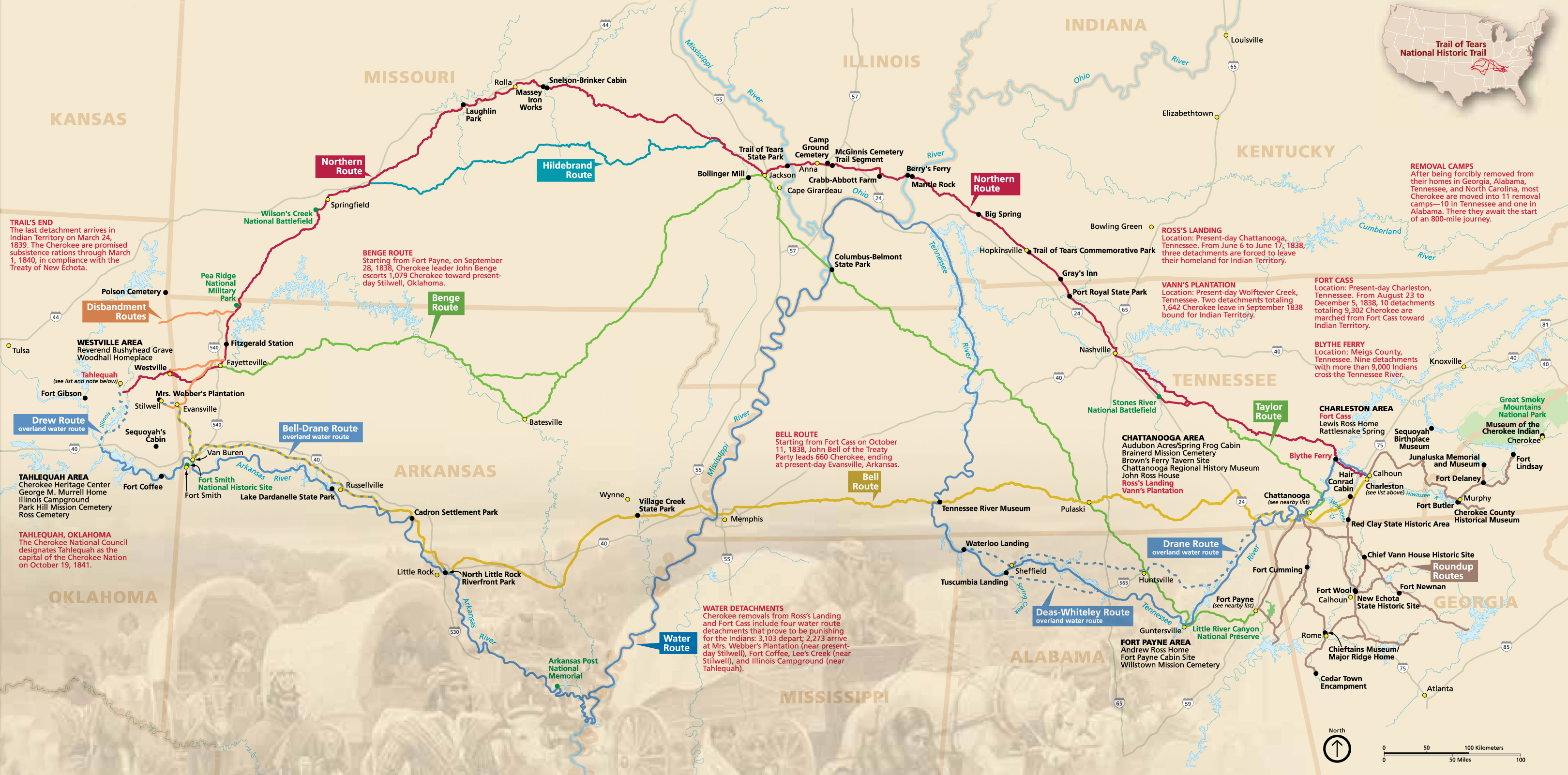
The Red Line marks the Northern Route
The Northern Route, between Rolla and Springfield, is similar to the Osage Trail and the more modern day Route 66 and US Highway 44.
At Springfield, Route 44 diverts from the path of the Trail of Tears and travels westward to current day Newton County, where Andrew Van Slyke settled prior to 1840.
 Finding the Yellow Bricks