Robert Lewis (1856-1935) had around 35 acres of strawberry fields on his farm in Newton County, Missouri.
In the Nov 24, 1929 issue of the Joplin Globe, the Chamber of Commerce ran an article describing Joplin as the “Center of a Rich Farm Belt” and that during the season, “solid trainloads” of Ozark strawberries are shipped out for the markets. The article valued that the strawberry crop alone was worth between $3.5 and $6 million dollars annually — thats about $90 million dollars in 2020.

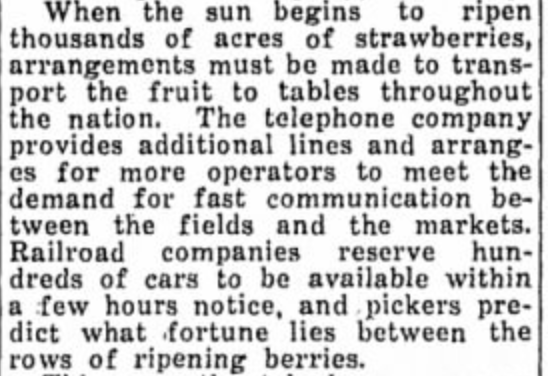
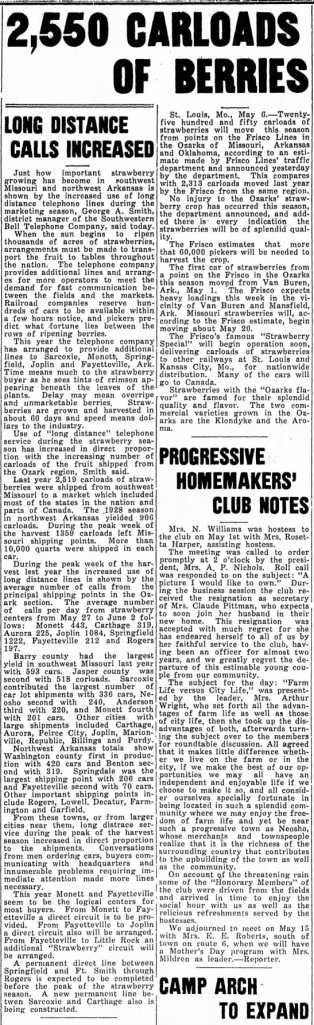
Strawberries, being a highly perishable crop, inspired the use of technology to ensure they were sold at markets. Both the railroads and telephone companies adapted their practices to the strawberry harvest.
In Railway Age (Volume 85, 1928) the magazine estimated that the St. Louis-San Francisco rail line handled 2,400 refrigerated cars of strawberries from southwestern Missouri and northwestern Arkansas. The refrigerated cars were organized by co-operatives in order to get the fruit shipped to their markets before they perished.
Long before the early morning dew was gone from the ground and vegetation, the pickers gathered…
Lest We Forget, Jewell Campbell, page 29
The men and children would pick the strawberries, often earning two cents for the quart, and the women worked in the shed, sorting and culling them, preparing them for shipment to the railroad shipping point. The photos below, while not the Lewis farm, are of berry pickers in the Ozarks in the early 1900s.

The only jobs I every had before I graduated from HS were working for my dad and picking strawberries for a neighbor… We had an old pony which I’d ride the one or three miles accordion to which neighbor I was picking for. The years Geo. [her younger brother] picked also, we’d ride double carrying our lunches in paper sacks.
The berries were usually ready to pick soon after school was out in May. If there was a heavy dew you couldn’t start picking very early in the morning because of the heavy foliage and weeks. The rows often grew together and you had to be very careful where you stepped and where you set the wooden tray on legs which contains usually 6 qt. boxes in which to put the berries. There was a wooden hand for carrying the ray. Strawberries bruised easily so they must be picked carefully being sure to break off a short stem and not pull the “cap” from the berries.
Most years, we were paid 3 cents a quart. When we took our full trays to the shed to exchange for empty ones, we were given a ticket for each quart we had picked. These were redeemed at the end of the season. I was not a fast picker but think I may have made between $5 and $10 a season depending on how good the berries were that is– how bg and how easy to find among the foliage to pick.
I usually wore overalls and a long sleeved shirt and straw hat.
From Irene Vanslyke’s handwritten autobiography. Irene Vanslyke was the grand-daughter of Robert Lewis. Born in 1920, she was raised in Newton County, near her grandparents.

Neosho, Missouri
07 May 1929, Tue • Page 1
 Finding the Yellow Bricks