Baptism
Commanding the cliffs at the mouth of the river Dart, sits a squat Norman church with a square tower, overlooking the waters. Due to its position, watching the ships in the English Channel, the church had been fortified into the Dartmouth Castle, watching the ships from France during the Hundred Years’ War and the arrival of the Spanish Armada.
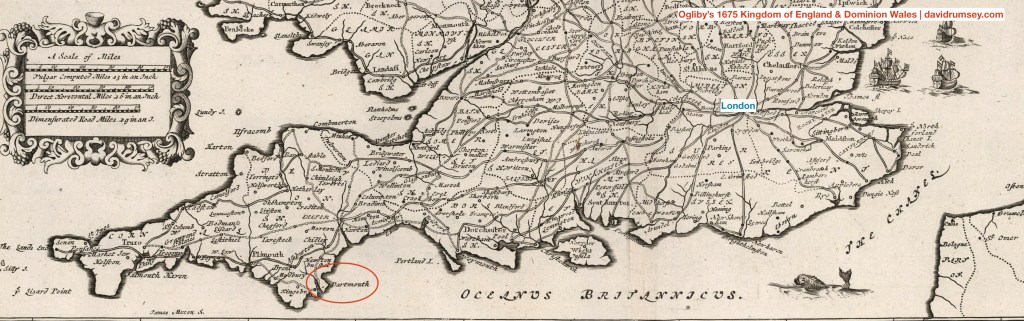
The church, called St. Petrox, is said to have been named for a religious Welsh prince who turned to a monastic life, and Peter, the rock of the church, is an apt name for the stone squat church that endured the wind and wave of the harbor. In July 1677, the Rexford family took their infant son, Arthur, to be baptized in that squat church.

Dartmouth, the town, sits north of the Castle, protected by a curve in the river, creating a harbor and haven from the English Channel.
A half-century earlier than Rexford’s baptism the Mayflower and Speedwell ships, carrying the first Puritan colonists away from the King and the Church of England berthed in Bayard’s Cove, between the castle and the town, as they awaited repairs. Soon after the colonies in Massachusetts were established, the town of Dartmouth engaged in trade with Newfoundland, as well as Spain and Portugal, due to rich cod beds nearby.
While in Dartmouth, the Rexford family disappears except for his 1677 baptism at the church overlooking the harbor.
Maritime Colonist
While many of the religious separatists who left England for the colonies were middle-class families, the emigrants from London and Devon tended to be young single men in search of a good fortune. By 1702, Arthur Rexford has crossed the Atlantic, following the path of the Mayflower. In the New World, he married Elizabeth Stevens in another harbor town: New Haven, Connecticut, where he continued to engage in maritime trade.

New Haven, located on the Long Island Sound, had been established by Puritans in the 1630s, seventy years before Rexford’s arrival, who were in search of sea port from which to grow an commercial empire. The founder viewed its spacious harbor in the Long Island Sound the epicenter of its hoped-for empire. While it conceded its dreams to Boston, the town became an agricultural center engaged in trade.

The Connecticut Colony was engaged in trade with West Indies, often sending merchants out twice a year, once in the fall and in the spring, to take the local agricultural products to the islands. There the enslaved Africans were forced to labor on the sugar plantations, which as the cash crop, supplanted other forms of agricultural and resource production. The enslavers sold the sugar for the meat and produce brought by the Connecticut colonists.
“When they had collected enough produce to fill a vessel they hired a captain and sent a ship to islands where they had agents, family members, or friends who assisted in disposing of the cargo and locating enough island products to return home with a full hold.” Connecticut and the West Indies: Sugar Spurs Trans-Atlantic Trade
Arthur Rexford commanded the sloop “Rose” which was recorded as traveling to Antiqua in 1711 and 1712. Sloops were described as the “tractor-trailer” of the colonial trade: “heavily built for bad weather and rough sea conditions, they were simple to sail, roomy for lots of cargo and passengers, easily handled by small crews, relatively swift, and usually armed for self defense wherever they might sail. They were also simple to build and inexpensive, so that if one were lost, it might not cause a crippling financial loss to its owners”, as described by the Smithsonian.
“The ship captain, who generally made two voyages a year, was responsible for the safety of the ship and the crew but also the profitable sale of the cargo. Working for different merchants, a captain would go once after the fall harvest and again in the spring after the harbor ice thawed. A voyage took from two to five weeks depending on the weather and port of call. Often, the ship’s commander had to visit several islands to sell the entire cargo. A profitable voyage depended on unknown market conditions, speed of delivery, local contacts, safe passage through often-fierce storms, fair prices, and reputable products. ” Connecticut and the West Indies: Sugar Spurs Trans-Atlantic Trade
In 1711, most likely after the return from the spring voyage, the customs man, a James Shackmaple, approached Rexford’s sloop and tried to impound it. Shackmaple reported to the crown that he was met with threats of violence as Rexford and others defended the sloop from the customs man. Despite Rexford’s resistance, the sloop was impounded for trial as Shackmaple called in reinforcements from the constable. This suggests that Rexford was not only engaged in legal trade, but also engaged in smuggling, though what he smuggled was unclear. The outcome of the trial was not recorded, yet, Rexford had command of the Rose again when he was recorded arriving in Boston in 1712, again from Antigua. The Public Records of the Colony of Connecticut [1636-1776]
His death is recorded in 1727, when he was 50.
 Finding the Yellow Bricks