William Crookham is included in the 1774 Tax List for the South Ward of Philadelphia.
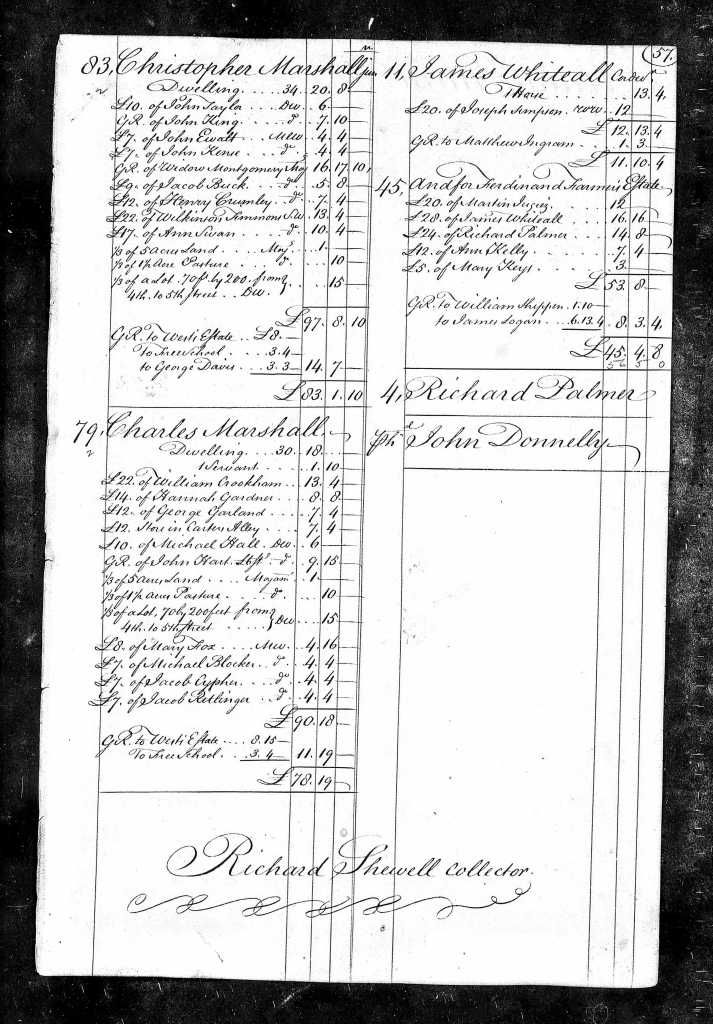
It is unclear how he is included, in that he seems to appear as a sub-item for the taxes of Charles Marshall who owed approximately 79 pounds.
South Ward, Philadelphia

The South Ward was bordered by Water and Chestnut Streets, between 4th Street and the western edge of the city. In the Vance map, this was colored a lime green. It was directly south of the pink ward.
The South was described as a a wealthy ward prior to 1785, as a residential and shopping district. The eastern end of the ward was wealthier than the western end of the ward.
William Crookham appears to have lived on the property of Charles Marshall, which was valued at 79 pounds. This placed the Marshall property in the midrange of the estates taxed. There were outliers like Israel Pemberton’s estate at 900 and several of the larger estates were in the 100-300 range. Charles Marshall ran an apothecary shop and set it up among the wealthy.
Prior to 1776, single men in Pennsylvania who did not own property paid taxes; additionally, because they did not owe taxes, they were prohibited from voting. This suggests that William Crookham was an unmarried man living in Philadelphia prior to a possible marriage and prior to owing property.
The purpose of the tax was twofold: to encourage marriage to increase the population and to discourage immoral living. Quakers, who ran the governing bodies in Philadelphia prior to the Revolutionary War, valued families and used the tax to assert its values in the community.
It is likely that this William Crookham is not the William Crookham who married Mary Philips at the Swedes’ Church, rather a son or nephew. Additionally, this may have been the William Crookham who married an Anna and lived in York County after the Revolutionary War.
Sources
Gentry, Thomas Samuel. Specialized residential and business districts : Philadelphia in an age of change, 1785-1800. Thesis. Montana State University. 1988
McCurdy, John Gilbert. “Taxation and Representation: Pennsylvania Bachelors and the American Revolution.” The Pennsylvania Magazine of History and Biography, vol. 129, no. 3, 2005, pp. 283–315. JSTOR, http://www.jstor.org/stable/20093800.
 Finding the Yellow Bricks