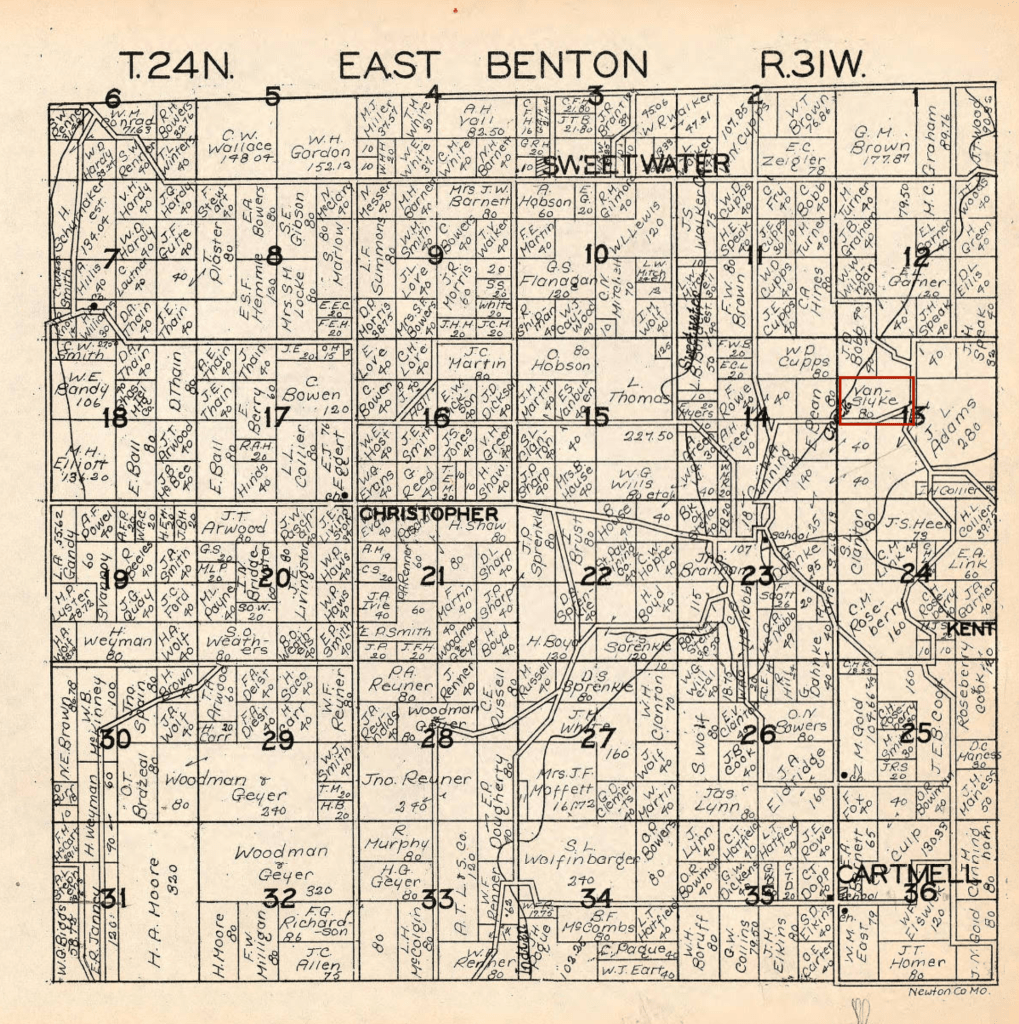
George Akin Vanslyke (1887-1967) was a farmer in Newton County, Missouri. He owned 80 acres of land near Indian Creek in Benton Township.
Granby RR was our mailing address but the farm was 15 miles or so from Granby and only five plus to Stella where my family traded and where we went to church and where I went to school from grade 5 until I graduated from High School.
from written memories of Irene Vanslyke, George Akin’s daughter.
He had purchased the land into two lots. The first forty were bought prior to his marriage and he purchased the second 40 acres around the time of World War I.
Farmhouse
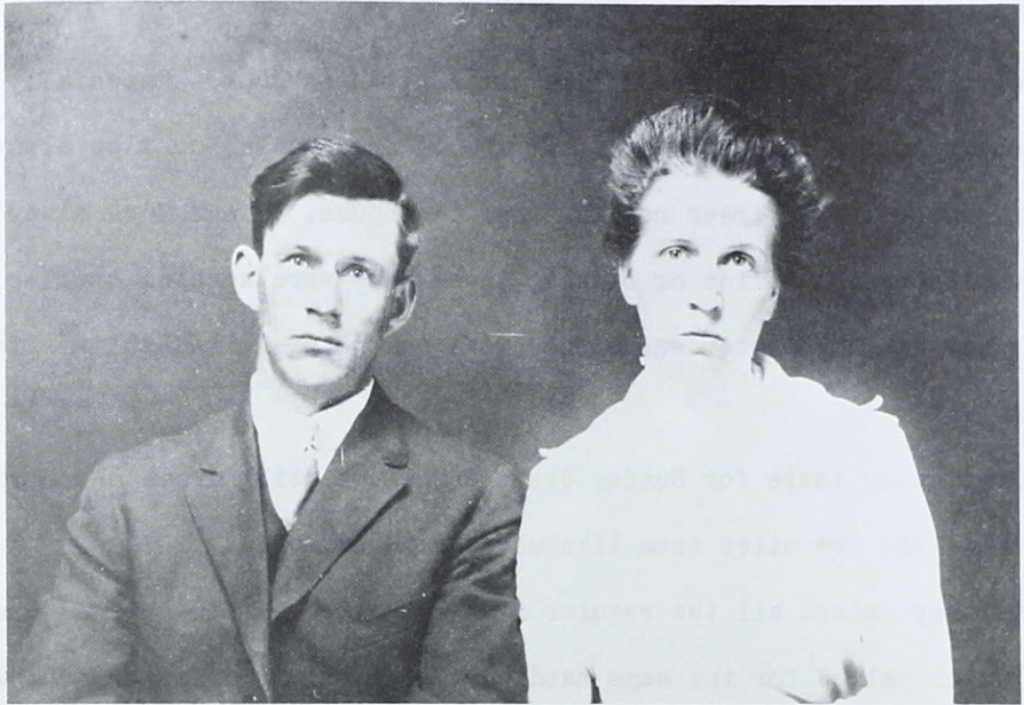
He built a house on the first forty acres prior to his marriage to Claudia Almeda Lewis, who he “courted” for five years. He lived in the smokehouse while he built the home. The family stored meat, lard, and other things in it during Irene’s childhood.
The house which had been built was one and three-quarters stories with two rooms downstairs and room for two which were never completely finished upstairs. I can just barely remember living in the two rooms as more rooms were added around 1926 or 27.
from written memories of Irene Vanslyke

Likely taken by Claudia Almeda Lewis Vanslyke. Irene describes her mother purchasing a box camera in the 1920s.
The picture, dated 1929, would have been most likely after the addition, as Irene notes in her memories it was completed prior to her sister’s death in 1828. “The addition contained a kitchen, dining room, a pantry and closed porch on the north end and an open porch on the south end. Of the two original rooms, the south one became a living room and the north one a bedroom”. George Vanslyke got Ernest Link, a carpenter who lived a mile and a half away, to help him build the addition.

I do remember eating in the north room which was the kitchen. I can sort of remember the arrangements of furniture in the kitchen which included a cream separator which set by the west door.
from written memories of Irene Vanslyke
Farming
George had two mules, Kate and Jack, which he used for farming, because they were “smarter and stronger” than horses. His father, John Harrison Vanslyke, had “specialized in raising horses and mules” (The Story of Stella, Pioneer Town of Newton County, Missouri). While Irene and her sisters were not expected to engage in team work, Irene’s younger brother George did.

When George was old enough to start going to the field with a team Dad always said Jack would go where he was suppose to and all George had to so was follow.
from written memories fo Irene Vanslyke
At times, prior to the Great Depression, George Vanslyke hired off and on a man to help him with the farm work. “Sam Hance lives in a shack which he built for himself just west of the northwest corner of our west forty acres.” Irene remembered him as an “old” man with gray hair and whiskers. He had had a breakdown after his wife died from a long illness and after his recovery at a hospital, lived near the Vanslyke’s working for neighboring farmers. He would eat lunch with the Vanslykes when he worked for them. He brought candy from the grocery store to give to the children. By the time of the depression, George Vanslyke had a young son, George Jr., who could help, and he could no longer afford a dollar a day for hiring him.
Threshing
In the summer, the neighbors would cooperate to thresh the cut and shocked grain. “No one in our immediate neighborhood had a threshing machine so the men would get together and get someone from of the surrounding communities to come threshing each farmers grain in turn.”
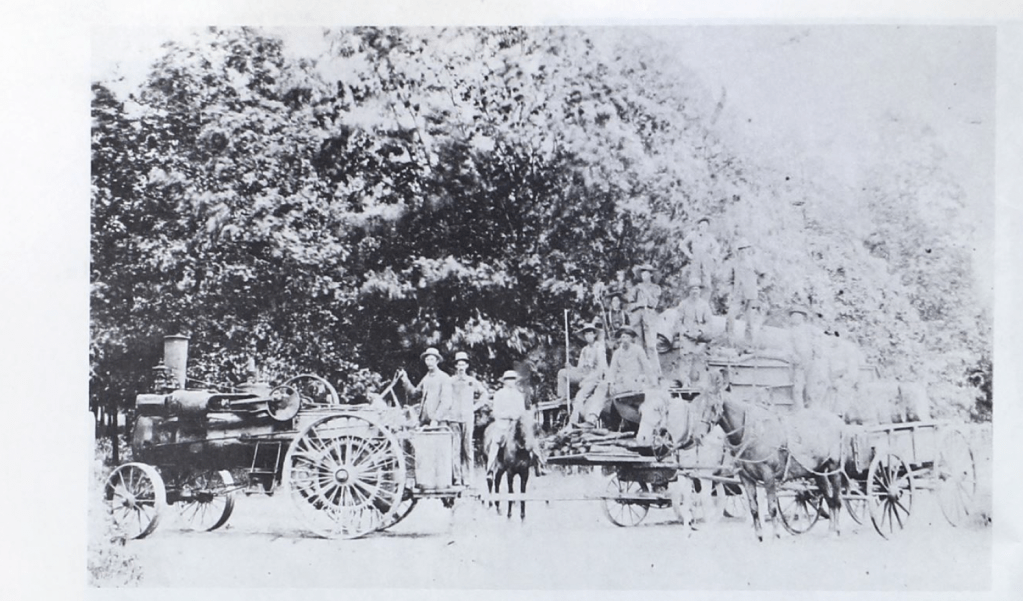
Picture from Lest We Forget Our Lewis-Hardy Heritage by Jewell Lewis Campbell, 1982
Irene describes the threshing process as follows:
The wheat would have been cut with a horse drawn binder which cut the wheat and tied it with binder twine into bundles. These, men would place the bundles on their butt ends in shocks of eight or ten bundles. One or two bundles would be bent slightly in the middle and placed on the top of the others to held shed any rain that fell.
Other than the one or two men which came with the machine, Dad would usually have three farmers with wagons equipped with hay frames to haul in the bundles and at least two wagons with grain tight beds to haul grain to the barn. Each wagon which hauled the bundles would have a driver and someone to load on the bundles which were pitched up to them by two or three men working in the field.
This usually added up to twelve or fifteen or more men and boys to be fed at noon at whatever farm, they were working.
from written memories of Irene Vanslyke
In addition to wheat, George grew corn and tobacco in his fields. He had apple and peach orchards and a vegetable garden tended to by his wife and children. In Lest We Forget, a cousin describes visiting the farm and the bee hives he kept under some apple trees.
Several years I earned money by picking worms off Dad’s tobacco plants. I hated the job. Sometimes I carried a little can of keorsene to drop the worms in. Sometimes I’d pick them off with two sticks, drop them on a rock, turn my head and squash them with another rock. When he cut the tobacco plants, he’d tie them in bunches and hang them in the barn loft. One time Aunt Bess, Dad’s youngest sister was visiting and I heard her ask Mom, “Does Doc [George] have any home grown tobacco?” Mom told her where it was and she went to get some. I know she chewed tobacco, but I thought she was pretty bad off to chew that!
from written memories of Irene Vanslyke
During the Depression, Irene describes how in the dry summers in the early thirties:
Dad would wait until the fall rains started and plant turnips. Everybody ate turnips! We chopped them up raw for the chickens and the cows. Dad cooked them in a big black kettle outside for the pigs and we at them almost everyday. For a long time, I didn’t like turnips.
from written memories of Irene Vanslyke
 Finding the Yellow Bricks