Thomas Relf (1857-1940) was born in Indiana and lived in Missouri, Kansas, and Nebraska prior to 1900.
Norton County, Kansas | 1879
In 1876, he married Sarah C Peniston in Madison County, Indiana. Shortly after their marriage, they migrated to Norton County in northwestern Kansas. It is the fourth county from the border with Colorado, and sits along the Nebraska border.
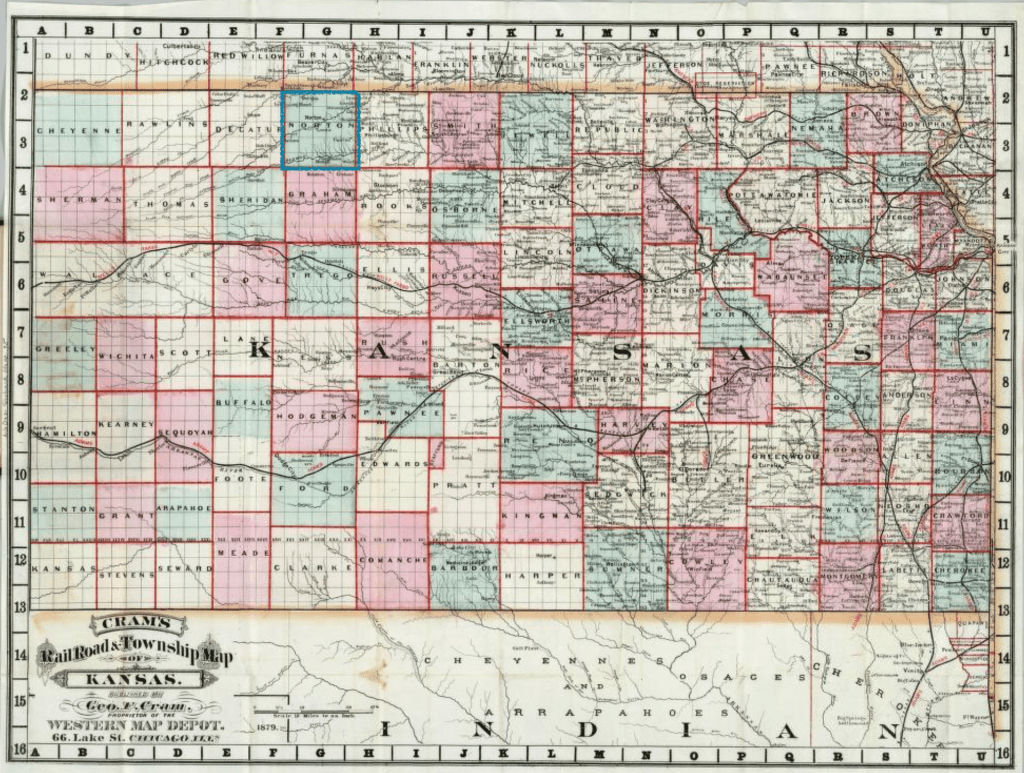
The biography of their son, Josiah Frank Relf, (History of Richardson County, Nebraska, 1917, p. 1042) records that he came to Edmond, Norton County in 1879.
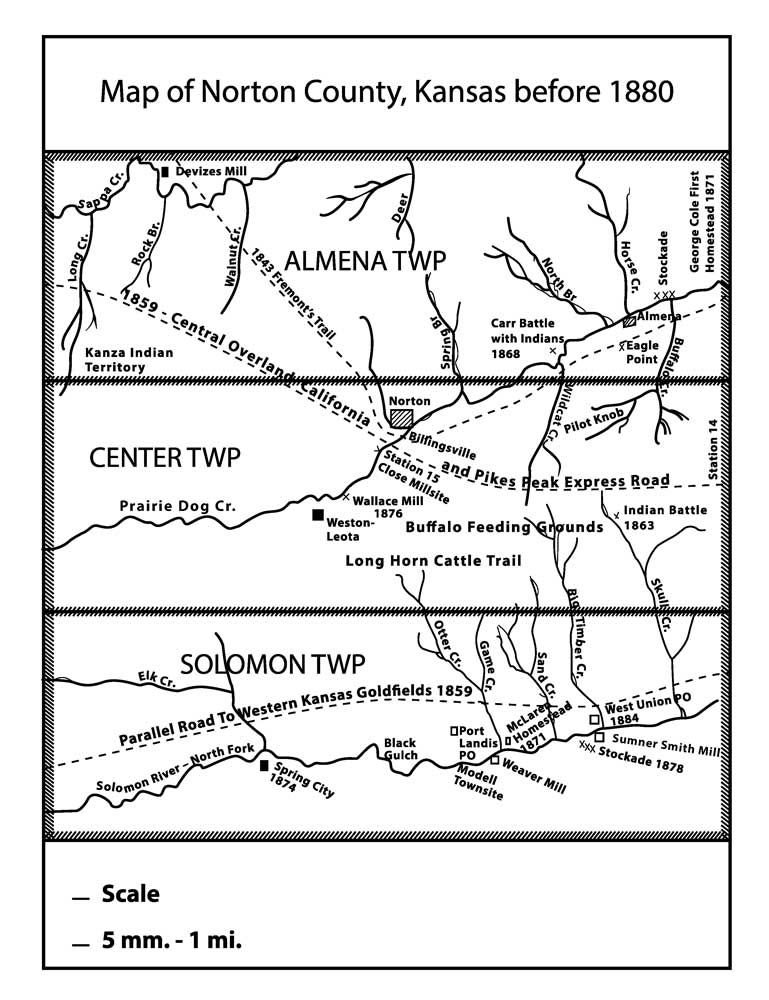
Settlement
Edmond is in the southeastern part of the county on the Solomon river, just east of Sand Creek. It was platted in 1879, the same year that the Relfs came to Kansas. It advertised its quick growth in the Norton County Advance:

25 Dec 1879, Thu | Page 3
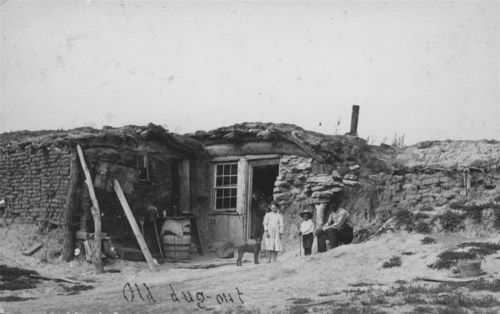
The building of a frame house was newsworthy as many of the settlers built homes with sod due to a lack of timber.

Norton County was established in 1872, and the Norton Courier in 1880 describes the immigration as starting in 1878:
The first genuine settlement in the county was in 1872, in Solomon and Center townships but the county did not begin to fill rapidly with settlers till the spring and summer of 1878…In 1878 nearly all the best vacant land in the county was taken, and the next year sa as much immigration, so that at the close of 1879 but little vacant land was left, except such as was too rough to suit.
Norton Courier (Norton, Kansas) | 15 Jul 1880 | page 1 | newspapers.com
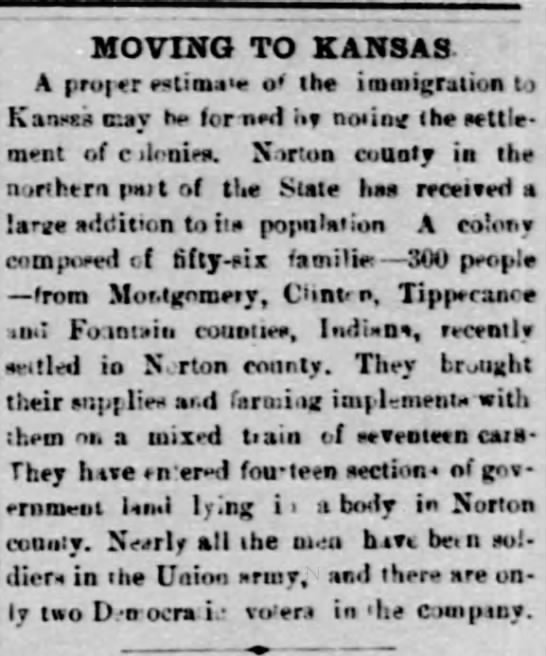
An article in the Dodge City Times describes the arrival of a large settlement of people from Indiana. The counties mentioned, Montgomery, Clinton, Tippecanoe, and Fountain west of Madison County. This was shortly before the Relfs came to Kansas.
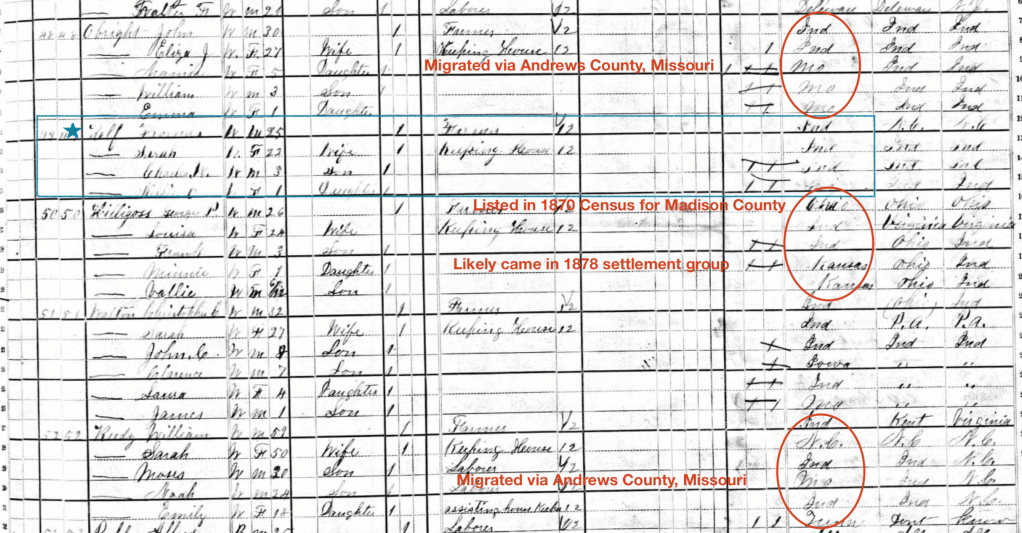
The 1880 Census for Norton County lists the Relf family settled nearby to other families from Indiana. Among these families, George Hilligoss was listed in the Madison County 1870 census and may be known by the Relf family prior to migration. It is likely, based on the birth dates of his Hilligoss’s children, that he arrived in the 1878 migration group.
Drought
The Relfs arrival in 1879 was untimely based on indications from editorials in the newspapers. While real estate agents advocated for immigration and newspapers promoted western Kansas, it seems that 1879 & 1880 were difficult years for farmers who weren’t used to the semi-arid weather of Kansas.
We then looked for the heaviest immigration in our history. Lots were contracted for in all the towns and preparations commenced for building in the spring. As the months rolled on and the dry weather continued fears began to be entertained for the crop of all grain. When this became a certainty of failure the farmers immediately proceeded to re-seed to spring grain, which from the same cause also failed, and the ground was then wanted to corn and other crops. Still no rain came and not until the 13th of the June was the ground gladdened with a genuine soaking. Meanwhile many of the weak-kneed had taken their departure, asserting that “they never did believe in Kansas, anyway” but in nearly every instance taking an extension to prevent someone else from taking the land on which they pretended to think so slightly. With them had gone many prudent persons who thought the country was all right, but that they could do better elsewhere this season.
Norton Courier (Norton, Kansas) | 30 Dec 1880 | page 4 | newspapers.com
In 1886, the Western Kansas World newspaper published in Wakeeney Kansas cited an undated Norton Champion piece that paints a picture of extreme poverty and hunger:
Only five years ago [1881] we had occasion to visit a neighborhood a few miles from here [within Norton County]; we remember that scene of poverty. There was a woman grinding corn in a coffee mill; two small children at the stove, jealous of each other for watching a nubbin of corn on the fire made of buffalo chip; and younger one at the ragged mother’s knee crying to be nursed. … If hunger asked to be incarnate, it would have haunted the frame of that mother. … Scurvy was in their teeth and rotten gums, for not a green plant grew in the garden to forestall it. The cornstalks withered long before under a scorching sun, or their sweet juice would be food and manna.
The editor of the paper continues with his own response describing how the “It was during the ordeal of 1880 that you witnessed the ghastly blight which overtook the pursuit of agriculture in western Kansas. The terrible extent of that blight lay in the immigration 1878-9, having come here, virtually as a whole, to follow farming. It followed by reason and reality that the failure of the farming community meant general suffering. Perhaps nearly all who felt it possible to do so left the county.” Those that stayed shifted from “straight farming” to raising livestock and raising crops to feed the stock.
The Relfs left Norton County in 1880. They returned east, headed toward Missouri.
DeKalb County, Missouri | 1880
In Norton County, the Relfs had lived near John O’Bright and William Reedy, who originally from Indiana, had migrated and settled in Andrew County, Missouri prior to coming to western Kansas. They likely told the Relfs about land in northwest Missouri and when the Relfs left western Kansas, they migrated to DeKalb County, to the immediate east of Andrew County, as related in the biography of Josiah Francis Relf (p. 1042).

excerpt from Northwest corner shows Andrews county on the Missouri River with DeKalb to its east
It’s unclear how long they stayed in DeKalb; by 1885 they were recorded in the Kansas State Census in Neosho county. Josiah, their third child, was born in Missouri in 1881, and their fourth child (listed in the census) was born in 1884 in Kansas. This suggests they stayed between two to three years before migrating again.
Neosho County | 1885
If Relfs were pushed from Norton County, Kansas to more fertile land, they were likely pulled to Neosho County by family.
Neosho County is in the southeastern part of the state.

Aunts and Uncles
Thomas Relf married Sarah C Peniston in Indiana in 1876. She was the granddaughter of William and Sarah (Barkeloo) Garrison who lived in Wabash County, Indiana. The Garrisons died in the 1850s, leaving their children orphans. The older children married in the 1850s.
Hannah, the eldest daughter, married Isaac Peniston, a farmer in Madison County, where her grandfather lived. In the 1860 census for Madison County, Isaac was a farmer with land worth $2000. By the 1870s, he isn’t recorded in the census. Isaac and Hannah took in her younger siblings, Oliver and Eliza.
Samuel, Sarah’s uncle, married Sarah and continued to live in Wabash County. In 1880 he had migrated to Grant County, Indiana, before migrating to Neosho County, Kansas, where he died in 1883. The Osage Mission Journal reported his death as the result of heart disease. He left behind his wife and children. His farm was advertised for sale to satisfy debts in his estate by his administratrix, Susan Garrison (Erie Record, 27 Jul 1883, p 4). It was described as located in T28, R 18, S 18 & 17, that is Canville Township. His land straddled the road north out of Earlton. He is buried in the Earlton Cemetery. His wife returned to Grant County, dying in the soldier’s home in the early 1900s.
Catherine, Sarah’s aunt, married George Riley in Madison County. It was at their home in Madison County, that Sarah and Thomas were married. They moved to Neosho County in 1880, according to the obituary of George Riley. Catherine, George’s wife, died in 1885 from a fall. She had been on a ladder placing jars of peaches on a high shelf.


The Kansas State Census lists the Rileys prior to Catherine’s death on page 8. On the next page, the census lists the Relfs. Thomas Relf is working as a mason, not a farmer, according to the census. The Chanute Blade in 1885 (19 Feb 1885, p. 4) reported out the Tioga Township’s Treasurer Report which included the details that Mr. Relf had earned over $60.00 working on the bridge. By 1887, The Chanute Blade (28 Jan 1887, p. 3) reported that Thos. Relf would be farming G. W. Riley’s farm in the coming season. His farm was located near Urbana, about 4-5 miles east of Earlton, and on the border of Townships.

showing Thomas Relf family, profession as mason, and that they migrated from Missouri, with the exception of their youngest who was born in Kansas
The Relfs stayed just a few years and then settled in Nebraska by 1888.
 Finding the Yellow Bricks