George Lennox Crookham moved to the Ohio frontier in 1799 where he settled and worked the salt works. He was a self-educated man who “used to read and study by the light of the furnace at night” by the salt boiler. (Jackson Standard, 14 Jul 1855, p 2 | newspapers.com)
“Jack Oak College” Burned
In the community , he became a schoolteacher and “noted for the originality of his ideas and philosophic turn of mind”. (Jackson Standard, 29 Jun 1876, p 3 | newspapers.com)
His school was known as “Jack Oak College” (for he used Jack oak to build the school house) and even after his death the area was known as the Crookham School District.
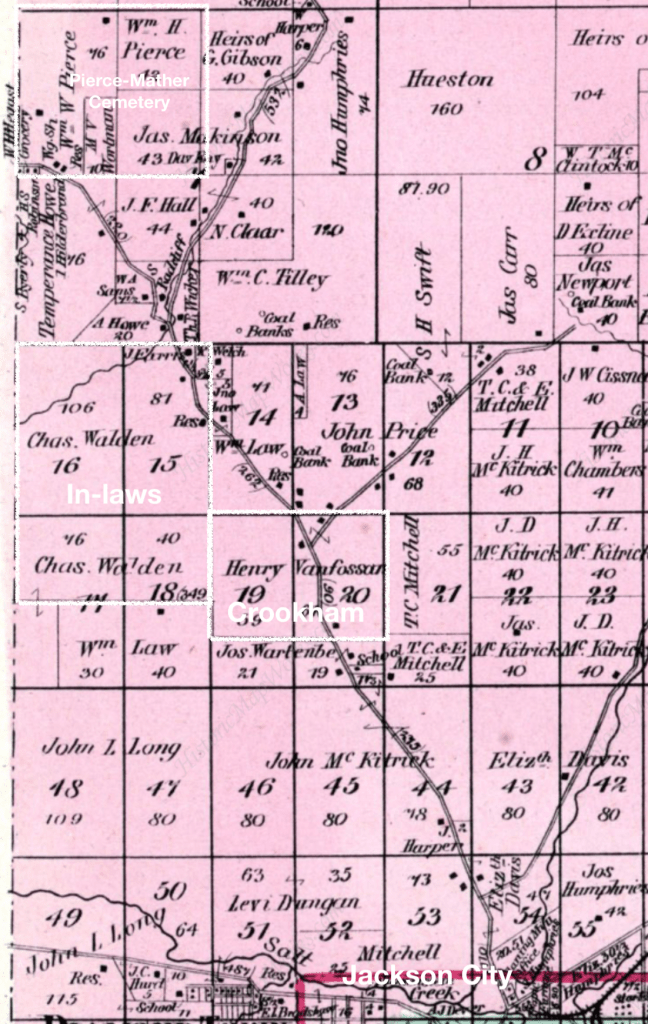
He had a private school house on his farm, two miles from town, on the Chillicothe road, wehre Henry Vanfossan now resides. There he taught his own and his neighbors’ children and in this little school house he kept his library, apparatus, and fine cabinet of natural curiosities, which he had been accumulating, collecting and arranging for many years.
Jackson Standard, 24 Jun 1876
The same article describes how in 1836 “the slavery question was agitated in the county, and a very few persons, among them Crookham, Alexander Miller, Dr. A. W. Isham and a few others, took open ground against this sum of all villanies.”
The article doesn’t specify what “agitated” the question, however, 1836 was the same year that James Birney began the publication of Philanthropist, an abolitionist newspaper in Cincinnati which called for the end of slavery and equal rights for Black people. White supremacists in Cincinnati tried to have his paper banned, and twice destroyed his printing press. (Ohio History Central.org)
Additionally, in 1836, in Pike County, Ohio, a neighboring county to Jackson County, there was polarizing discord over the “slavery question.” Rev. Edward Weed, an organizer for American Anti-Slavery Society had been forced to leave by a mob headed by the town’s founder and wealthiest resident, James Emmitt. In response to Weed’s presence, a meeting of citizens was called. John Innskeep Vanmeter, a Whig, was a political leader of the group who were anti-abolitionists and pro-slavery. They sought to ensure the continued oppression of Black people and the enslaved. (Scioto Historical Society)

The pro-slavery crowd in Jackson County, Ohio burned Crookham’s schoolhouse and its collections “because of his extreme views on the questions of temperance and slavery”. (Biography of Judge J. A. L. Crookham). “It was well known who committed the arson, yet no attempt was every made to bring the perpetrators of this outrage to justice”. (Jackson Standard, 29 Jun 1879).
In the Standard History of the Hanging Rock Iron Region of Ohio published in 1916, the author claims his schoolhouse was burned shortly after Crookham with Reverend Powell (John Wesley Powell’s father), and W. W. Mather, noted geologist, invited Professor Williams of Oberlin to speak in town. On this occasion, a mob attacked the abolitionists and forced them to seek refuge in a “leading citizen’s” house. (p. 369) Oberlin was founded in the 1830s as a religious community and became a focal point in the abolitionist movement.
Underground Railroad
In his son’s biography, it described Crookham as “an old federal whig and assisted many a colored man to gain his freedom, his home being on the Underground Railroad of that day and his own son, Jefferson G, at one time drove a team that carried a load of these unfortunate people farther north.” He is listed in Siebert’s history of the Underground Railroad as a participant. “One of the underground railroads ran from the mouth of the Guyan through Jackson, and Crookham had charge of a local station. There was no difficulty in harboring runaways in the many rock shelters along Salt Creek and its tributaries… Through the aid of Crookham, runaways were conducted to the first of these houses located not far from his home, and no officer could ever trace them farther.” (Standard History of the Hanging Rock Iron Region of Ohio, p 370)
Guyan refers to Guyan Trace, a track used to move bushels of salt to the Ohio river. It had been a trail established by the Indigenous people, and used by Euro-Americans to transport goods. The description in the Standard History uses stations and furnaces to mark its location:
That trace left town where Nelson’s Furnace was located. It ran a south course and crossed the divide near where Irwin’s station now is. It then ran southward t the Adkins place, from there to old Joseph Price’s, crossed the Black Fork of Symmes creek near where old Henry McDaniel lived, then up long creek, and crossing Greasy Ridge rand own Trace Fork to the forks of Indian Guyan, now Scott town; then south or nearly so to Guyandotte [Huntindon, West Virginia]
p. 409
One of Crookham’s students, John Wesley Powell became a famed geologists who explored the Grand Canyon. In “Powell of Colorado”, the author describes how Crookham took Powell to explore Salt Creek Gorge to see the caves where self-emancipated Black people hid as they travelled along the railroad. Salt Creek Gorge is northwest of Jackson and formed by erosion from glacial waters.
He promised to show him a different kind of railroad. The two worked their way through Salt Creek Gorge, father than they had ever gone previously, until they came to a ravine where the overhanging ledges formed protected caves high above the stream bed. Suddenly, a black man, the first..Wes had very seen, crawled out of the caves. He was followed by another man, and then a third….
Indeed Crookham was familiar with this mysterious railroad be chase had had been in charge of the local station, and during his lifetime had assisted scores of runaway slaves on their way to Canada. The first of the refuge houses of Jackson was located close by Crookham’s farm and he had helped many to reach this station of safety and escape. A large colony of runaway [Black people] became established in the more inaccessible branch of Rock Run, Salt Creek Gorge, and West Pigeon Creek.
pg. 13, Powell of the Colorado.
Sources:
Andrew Feight, Ph.D., “Rev. Edward Weed & the Piketon Anti-Abolition Resolutions,” Scioto Historical, accessed May 29, 2022, https://sciotohistorical.org/items/show/107.
“James Birney,” Ohio History Central, accessed May 29, 2022, https://ohiohistorycentral.org/w/James_Birney.
“Judge J. A. L. Crookham”, Past and Present of Mahaska County, Iowa, by Manoah Hedge. accessed May 29, 2022, http://www.beforetime.net/iowagenealogy/mahaska/pastandpresentbook/ppcrookhamjal.html
A Standard History of the Hanging Rock Iron Region of Ohio: An Authentic Narrative of the Past, with an Extended Survey of the Industrial and Commercial Development. (1916). United States: Lewis Publishing Company.
Darrah, W. C. (2015). Powell of the Colorado. United States: Princeton University Press.
 Finding the Yellow Bricks