
In 1867, William A. Walden posted an Executor’s notice in the Jackson Standard that he had been appointed as the executor of John Walden’s last will and testament.

His will was recorded in the Probate Office of Jackson County, where his mother and most of his siblings were residing. He bequeathed “all the interest I now own in the farm heretofore owned by my father in the Jackson County Ohio” to his brother Charles Walden, and his “beloved mother” money to be paid by his brother from the land bequeathed to him. Additionally, he bequeathed his mother six acres of land conveyed to by his brother, William Walden in 1863. He also bequeathed to his mother a promissory note executed to him by Charles Dickason (relatives on his mother’s side of the family).
He also bequeathed to his bother a “claim against the US for a horse taken from me by the Rebel General Morgan or the men under his command, and which was afterward recaptured by the Union forces.”
The Will was signed and dated August 1866 and witnessed by James Baker, OC Crookham and Mary J Crookham.
The Crookhams were living in Greene County, Missouri in 1866. The obituary of Sarah (Crookham) Wyant states that she moved with her parents (OC and Mary Jane Crookham) to Ash Grove, Missouri, in 1865. (Eureka Herald, 10 Sep 1942, p 3 as cited in findagrave.com) Ash Grove was in Greene County, Missouri, where Springfield is located. That they witnessed John Walden’s will suggests that Walden moved with them to Springfield after the Civil War.
Morgan’s Raid

Brigadier General John Hunt Morgan led a diversionary raid into Indian, Kentucky, Ohio and West Virginia in the summer of 1863. The raid covered over a 1,000 miles. During the raid, they destroyed bridges and railroads, while seizing property including supplies, food and other items. In Ohio, about 2,500 horses were stolen and over 4,000 homes were raided. He and his men raided Jackson County on July 16 and July 17th, 1863. There were a few clashes with Ohio Militia at Berlin and Hamden and he encountered the 9th Michigan Calvary in Centerville, Gallia County.
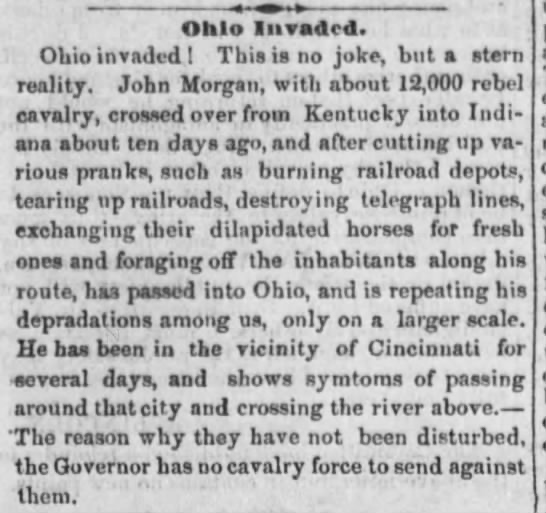
Text from the newspaper article:
Ohio invaded! This is no joke, but a stern reality. John Morgan, with about 12,000 rebel calvary, crossed over from Kentucky into Indiana about ten days ago, and after cutting up various pranks, such as burning railroad depots, tearing up railroads, destroying telegraph lines, exchanging their dilapidated horses for fresh ones and foraging off the inhabitants along his route, has passed into Ohio, an dit repeating his depredations among us, only on a larger scale. He had been in the vicinity of Cincinnati for several days, and shows symtoms [sic] of passing around that city and crossing the river above.–The reason why they have not been disturbed. The Governor has not calvary force to send against them.

Text from the newspaper article:
Col. Runkle, with about fifteen hundred men, encountered Morgan’s forces at Berlin, Jackson County, this afternoon. The enemy lost four killed. No loss on our side. Morgan moved off in an easterly direction. It is supposed he is making for Pomery or for the ford below Buffington Island. The roads leading to Pomery are blockaded with trees for fifteen miles. Gen. Hobson’s advance reached Piketon to-day twelve houses after Morgan left. The Gazette’s Portsmouth dispatch says the rebels on Thursday burned the steam saw mill and the bridge across the canal at Jasper and the bridge across the Scioto above Piketon. This morning they burned a flour mill and railroad depot at Jackson, completely sacked the town and carried off all the horses found.
A historical marker is located in Jackson County and reports:
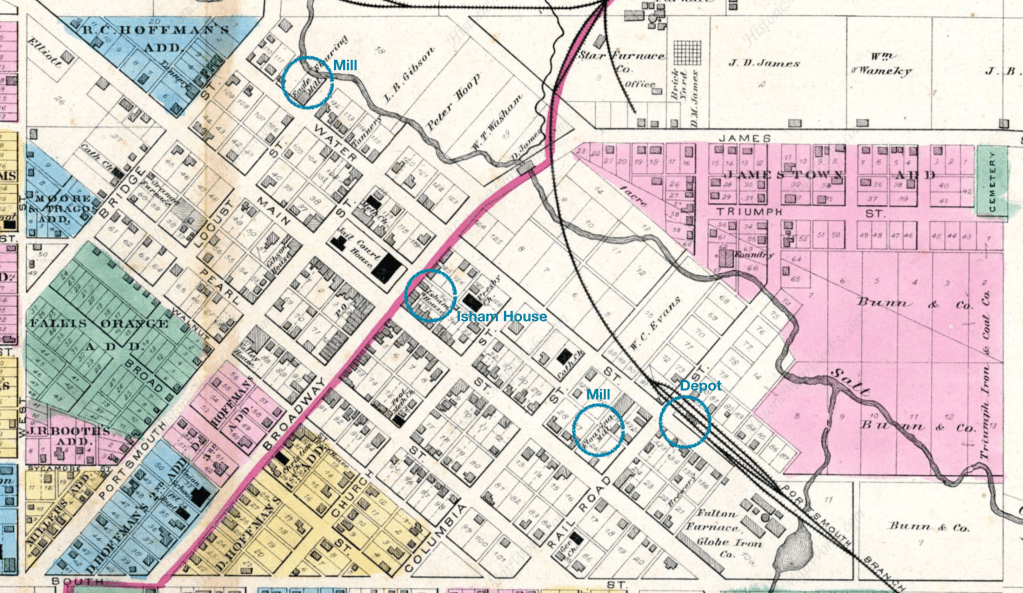
Late in the evening of July 16, 1863, Confederate General John Hunt Morgan entered Jackson with 2,000 cavalrymen, meeting with no resistence. Finding many townspeople assembled, the raiders took the men as prisoners and held them at the fairground. They then foraged the town at will, taking food and all available horses. The raiders also burned the Cincinnati and Marietta Railroad depot and destroyed the office of The Standard, the Republican newspaper. Morgan made his headquarters at the Isham House, directly across the street from this marker. He continued eastward on the afternoon of July 17. Strongly divided politically during the Civil War, Jackson received no speical consideration by Morgan. Both unionists and “Copperheads” (southern sympathizers) suffered equally.
The letters of the Ford Family describe the preparations the town of Jackson took as they heard of the advance of Morgan and his men:
The stores were closed and such things as could be easily put away were secreted. We still hoped it was a false alarm. Mr. Dickerson left with the fund’s of the Treasurer’s Office. Mr. Matthews with the contents of the P.O. Most of or many of the good horses were taken to the woods with the hope of saving them.
Fannie Ford Latter, 23 July 1863 | ohiomemory.org
The letter detailed the plunder of homes and stables:
It is estimated that 200 horses were taken in a 10 mile area about J–. Squads came in by leading 2 or 3 each. They took sheaf wheat from the field to feed with.
Fannie Ford Latter, 23 July 1863 | ohiomemory.org
John Walden claimed one horse and saddle. The horse was valued at $100 and the saddle at $15. His uncle, Lewis D Walden claimed a horse valued at $80.00. The Crookhams and the Millikins did not make claims.
Sources:
Ford Family Letters Regarding Morgan’s Raid
For dates of raid: https://www.carnegie.lib.oh.us/morgan
Morgan’s Raid Losers Including An Abridged Reprint of the Report of the Commissioners of MORGAN’S RAID CLAIMS To the Governer of the State of Ohio December 15, 1864 – Page 87
 Finding the Yellow Bricks
I have really enjoyed reading these historical accounts of my Crookham Family. Susan C Burkholder
LikeLiked by 1 person