Cader Edwards, b 1705 in Wales, was a sea captain who settled on the Tennessee/North Carolina frontier in the 1770s. Despite his frontier residence, he “kept in touch with the outside world to some extent, and was generally well posted in regard to the various political developments, both in the colonies and the mother country, which preceded the Revolution.” (p.13) He subscribed to newspapers from Philadelphia, Baltimore, and Williamsburg.
Edwards was “an ardent patriot and a supporter of the colonies against the mother country”. When the Revolution first started, he rode to Williamsburg to offer his services and refused on account of his age. “Like many others, and at the beginning of all wars it is the same, he thought that the struggle would be over in a short time, before his boys would be of military age, but it lasted until three of them were sold enough to serve against Cornwallis in the Carolinas, and were present at King’s Mountain, at the Cowpens and at the siege of Yorktown.” (p. 14)
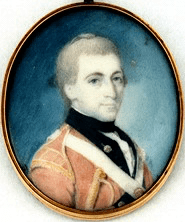
Patrick Ferguson
Scottish officer in the British Army sent to the Carolinas to recruit Loyalists.
The southern colonies were thought to have a considerable Loyalists population, and Ferguson was sent out by Cornwallis to recruit them to the British Army while intimidating the colonists who supported Independence.
In Sept 1780, Ferguson sent out a message from his camp “to the officers on the Western Waters” that if they did not “desist from their opposition to the British Army, and take protection under his standard, he would march his army over the mountains, hang their leaders, and lay their country waste with fire and sword”.
Below is an address by Ferguson to the inhabitants of North Carolina on 1 Oct 1780, a week prior to the Battle of Kings Mountain. Denard’s Ford was near Gilbert Town, where Ferguson was stationed before he marched to King’s Mountain.
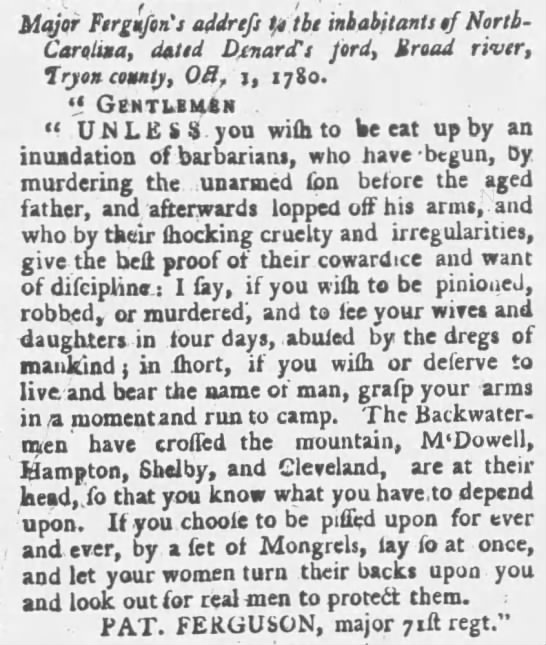
Unless you wish to be eat up by an inundation of barbarians, who have begun, by murdering the unarmed son before the aged father, and afterward lopped off his arms, and who by their shocking cruelty and irregularities, give the best proof of their cowardice and want of discipline: I say, if you wish to be pinioned, robbed and murdered, and to see your wives and daughters in four days abused by the dregs of mankind in short, if you wish or deserve to live and bear the name of man, grasp you arms in a moment and run to camp. The Backwatermen have crossed the mounts, McDowell, Hampton, Shelby, and Cleveland, are at their head so that you know what you have to depend upon. If you choose to be pissed upon for ever and ever, by a set of Mongrels, say so at once, and let your women turn their backs upon you and look out for real men to protect them.
Battle of Kings Mountain
The Battle of Kings Mountain is unique in that the battle was between the formal British Army and a loose confederacy of 1,000 militiamen who came from “over the mountains”. Among them were 240 militia men under the leadership of Isaac Shelby, among whom rode Cader Edwards, his two sons and his son-in-law. They joined the militia raised by Shelby at Sycamore Shoals of the Watuaga, along with militias raised from Washington County, Virginia, as well as Washington, Burke, and Rutherford Counties, North Carolina. They were later joined with militia from Wilkes and Surry Counties, North Carolina.
These men were frontier Euro-Americans who showed up with their hunting gear: leather pants, moccasins, white shirt and rifles. They had settled in the 1760s and 1770s on the western side of the mountains, which meant they had invaded territory that the British considered to be off-limits for Euro-Americans, having made treaties with the Indigenous tribes. Like the Edwards Family, many were not English settlers, rather Irish and Scottish settlers. Some had fought against the English in the Jacobite rebellion or their fathers had. Most of their time leading up to the Battle of Kings Mountain had been spent fighting tribes who had allied with the British against the settlers.
When Ferguson sent out his call to lay waste to those across the mountains, militias from both sides of the mountains reacted quickly, forming the 1,000 men strong militia and marched to Ferguson. Upon hearing that the Backwatermen were coming, Ferguson began to march toward Cornwallis, to rejoin the troops, and yet he stopped when he reached Kings Mountain (a hill with a plateau top). There he stationed his men on top of the plateau and thinking he has a strategic defensive position, allowed himself and his men to be surrounded by the militia. He and his army was shot. Ferguson and 120 of his men died and the rest wounded and/or captured.
Due to his age, Cader Edwards acted as a volunteer aide for Shelby.
He had the best horse in the little army, and he managed to be of much service, though no duty was required of him except such as he volunteered to perform; and it was said afterward by Colonel Shelby and the other officers, that the presence among the men of the old white headed sailor; his well known exalted patriotism; his silent and cheerful endurance, without complaint of fatigue, rain, cold and hunger, and his constant exhortations around the camp fires to the young men to stand up like men, and never to turn back until Ferguson’s army was overtaken and utterly destroyed was worth more to the expedition than would have been the services of quite a number of able bodied men. (p. 17)
While marching to Kings Mountain, Cader Edwards was struck by a limb. The night before the battle was described as “dark and rainy”. The limb struck him as he was riding his horse at daybreak, and he fell from the horse to the ground, where he struck a small log. He was helped back on his horse, and the continued to take part in the battle. However, the injury was severe, became infected. Upon his return to home (200 miles across the mountains) after the battle, he took to his bed. His injury in his side never fully healed.
Source:
Edwards, C., & Gorin, S. K. L. (1997). The Edwards family of Barren County, Kentucky: History and traditions. Glasgow, KY: Gorin Genealogical Pub.
 Finding the Yellow Bricks