
Levi Garrison is said to have been born in 1743 in the colony of New Jersey. Living in southern New Jersey, he grew up in Salem County and resided in Cumberland County during the Revolutionary War. Both Salem and Cumberland County border the Delaware Bay. The two townships, Pittsgrove and Deerfield border each other, and it is possible the borders shifted over time.
After the War, Levi Garrison migrated west, through Pennsylvania to what would become Cincinnati, OH, to Indiana.
Prior to his migration west, Levi was expelled from the Presbyterian Church in Deerfield, Cumberland, NJ for “adhering to the Methodists”. He was suspended from the Presbyterian Church on 11 March 1782.
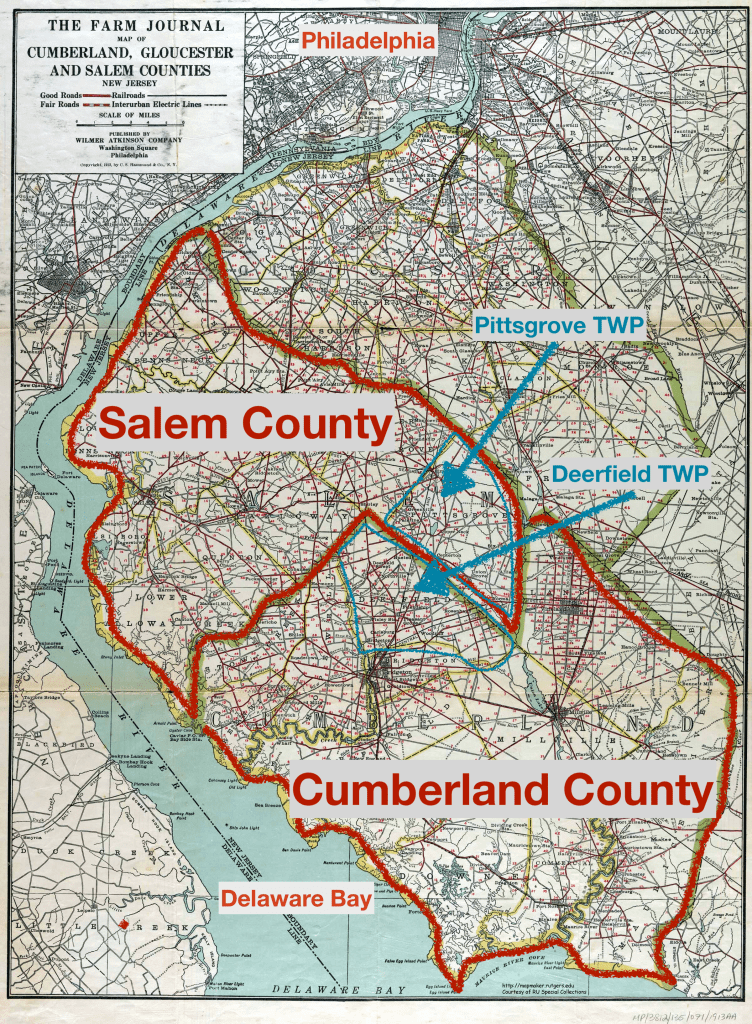
The earliest European settler colonists were Swedes and Dutch. In the late 1600s, William Penn and other English settler colonists began to settle in and around Philadelphia. The English crown granted large land patents and the English began to “purchase” lands from the Indigenous tribes, effectively removing them from their lands. A John Garrison is recorded in 1697 as settling on a land tract called “Coffin Point” near Muddy Branch (near Bridgeton), the he built a house of cedar logs. In 1794, a John Ambler bequeathed “8 acres purchased of Levi Garrison and a piece of cedar swamp on Pond Muddy Run” to his sons. While the relationship between the two have yet to be determined, this suggests a geographical connection between the individuals.
Presbyterian in Deerfield
The upper part of Deerfield, and other townships along the Cohansey River, was said to be settled by Presbyterians. The English settler colonists were organizing churches “as early as 1732”. An Abraham Garrison (relation to Levi not determined, though possibly his father, based on a 1766 will), granted land to the Presbyterians to build their first log meeting house.
Presbyterians were likely from New York and New England, breaking away from the Puritans of Massachusetts Bay Colony. Puritans believed that church membership was limited to “saints” and each congregation had its own authority. While both Puritans and Presbyterians were Calvinistic in believe, Presbyterians, on the other hand, believed in the unity of the church, including more than “saints” into its church membership and believed that the congregations worked together as a whole.
On 27 Sept 1771, Rhoda, the daughter of Levi Garrison, was baptized by the Reverend Enoch Green in the Presbyterian Church in Deerfield. In April 1774, Reverend Enoch Green recorded the death of a child of Levi Garrison. In March 1775, he recorded the death of another child of Levi Garrison as well as the deaths of Abraham Garrison and John Garrison (unknown relations). On 14 Jan 1776, Levi (II), son of Levi Garrison was baptized. Enoch Green was the pastor of the Deerfield Presbyterian Church from 1767 until 1776, when he died.
Adhere to the Methodism
In 1782, Levi Garrison was dismissed from the Presbyterian Church for adhering to Methodism. In the 1700s, Methodism was a new religion. Its founder, John Wesley, began his preaching career in 1735. He inspired other Euro-American preachers, including George Whitefield. By 1769, itinerate Methodist preachers were in Middle American. Wesley and his preachers were critical of colonists resistance to the Crown and its policies and engaged in missionary preaching to those on the margins of Euro-American colonial society: women, African slaves, and American Indian tribes, as well as Euro-American males who were in the lower middle-class. The History of Cumberland County describes an early convert:
He was a good specimen of an old-fashioned Methodist. An illiterate man, knowing very little bit what he learned from the Bible, and his own experience as a Christian, of good practical sense in all matters not too much influenced by his prejudices, an earnest exhorter, and maintaining a character above suspicion
page 115
As part of the Great Awakening, Methodism in the 1700s had a wide and inclusive membership and encouraged “religious experience”– “emotions and enthusiastic responses to evangelical preaching were increasingly accepted”. Its itinerant preachers first found great success in the Middle Atlantic colonies, where religious pluralism was accepted and a part of life.
Benjamin Abbott of Pittsgrove Township converted in 1772 and worked with another resident to establish a society. His work within his community to spread Methodism allowed it to spread into Cumberland County soon after. Abbott was a “reformed drunkard” and upon his conversion to Methodism became an “inflammatory” preacher whose sermons would cast a spell and cause listeners to fall to the floor.
The church record lists at least twelve people who adhered to the Methodists. In Dec 1781, John Ambler, Levi Riley, Sarah Stratton and a scratched out name were listed. In March 1782, Levi Garrison with Priscilla Tarble were listed. Then updated, Fithian Stratton, Abraham Tarble, Sarah Foster, Phebe Swain, Benjamin Kenard were listed.
John Ambler
The name John Ambler likely represented multiple generations of the Ambler Family, who were connected with the Garrisons as neighbors and friends. In 1765, a John Ambler witnessed the will of Abraham Garrison, a yeoman of Deerfield Cumberland County; Abraham bequeathed land on the east side of the Burlington Road to his son, Levi. Fithian Stratton was named executor; his name also appears along those who adhered to Methodism. In 1766, John Ambler along with Daniel Garrison made an inventory of Garrison’s estate. A John Ambler also mentioned 8 acres that he had purchased of Levi Garrison in his own will thirty years later, in 1796, suggesting that this was a son of the John Ambler mentioned in 1766.
In 1799, a John Ambler filed a complaint on behalf of a Johnathan and Lewis Garrison. Lewis Garrison was studying medicine under the auspices of a Joseph Brewster, and Ambler and the Garrisons contended that Brewster was not upholding his contract and had failed in his duties as teacher. The Presbyterian Church in Deerfield held the meeting to discuss the charges.
Migration West
Shortly after his conversion to Methodism, Garrison moved his family west. First to Westmoreland County, Pennsylvania, outside of Pittsburg. Then to the Northwest Territory near what is now Cincinnati. Finally, across the Indiana border into Dearborn County.
Sources:
“How American was Early American Methodism” accessed from princeton.edu
Elmer, L. Q. C. (2020). History of the Early Settlement and Progress: Of Cumberland County, New Jersey: and of the currency of this and adjoining colonies.
“History & Cemetery” of Deerfield Presbyterian Church accessed from deerfieldpres.org
“Religion” from Historic Themes and Resources within the
New Jersey Coastal Heritage Trail Route accessed from nps.gov
Honeyman, A. V. D. (1997). Calendar of New Jersey wills: Volume IV. Westminster, Md: Family Line Publications. accessed from donquigley.net
Transactions of the Medical Society of New Jersey. (1871). United States: The Society. accessed from Google Books
 Finding the Yellow Bricks