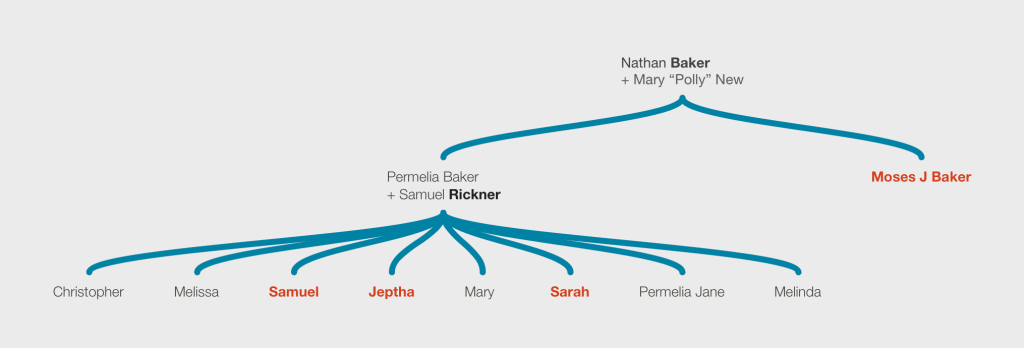
Samuel Rickner married Permelia Baker in 1832. Rickner, an immigrant from Switzerland, married into a slave-holdinng family that had migrated to Missouri from Kentucky and who in previous generations had migrated from the Albemarle Sound region of North Carolina, all slave-holding states.
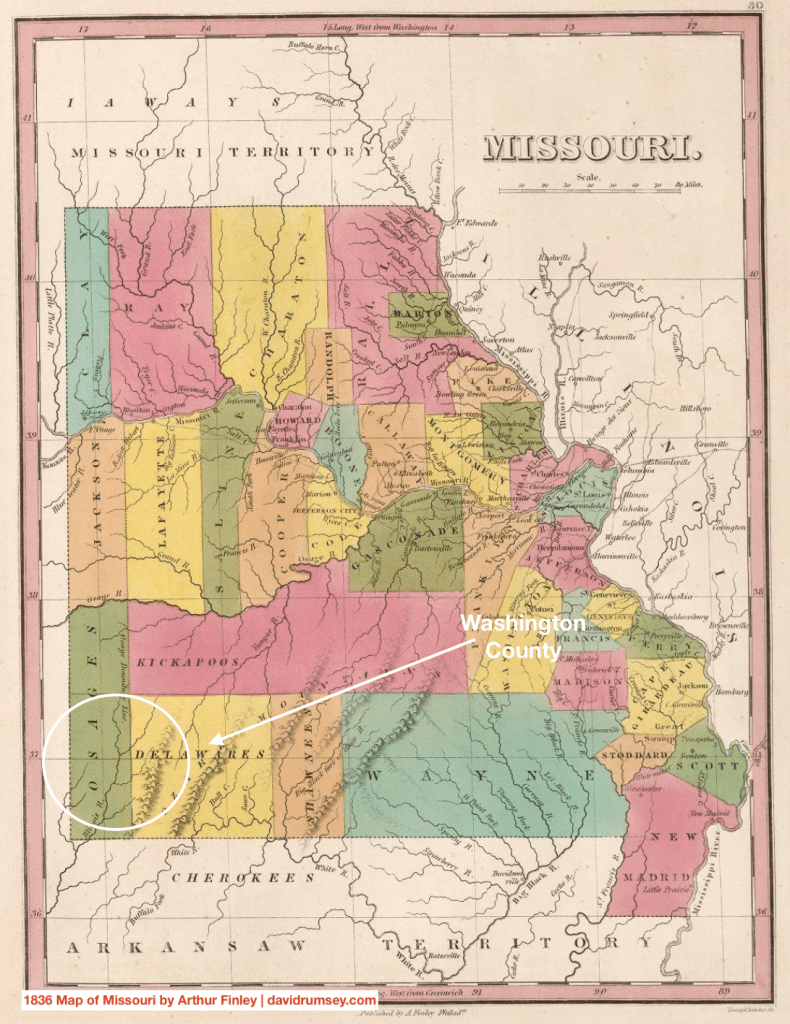
In the mid 1830s, the Rickner family and Permelia’s brother, Moses J Baker migrated again, leaving Washington County, Missouri for southwestern Missouri. The land was still predominately occupied by American Indians who had been removed from their homelands in the east. In 1837, rumors spread the the Osage “were coming” and the Missouri government sent a sizable militia to the area. The Osage, out-numbered, surrendered. By 1840, the land would be organized into counties, that were rapidly subdivided into smaller counties as the Euro-American population grew and the American Indian population was killed or removed into the Indian Territories (Kansas & Oklahoma).
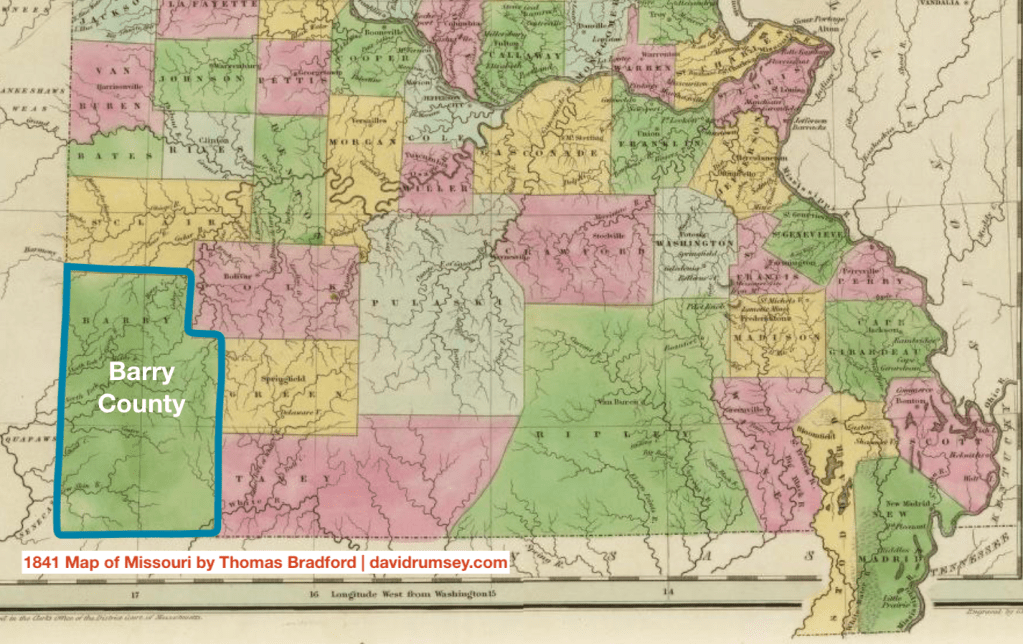
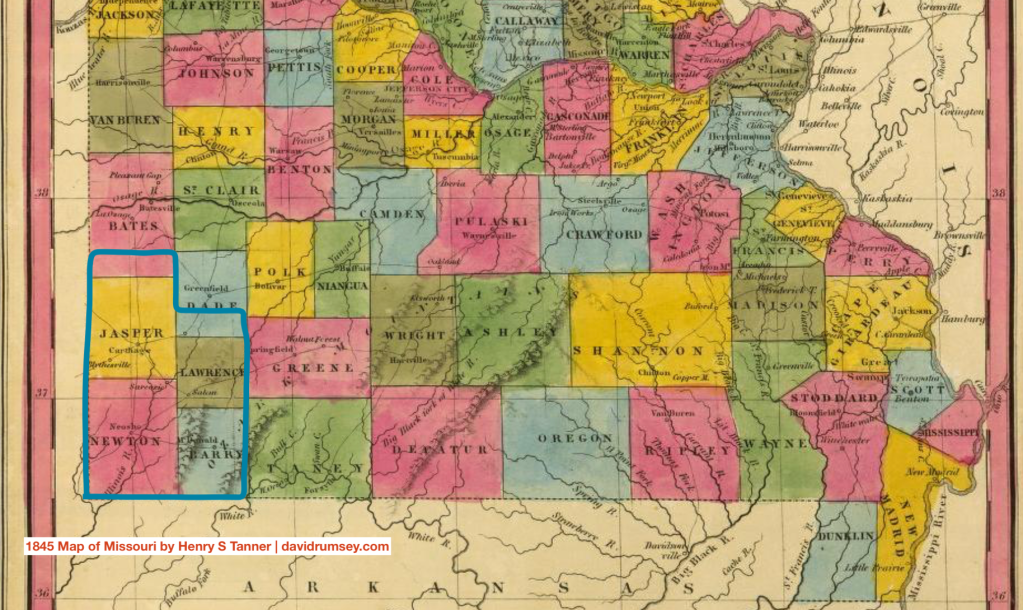
Moses J Baker
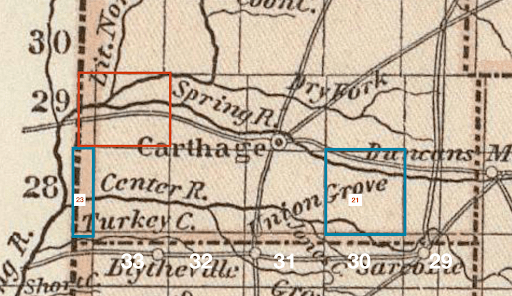
Moses J Baker, Permelia’s brother, married Amanda Melugin in Barry County in 1838. Three Melugin families were living in Marin Township, Newton County (immediately south of Jasper County) in the 1840 census. Joseph appears to the patriarch with his two sons: Samuel and Thomas. Land patents given by the US Government in the 1840s and 1850s specify acreage in Jasper County and in the 1850 Census, the Melugins are living near Sarcoxie, Jasper County, Missouri. Sarcoxie is named as one of the earliest Euro-American settlements in Jasper County and is said to be named after an Osage chief. The Melugins had migrated to southwestern Missouri from Tennessee. Many of the Euro-American settlers had come from Kentucky and Tennessee like the Bakers and Melugins.
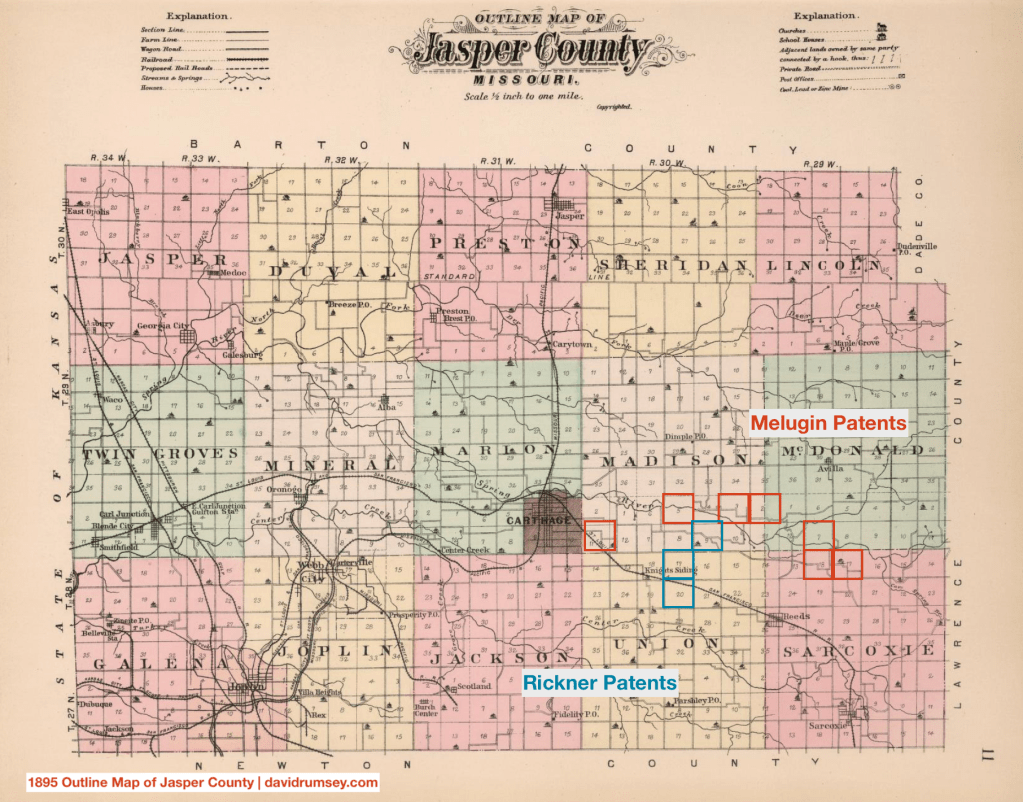
In 1857, Mary Ann Rickner, daughter of Samuel and Permelia Rickner married Thomas E. Melugin, son of Samuel Melugin and they lived on a farm in McDonald Township. Amanda Melugin, wife of Moses Baker, died prior to 1850.

Moses remarried after the death of his wife Amanda, to Nancy Jackson. Baker who had acquired land near the Rickner’s and Melugin’s in the 1840s, acquired land on the western border of the county, near the border of Kansas Territory in the 1850s and 1860s.

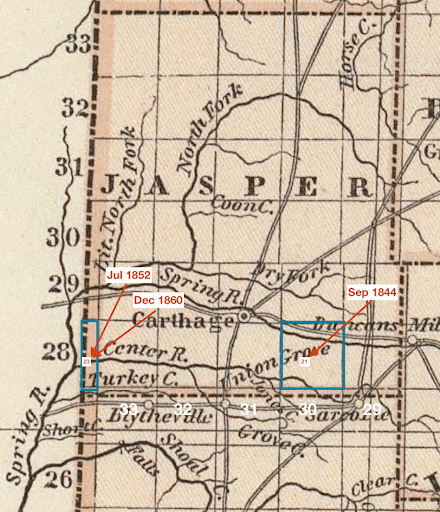
In 1850, Baker’s land was valued at $1000 and and in 1860, his land was valued at $3500. Additionally, he enslaved two children, Martha, age 13, and Ella, age 5. He was living within the vicinity of the town Sherwood, a town settled by Andrew McKee, who enslaved multiple people and ran a trading post with agents in the Indian Territory. Located near Center Creek, flatboats would run goods to the Arkansas River via Spring River. The town had about 200 inhabitants, stores and a brick school house when the Civil War began in 1860.
Bleeding Kansas

Prior to the Civil war, there had been violence along the border of Kansas and Missouri as a result of the Kansas-Nebraska Act of 1854. The decision to allow popular sovereignty to decide if Kansas would be a “free state” or not created conflict between the groups on either side of the slavery “question”. The conflict was not only marked by electoral fraud, the establishment of two capitals, but also raids, assaults and murder.
In McGee County, Kansas, where the Rickners homesteaded prior to the Civil War and across the border from Moses Baker’s land, the electoral fraud was flagrant: the ballot returns for an 1857 election showed that 24 settlers voted the free-state party, while 1,202 votes for a Democratic (pro-slavery) party. The 1860 census only enumerated 815 males with 429 of them less than twenty years old, which made the electoral fraud obvious.
The political conflict soon became gang violence as groups used the question of slavery to justify their acts of violence. The pro-slavery gangs from Missouri were called “border ruffians” and the anti-slavery gangs from Kansas were called “jayhawkers”.
Jayhawker Attack
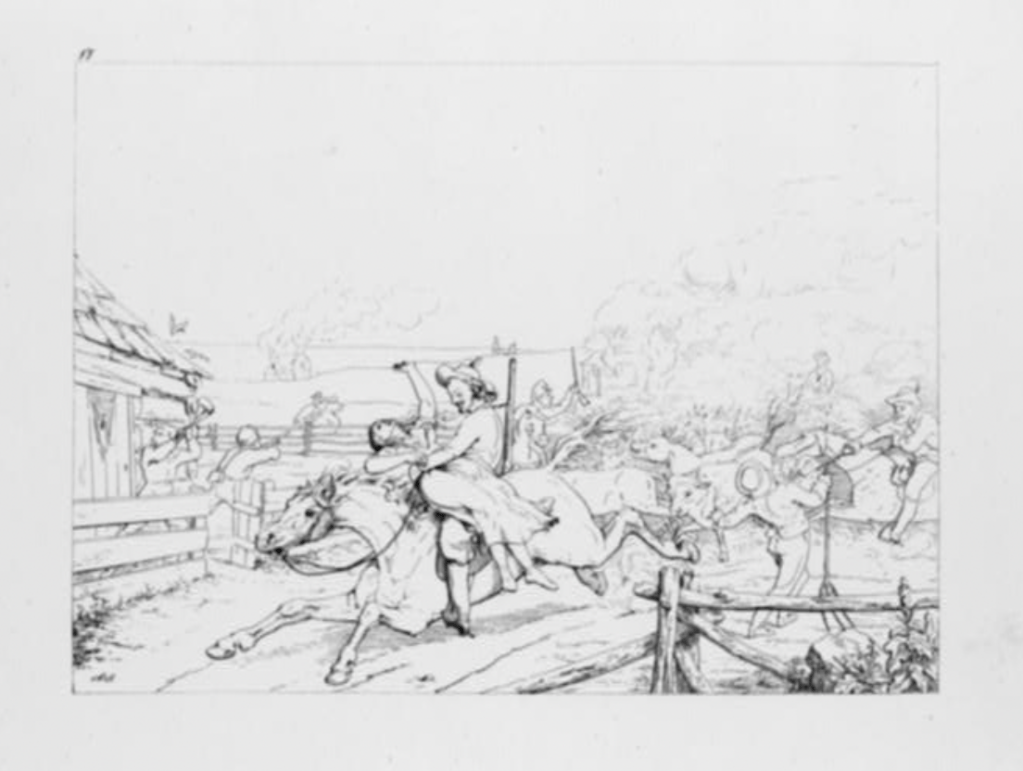
An unnamed source claims that “jawhawker bands swooped down on the Baker farm and drove off a herd of 700 mules” early in the war. It is possible, as raids were conducted by both sides. In fact, in August 1861, George W. Broome, a wealthy landowner and slave holder from Georgia who lived in the township/range north of Baker had his home attacked, mules stolen and his life taken by “a band of marauders”. The attackers were said to have stolen forty horses and ponies. In March 1861, Broome advertised the sale of hundreds of acres of land in Jasper County and that he would take Black people as payment for the sale.
Three sons from the Ireland family were accused of participating in the raid on Broome’s life and goods. Abraham Ireland, the father of the three sons, was a neighbor of Broome’s, enumerated immediately before him in the 1860 census. Unlike his neighbors, who migrated from Tennessee, Kentucky and other southern states, Abraham Ireland was from Ohio and his sons born in Indiana.
Unnamed prominent citizens found one of the sons and held an extrajudicial trial for the son and lynched him. The other two sons were also murdered. From where they died, it appears they were tracked down. One was killed at a trading post on Spring River, and the other on Lightening Creek in Kansas.
While the family anecdote claims that it was a raid on Baker’s farm that inspired his next steps of joining the border ruffians and getting revenge on the jayhawkers, it may very well have been the raid on Broome’s home.
While most retellings of the events claim the deaths were caused by unnamed prominent citizens, rumors swirled that Baker had a hand in the trial and death of the lynched Ireland son.
On 27 November 1862, the Leavenworth Times announced that “Capt. Coleman … captured Capt. Baker of Livingston’s command, directly after the raid on Dry Wood, and the said Capt. Baker being a very noted character on Shoal Creek and Spring River, and was at the hanging of Ireland and is accused of putting the rope around Ireland’s neck.”
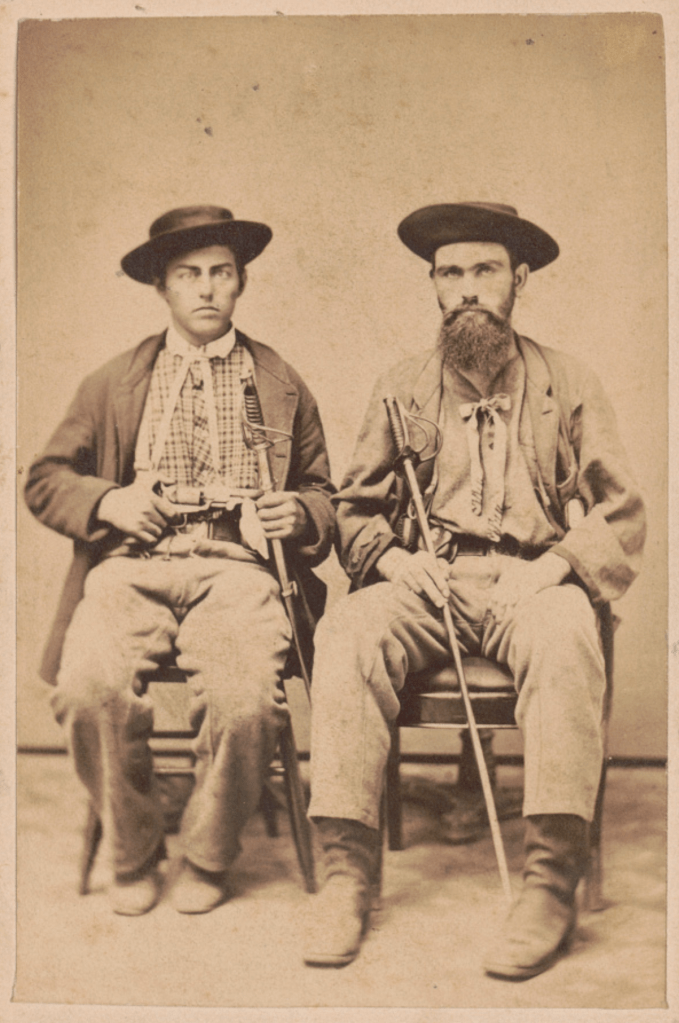
Photograph shows pro-slavery activists from Missouri who crossed into Kansas Territory between 1854 and 1860 to promote slavery.
Border Ruffian and Bushwhacker
In 1883 The History of Jasper County, the authors report that “Moses J. Baker took an active part in the war. Was with Livingston; was captured by Federals at Sherwood; taken to Ft. Scott, and then killed by some parties who had ridden out with him.” (page 199)
“Major Tom Livingston, as he has generally been called, has operated in Newton, Jasper and Barton Counties, Missouri, since early in the war.” (Wiley Britton, p. 352) Thomas R. Livingston was a Jasper County resident prior to the outbreak of the Civil War. He advocated for secession and when war broke out joined the Missouri Home Guard. In September 1861, he led a raid on Humboldt, in Allen County, Kansas.

The Kansas State Journal reported “the party consistent of 125 men, a part of them whites and the part Indians, but the whites were all disguised as Indians. The party was led by Matthews and Livingston, two notorious men.”
The town was surrounded, and no person was allowed to escape, several being shot at in attempting to do so. No person was seriously injured. The two principal stores were relieved of their dry goods and groceries and sixteen horses were stolen. Eight [Black people] were kidnapped. Men and teams were pressed into service. Property taken worth about $3000. The county was unable to resist, able bodied men having gone to the assistance of Lane.
The Kansas State Journal, 12 Sep 1861
In Dec 1861, Livingston was returning from an expedition to Fort Scott and his words were recorded in the Weekly News-Democrat of Emporia, Kansas: that he had hung 13 and shot 13 more “Union abolitionists, and sent them to —-.”
In 1862, the Home Guard was disbanded and Livingston returned to Jasper County and found that Federal militia had seen stationed throughout the county, and he organized a paramilitary group called “Provisional Army of Confederal States” with the goal to disrupt Union supply lines. Additionally, he would engage in arson and robbery, like he had in Humboldt. Wiley Britton, writing his memoirs, wrote that men like Livingston, i.e., guerrillas, function like privateers. “While the privateer is commissioned by rebel authorities to prey upon our marine commerce, the guerrillas are commissioned to prey upon on inland commerce, destroy public property, such as train, &c, and to impede our movements in every possible manner.”
Britton also reported that Livingston operated at one time from a headquarters near Baxter Springs in Kansas (Cherokee County): “We were at that point not more than seven or eight miles from Livingston’s old headquarters.” Baxter Springs is near the homestead of Samuel Rickner, Baker’s brother-in-law in Cherokee County on Shoal Creek. This fact also aligns with the description given Baker by Coleman in his new that he had captured him: “noted character on Shoal Creek and Spring River”.

Capture and Death
In November 1862, Livingston with about 100 men, including Moses Baker, were attacking settlements along the Dry Wood Creek in Barton County, immediately north of Jasper County. The Federal troops, hearing that Livingston and his band were nearby, sent troops out along the different rivers and creeks to intercept him. A Captain Coleman was sent along Spring River to Sherwood. After camping out along the river, Coleman and his men came across some of Livingston’s men, killing 4 or 5 and taking 4 prisoners, “including the notorious Captain Baker”.
The prisoners were taken to Fort Scott, where he died the next fall. The Independent of Oskaloosa Kansas reported that “A notorious bushwhacker, named Mose [sic] Baker, while attempting to escape from the guard at Fort Scott, was shot and killed.” [Sept 26, 1863]
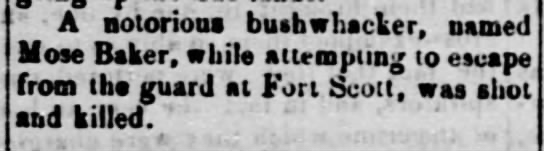
The Leavenworth Bulletin (Leavenworth Kansas) reported a more detailed description of his death 5 days prior, though it did not name him:
We learn that a rebel Captain was shot by a guard at Fort Scott last week while attempting to make his escape from the military prison. He was allowed to go down to a spring for the purpose of procuring waters and thought it an excellent opportunity to “procure” his escape from durance vile, and set the project on ‘fort’ by commencing the tallest kind of skedaddle. The guard was too sharp for him, however, and shot him dead. Eight balls went through him, which let sufficient daylight in to see the other world.
Leavenworth Bulletin, 21 Sept 1863
Sources
Schrantz, W. L. (1923). Jasper County, Missouri, in the Civil War. United States: Carthage Press.
The History of Jasper County, Missouri: Including a Condensed History of the State, a Complete History of Carthage and Joplin, Other Towns and Townships …. (1883). United States: The Printery.
Britton, W. (1882). Memoirs of the Rebellion on the Border, 1863. United States: Cushing, Thomas & Company.
Perry, L. J., Ainsworth, F. C., Lazelle, H. M., Moodey, J. S., Davis, G. B., Kirkley, J. W., Scott, R. N. (1902). The War of the Rebellion: A Compilation of the Official Records of the Union and Confederate Armies. United States: U.S. Government Printing Office.
 Finding the Yellow Bricks