Sarah Jane Rickner, a daughter of Samuel and Permelia Jane Rickner, was born in Jasper County, Missouri in 1844. Her father had a farm east of Carthage for the better part of the 1850s. Her mother died in the 1850s and her father remarried. Samuel with his new wife set up a homestead in McGhee County, Kansas Territory. Sarah stayed in Jasper County.
1860 Household
In the 1860 US Federal Census, Sarah is enumerated in the household of W. K. Franklin, her brother-in-law. William K. Franklin had married Malissa Ann five years earlier in 1855. He was a saddler living in the town of Carthage. His real estate was valued at $1250. In addition to the Franklin family and their sister-in-law, Sarah, the household also had what appears to be William’s brother: J. C. Franklin, also a saddler. Additionally, there were four other males who appear unrelated: William Vermillion, saddler, Mathias Buss, a brickmaker, and John Snyder, a day laborer, and Shelton Sheppard. Buss had his own real estate valued at $2800.
The History of Jasper County locates the shop in Carthage:
The following description of the public square at that time, furnished by Judge John Hornback, an old citizen of the county, and a frequent visitor to Carthage, will no doubt be interesting to the reader of this work: Commencing on the northeast corner of the square, on lot number on was the residence occupied by Mr. Johnson. The first business house on the east side was on lot number two, it was a drugstore owned by Ben C Johnson; the next was a small saddlery shop, on lot number three, kept by Franklin & Vermillion, then came the Franklin House on lot number four.

A Walter K Franklin (1832-1860) is memorialized in Pioneer Cemetery; no other Franklins were listed in the 1860 census suggesting that W(illiam). K. Franklin and Walter K. Franklin are the same. After the Civil War, Malissa married Archibald Danford, a veteran of the Union Army (Wisconsin Calvary) and had likely served at Fort Scott and Fort Leavenworth in 1862.
Battle of Carthage
Missouri was a border state during the Civil War — it was a slave-holding state with many of its citizens advocating for secession. In the decade prior, “border ruffians” and “jayhawkers” had criss-crossed across the border of Missouri and Kansas in the fight to make Kansas a slave-holding state as well. In April 1861, the governor of Missouri was pro-Confederate and had refused to send troops when Lincoln requested troops after the Confederacy fired on Fort Sumter. When he instead called the Missouri State Militia with an apparent intention to seize the St. Louis Arsenal, the US responded by mustering Union forces to protect and transfer the arsenal out of pro-Confederate control. In June 1861, the Federal troops tried to capture Jefferson City (then state capital) and the governor and his militia retreated to Boonville, Missouri. The Federal troops followed, forcing the further retreat to Springfield and then Carthage, Missouri.

The Battle of Carthage was fought in July 1861. The battle started 10 miles north of Carthage and steadily moved south into the town and the town square, where the Franklin & Vermillion saddlery shop was located and where the Franklin family lived with Sarah Rickner. The two sides “engaged in a firefight around the original brick courthouse and the wood-framed buildings that made up the square at the time.” (Joplin Globe, 23 June 2022). The Confederate forces forced the retreat of the Federal troops.
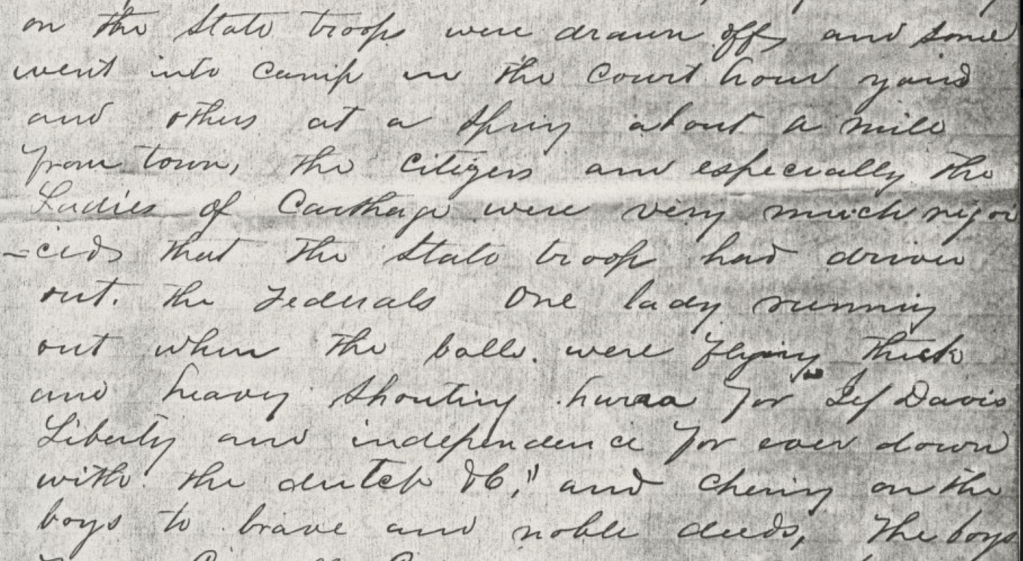
An Archy Thomas wrote a short six page memoir of the Battle of Carthage (n.d.). In his memoir he described at the end of the battle how “the state troops … went into camp in the court hours yaird [sic] and others at a spring about a mile from town, the citizens and especially the Ladies of Carthage were very much rejoiced that the state troops had driven out the Federals One lady running out when the balls were flying thick and heavy shouting hurra for Jef [sic] Davis Liberty and independence forever down with the dutch &c. and cheering on the boys to brave and noble deeds”
A battle report printed in the Baltimore Sun (Baltimore, Maryland, 12 July 1861) describes how “the loss of Jackson’s side [Confederate] was very great. Our informant says he counted between seventy and eighty wounded on the field and in houses by the wayside. At Dry Fork, a large amount of beef was thrown out of the wagons, it is supposed to make room for the dead. Another informant, a resident of Carthage, states that he passed her a part of the battlefield yesterday morning and saw wagons and hacks passing in every direction, gathering up the dead for interment.”
Carthage During the War

In the fall and winter after the Battle of Carthage, the Confederates had control of southwest Missouri. Residents who supported the Union were “encouraged” to leave and many went to either Fort Scott or Springfield. As they withdrew in 1862 and 1863, they took pains to “prevent Carthage from becoming a place of shelter for the Federal forces.” The town was ruined and “nearly every building” was destroyed. Carthage became a “heap of ruins”. Union forces “made a fort out of the ruins of the courthouse, in the public square, but it was afterward destroyed by rebels.” A band of guerrillas, thought to be associated with Bill Anderson, burned the courthouse in 1863. The History of Jasper County recounts only three or four buildings left standing in Carthage at the end of the war.
Where Sarah Rickner and the widow Malissa Franklin lived during the ruin of Carthage is unknown. Sarah’s obituary in 1945 states simply “Her family was among many of the early settlers who lost all they had due to the turmoil of a civil war.”
Stolen Horse
At some point, date unknown, Sarah’s horse was taken by the Union soldiers.
Mrs. Gaither [Sarah Rickner] was a young woman during the civil war and often recalled many incidents of that time. She was an expert rider and her father gave her a horse of racing blood.
Obituary | Joplin Globe, 9 Aug 1945
The 1860 Agricultural Schedule of the US Federal Census recorded information about Samuel Rickner, Sarah’s father, homestead in McGhee Kansas, where he had 9 horses on his 160 acres of land in addition to 30 pigs and 30 sheep. Her uncle, Moses J Baker, was said to raise mules, suggesting that both sides of the family engaged in horseflesh.
One day, when she was away from home, some union soldiers took her horse and left a worn-out nag in the lot. When she discovered the exchange, she went immediately to the union officers, and demanded her horse, which was returned to her.
Obituary | Joplin Globe, 9 Aug 1945
After the War
Sarah married a Confederate veteran named Edward Thomas Gaither who was described as a Carthage mercantile businessman and farmer. She married him on April 8, 1866. in 1882, he opened a grocery, provision, and feed store in Carthage.
Sources:
Schrantz, W. L. (1923). Jasper County, Missouri, in the Civil War. United States: Carthage Press.
The History of Jasper County, Missouri, Including a Condensed History of the State, a Complete History of Carthage and Joplin, Other Towns and Townships. (1883). United States: Mills & Company.
 Finding the Yellow Bricks