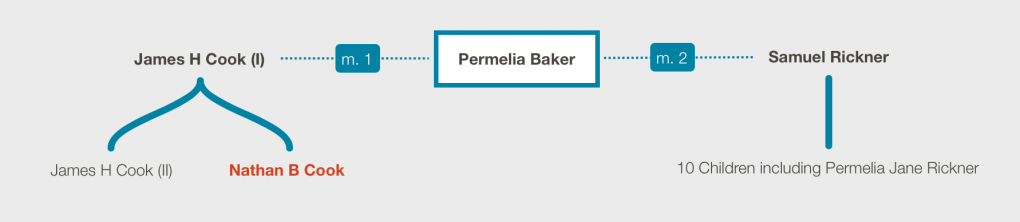
Nathan B Cook was the second son of Permelia (Baker) Cook Rickner. Permelia had married James H Cook (I) in Washington County, Missouri in 1828. In the 1830 US Federal Census, they were enumerated in Crawford County, Missouri, a neighboring county in Meramec Township, created in 1829 from Gasconade county.

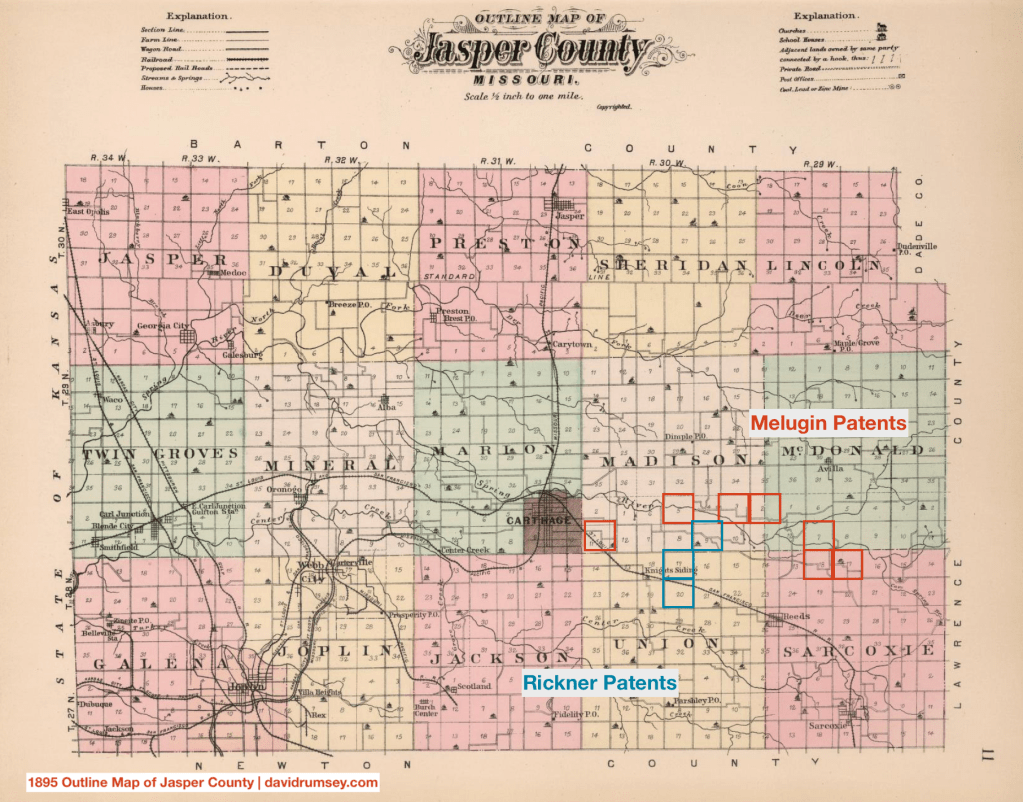
Nathan’s father died prior to 1832, when Permelia remarried a Swiss immigrant, Samuel Rickner. In the 1840s, they moved southwest to what became Jasper County, Missouri.

In the 1850 US Federal Census, Nathan and his brother James are enumerated living with the Rickners east of Carthage, Missouri.
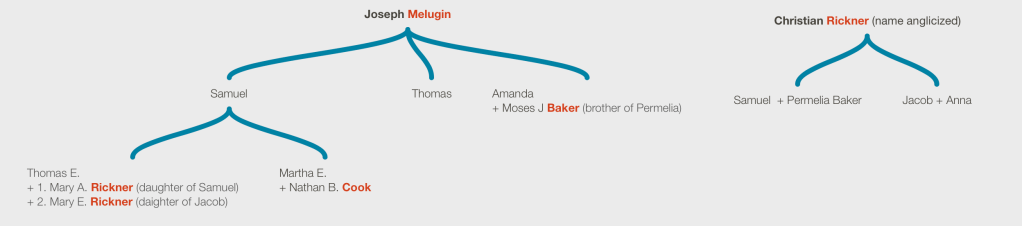
In 1851, Nathan B Cook married Martha E. Melugin, the daughter Samuel Melugin, a landowner near the Rickners in Jasper County.
The extended Rickner family had at least four marriages with the Melugin family.
In 1858, Nathan was appointed postmaster of Valley Forge, a short lived town at the confluence of Spring River and the White Fork of Spring River east of Carthage. The post and post office was discontinued in 1859.

In 1860, before the outbreak of the Civil War, Nathan B Cook was living with his wife, Martha, and their three children on a farm valued at $1600. Samuel Rickner, Nathan’s half brother, was living with them working as a farm laborer. Christopher Rickner, an older brother of Samuel, and Jacob Rickner, the Rickner’s uncle, was enumerated on the previous page in the census, suggesting that they were close by as well.
Engagement in War
In 1862, DeWitt C Hunter, a committed secessionist began to recruit soldiers from the Missouri State Guard. Recruiting in both the border counties Missouri and the northwestern counties of Arkansas, he was able to create a regiment originally called Hunter’s 2nd Missouri Regiment. On August 23, 1862, Nathan B. Cook enlisted into Hunter’s regiment.
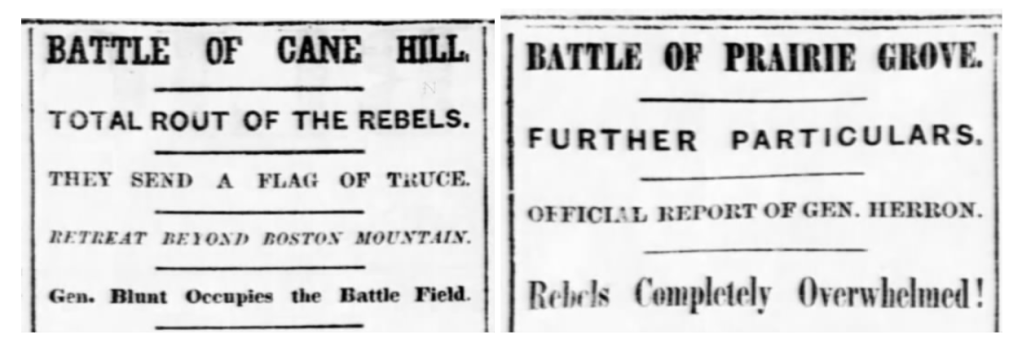
In the late fall and early winter of 1862, Cook with his regiment fought at the Battle of Cane Hill and the Battle of Prairie Grove, as the Confederate Army tried to regain entry into Missouri and take control of the border state. The Confederates lost both battles, and the regiment fell back to Van Buren, Arkansas. After participating in two overwhelming defeats, the morale must have been fairly low.
Cook’s service records indicate that he may have been captured and taken to Fort Scott. The March and April 1863 Muster Roll provided the following remarks “Prisoner at Ft. Scott when last heard from”. By May 5th, he was listed as a deserter.
Capture and Imprisonment
On 10 Sept 1863, Nathan B Cook was captured near Carthage, Missouri by the Union Army. His prisoner of war records note that he “gave himself up”.

Cook was sent first to St. Louis as a prisoner of war, where he expressed willingness to take the oath of allegiance to the US. He was held in the Gratiot Street Military Prison in October 1863. The Gratiot Military Prison was the largest in Missouri and used as a transfer point to other prisons.
From St. Louis, Cook was transferred to Camp Morton, Indiana in November 1863. The Camp was built on the Indiana State Fairgrounds in Indianapolis and was originally used as a training ground before it transformed into a military prison. An article in the Brookville Republican (Brookville, PA) reported that in January 1864 the prison held between three and four thousand prisoners. During the war, 17,000 prisoners died while at Camp Morton.

. United States Indiana Camp Morton Indianapolis, None. [Between 1862 and 1865] Photograph. https://www.loc.gov/item/2012647767/.
In May, 1864, Nathan B Cook was admitted to the General Hospital at Camp Morton for chronic diarrhea and erysipelas. Erysipelas is a skin rash usually caused by staph bacteria. The skin would become swollen and discolored. During the civil war, microbiology had not yet been established and medical doctors were unable to effectively treat the disease, unaware of how the bacteria traveled from patient to patient. Statistics suggests that about 41% of the soldiers who contracted erysipelas during the war died from it. Nathan B Cook was one of the soldiers.
He was buried in Green Lawn Cemetery in Indianapolis.
 Finding the Yellow Bricks