Europeans and Euro-Americans designated the Red River as boundary for a long time. The French and Spanish viewed it as dividing line in the 1700s, the US and Spain continued its use as a border in the 1819 Adams-Onís Treaty in conjunction with Mexico. The Republic of Texas used it as a boundary.
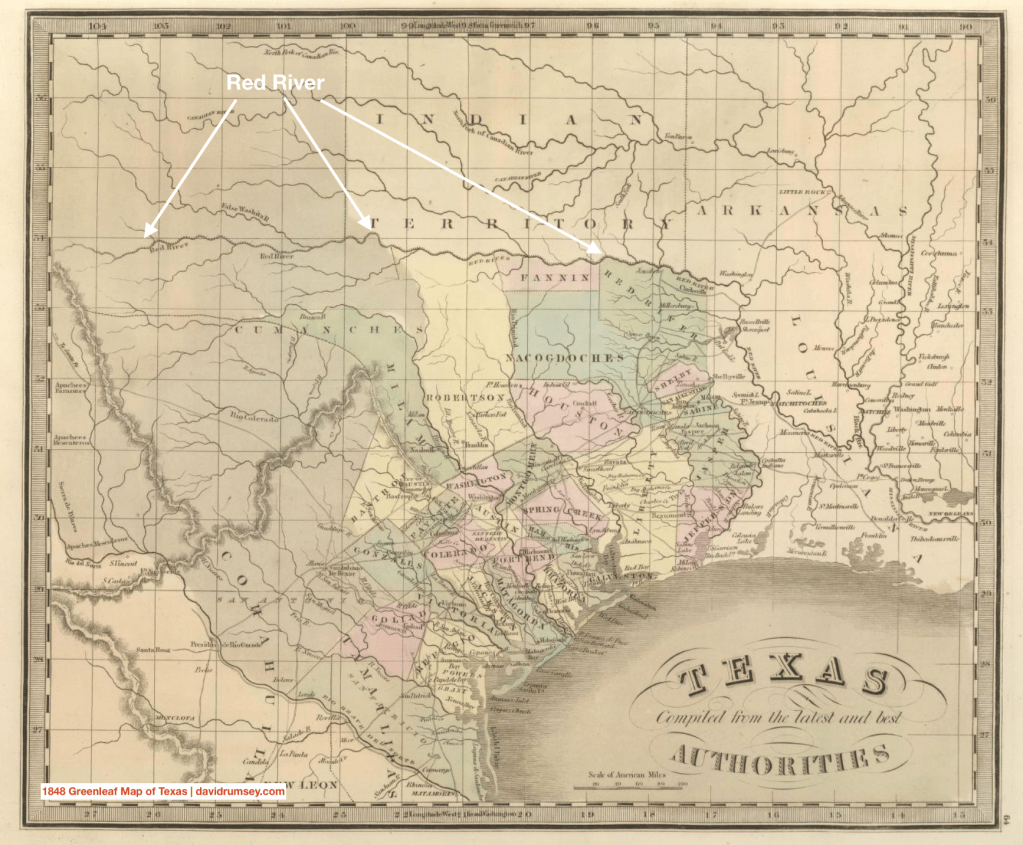
The Southern Plain Indians had been living in the land north and south of the Red River for centuries prior to the arrival of Euro-Americans. The Wichita, the Comanche, the Kiowa, the Osage were among the Indigenous people that traveled the Plains as hunters and gatherers, following the buffalo and other large game back and forth across the Red River.
Settler Colonizer
In the 1840s, Euro-American settlers began to intrude into the areas populated by the Caddo, the Kickapoo and the Comanche south of the Red River. The Van Slyke family came from Arkansas and Southwest Missouri to acquire and settle land as part of the Peters Colony.

In 1849, their eldest daughter, Elizabeth, married James Hamilton, an Irish immigrant, in Grayson County, Texas. In 1850, the Van Slyke family is went farther west into the newly organized Cooke County while the Hamiltons are likely living on the claim James Hamilton had in Grayson county, about 5 miles southwest from Preston. Hamilton received 320 acres as part of his headright as a single man who immigrated to the colony prior to 1848. He sold the land in 1852 for $108.

1852 is the same year Elizabeth’s father died and is likely when the Hamiltons moved back to Arkansas as evidenced by the birthplaces listed for their children in the 1860 census. The family returned to Texas when Elizabeth’s mother died in 1857, leaving her younger siblings without guardians. Her husband administered the estate.

In 1860, James Hamilton and his wife and three children, have migrated farther west into Montague County, which was named after Daniel Montague, a prominent Euro-American citizen in Cooke County who surveyed much of the land. The Hamiltons are listed in vicinity of Montague Post Office.

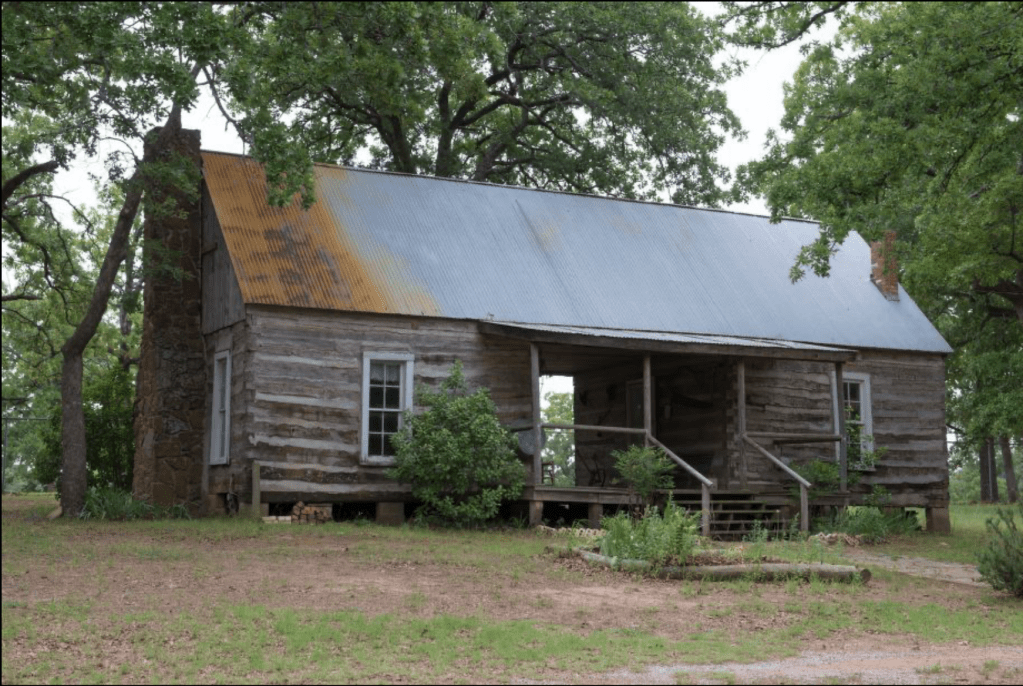
Some of the recollections of settlers often describe their homes as “dogtrot” log cabins. A double log house, the “dogtrot” cabin would have a covered breezeway between the cabins. The Brumley family who were enumerated next to the Hamiltons on the 1860 US Federal Census were said to have lived in the a dogtrot cabin.
Borderlands
The land along the Red River border was contested as the Indigenous nations had been living in the region prior to the Euro-American settler colonizers arrival in the 1840s and the Indigenous nations utilized strategies to maintain access to their homeland. Prior to the Civil War, the US Army had regiments stationed in a series of “frontier forts” in an effort to remove the Wichita, Kickapoo, Comanche, Caddo and other Indigenous nations to allow for white settlers to take the land for their own.
Fort Worth (of Dallas-Fort Worth) was fort farther north of the line of forts that stretched from the Rio Grande to the Red River. As settlers continued to intrude west into territory commanded by the Indigenous nations, conflict over the lands and settlements occurred.
Civil War
US Army Withdraws Protection
When the Civil War started and Texas seceded, the US Army withdrew and the Euro-American settlers left in the new Confederate States of America no longer had the same military force to block the Indigenous peoples from returning to their territory. Ironically, Texas “listed frontier protection as a major reason for secession after the protection of slavery”, yet as the Confederate Army focused its energies on the east and the US Army, it continued to pull forces from the western borderlands.

Over the course of the Civil War, the borderland between the Euro-Americans settlers and the Indigenous nations shifted east instead of west, as it had done prior to the war. In Dec 1861, the “Frontier Regiment” was authorized by the Texas Legislature to raise a regiment of rangers to protect the northern and western borderlands to replace the withdrawn Confederate forces.
Frontier Regiment
Near Red River, on the Salt Creek was a large animal crossing, where the buffalo would cross the river, and following them the Indigenous hunters. The Indigenous nations would also use the crossing when they resisted Euro-American settler colonists by sending raids across the river to disrupt settlements on their hunting grounds. It was near here that the Texans established the Red River Station as part of their “Frontier Regiment” to guard the Euro American settlements from Indian raids.
Captain John T Rowland enlisted over a hundred men from around Montague and Cooke County for the Red River station, including James M. Hamilton who enlisted in Dec 1862. The intent was that men stationed would send out daily scouting parties between the stations to effectively patrol the borderlands. Col. McCord tried to create a more aggressive role by advocating for larger patrols to be sent beyond the borderlands into the territory controlled by the Indians in an attempt to “search and destroy” the Indian bands. The legislature commanded him to keep the role of the regiments as a defensive presence in the borderlands. The regiments were underwhelming in their ability to provide defense.
Settlers Retreat East
In early 1863, Jas. J. Diamond wrote General Steele about conditions in Gainesville (Cooke County):
We found our country invaded by the Indians, jayhawkers, &c., and our people most ready to flee their homes and sacrifice to the foe their large possessions of cattle and horses, as well as promising fields of grain….The troops on the frontier directly west, under State control, are unable to aid us in this defense. The stealing and murdering parties come into our county [Cooke County] and Montague from the north, that is out of the Indian Territory.
OR, ser 1 v22 pt 2 page 800
In 1889, John Wesley Wilbarger compiled stories of 250 “depredations” [19th century term for Indian raids], chronicling the conflict from the 1820s to the 1870s. Wilbarger wrote from the perspective of a settler colonizer who viewed intrusions into Indian territory as part of “Manifest Destiny”. In his text, he describes how the Indian raids “caused a general desertion of the organized northwestern counties. The counties, Stephens, Palo Pinto, Jack, Wise and Montague were almost entirely abandoned by the [Euro-American] settlers, only a few cowboys remaining at the large ranches — or as they were then called, “forts.”
Morale and Regard
Confederate leadership viewed the northern Frontier Regiments with suspicion, believing that many of them were deserters or only joined the regiments to escape enlistment in the Confederate Army. Col James Bourland, after touring Red River Station specifically declared the men “disloyal Texans” for their avoidance of the Confederate Army and that they were solely focused on protecting their local communities rather than the Confederate cause.
December 1863 Raid
On 21 Dec 1863, about 300 Comanches entered Montague County relatively near the Red River Station and attacked a settlement called Illinois Bend along the Red River close to the boundary between Montague and Cooke Counties. The Comanches attacked three homesteads, killed some of the settlers and burnt the homes before moving to their next target near Wallace Settlement, east along the River. They crossed back across the river, convincing the following Frontier Regiment into thinking the raid had ended and the Regiment rested near the Wallace Settlement for the evening. The next day, the Comanches crossed the river back into Texas and continued attacking settlements along the river as it got closer to Gainesville, situated in the center of Cooke County.
The Frontier Regiment was unable to defend the northern Texas border, as the Comanches outnumbered the men in the regiment and were able to disperse quickly when the regiment gained proximity to the group. Horses were stolen, ten homes burned, and twelve were killed in the raid with seven wounded.
In the year that followed there were few attacks by Indians on the Euro-American settlers, and an author wrote “perhaps the reason was that the country was so full of jayhawkers [Union guerrilla fighters], deserters, renegades and military parties hunting them, that the Indian considered it a very unsafe place.”
By March 1864, as the war entered its third year, the Confederate Army needed men farther east and south, and reassigned those in the Frontier Regiment into the Confederate State Army. No longer under command of Texas for the purpose of defending their settlements, the men were drafted into larger army to battle the Union Army over the political goal to maintain chattel slavery.
An April 1864 Letter from James Bourland to Brig. Gen McCullough reported that two-thirds of the force at Buffalo Station and Fork Belknap had deserted and “We do not know if any have left Salt Creek Station [Red River Station] or not. Captain Roland is here.”
James Hamilton appeared on the muster roll of the newly created regiment for the CSA in April 1864, and then his records end. The Hamilton family have yet to be located in the 1870 census.
Sources:
Wilson, G. O. (1956). Red River Station: An Address. The Southwestern Historical Quarterly, 60(1), 76–79. http://www.jstor.org/stable/30235281
Ely, G. S. (2007). Gone from Texas and Trading with the Enemy: New Perspectives on Civil War West Texas. The Southwestern Historical Quarterly, 110(4), 438–463. http://www.jstor.org/stable/30239529
United States. War Records Office, et al.. The War of the Rebellion: a Compilation of the Official Records of the Union And Confederate Armies. Washington: Govt. Print. Off, 18801901. [OR]
Wilbarger, J. W. (1985). Indian Depredations in Texas. United States: Eakin Press.
Smith, David Paul, 1949-. Frontier Defense in Texas: 1861-1865,dissertation, December 1987; Denton, Texas. (https://digital.library.unt.edu/ark:/67531/metadc331889/:accessed June 26, 2022), University of North Texas Libraries, UNT Digital Library, https://digital.library.unt.edu; .
 Finding the Yellow Bricks