In 1852, Henrietta’s father, Andrew Van Slyke died. In 1857, her mother. Her eldest sister and her husband moved back to Texas to administer the estate and three siblings were sent to lived with three separate guardians. Guardianship was a legal arrangement to manage the property of those considered unable to manage it themselves, either due to mental capacity or age. In the case of the Van Slyke minor heirs, they were minors, and their parents left them around 1,000 acres of land in Cooke County, Texas, along with their three married sisters.
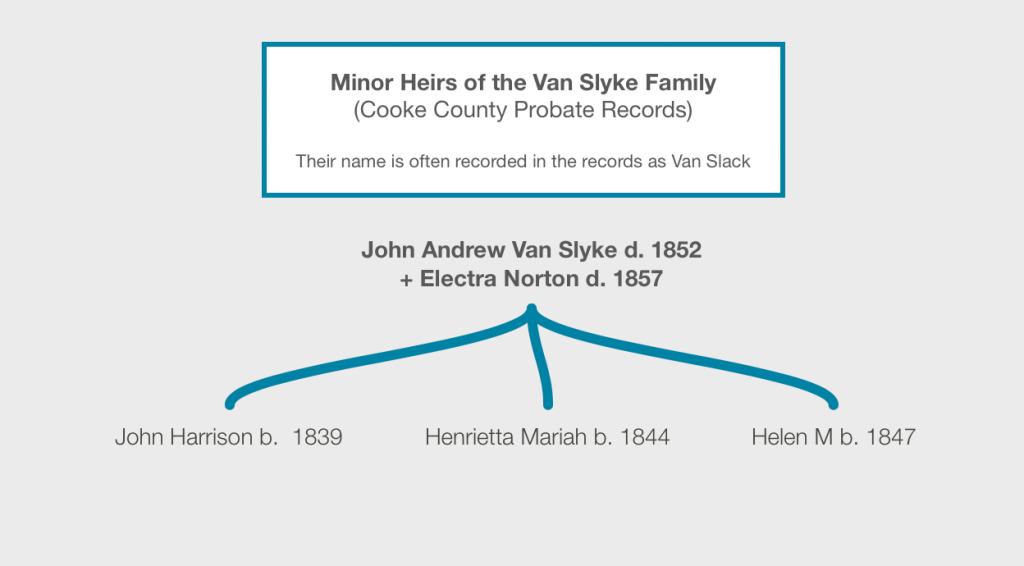
The three men assigned as guardians to the heirs had property. Daniel Montague, Henrietta’s guardian, had real estate valued at $2000 and a personal estate valued at $3845 in the 1860 census. He enslaved a Black woman, age 45. Henrietta’s sister, Helen had been assigned Allan J Mann as her guardian, and by 1860 was living in the household of J A McGarity. In the 1860 tax rolls, Mann is listed as Helen’s guardian and he had acquired 110 acres in addition to his original patent on Davies Creek northwest of Gainesville. His real estate was valued at $2500 and real estate valued at $3250. Mann enslaved a Black woman. John Harrison, their brother, had been assigned Thomas Rutledge, an emigrant from Ohio whose land was valued at $1000 and personal estate at $1455 in the 1860 census.

Daniel Montague, Guardian
In the 1860 US Federal Census, Henrietta is living with her guardian, Daniel Montague in Gainesville, Texas (Cooke County). Montague was an early settler colonizer in the Red River area of Texas, arriving in 1837 with his family after having established a plantation in Louisiana. Trained as a surveyor, he was instrumental in the Euro-American settlements and counties along the Red River. In 1854, he was elected district surveyor; in 1858 & 1862, County Commissioner and in 1863, State Senator. Montague County, the county immediately west of Cooke County was named for him.

Many of the northern counties in Texas, including Cooke County, opposed secession in 1861. Nonetheless, the men holding political offices, like Montague, were slaveholders and used their economic and political power to ensure support for the Confederacy. In 1862, Daniel Montague was one of the chief participants the “Great Hanging of Gainesville”. When the major slave-holders in Cooke County including a Confederate officer, learned about a “Union League”, they established an extrajudicial “Citizens Court” to determine the guilt of the suspected Unionists. Montague was elected to act as jury foreman. Six other men on the jury were also slave holders in a county where 11% of the household enslaved people.
The Confederate officer who helped to organized the “Citizens Court”, James Bourland, had long written his officers about the number of deserters and jayhawkers in the region and had expressed contempt for the men who had joined the Frontier Regiment as avoiding service in the Confederate Army. Bourland had his troops arrest over 150 men for desertion. Bourland and another confederate office, William Young, whom Bourland put in charge of the court, enslaved 25% of the Black people in Cooke County. Young had led the “Red River Volunteers” with Bourland and Montague in the Mexican War in the 1840s.
The kangaroo court executed 41 suspected Unionists. At first, they executed one to two men at a time after their trial. However, the mob that formed demanded a more urgent execution of the men and the court handed over 14 men to be lynched without a trial. 19 men who had been found not guilty by the court, were returned to the court and this time, without new evidence, retried for the same crime, found guilty and executed, again because of the demands of the mob.
Montague and his family left Cooke County after the Civil War, moving to Mexico.
Henrietta Mariah lived in Montague’s household during the 1860 census and did not marry until 1865, suggesting that she lived in his household while he commanded the lynch mob. How Henrietta was included into the household is unclear; was she expected to perform household labor in exchange for room and board, or was she considered like a family member with similar chores to the other daughters.
Marriage to Thomas B Jackson
In 1865, Henrietta married Thomas B Jackson, a Confederate veteran living in Grayson County. He had enlisted in the 11th Calvary (Confederate) near the beginning of the war in October 1861 at Camp Reeves. It was led by William Young, the same Confederate Official who had organized the “Citizen Court” of the Great Hanging. The regiment engaged the Chustenhalah nation in battle in the Indian territory and fought at the Battle of Pea Ridge in Arkansas (March 1862).
The regiment was sent to Tennessee and Kentucky to fight. In Dec 1862, the regiment fought at the Battle of Murfreesboro. The next fall and winter, the regiment was stationed near Knoxville, Kentucky and two large federal raids captured multiple members of the regiment.
The muster records for Jackson noted that he had gone missing from the army in November 1863 near Knoxville, where the Confederate army had surrounded the Union garrison (November 19-December 4).

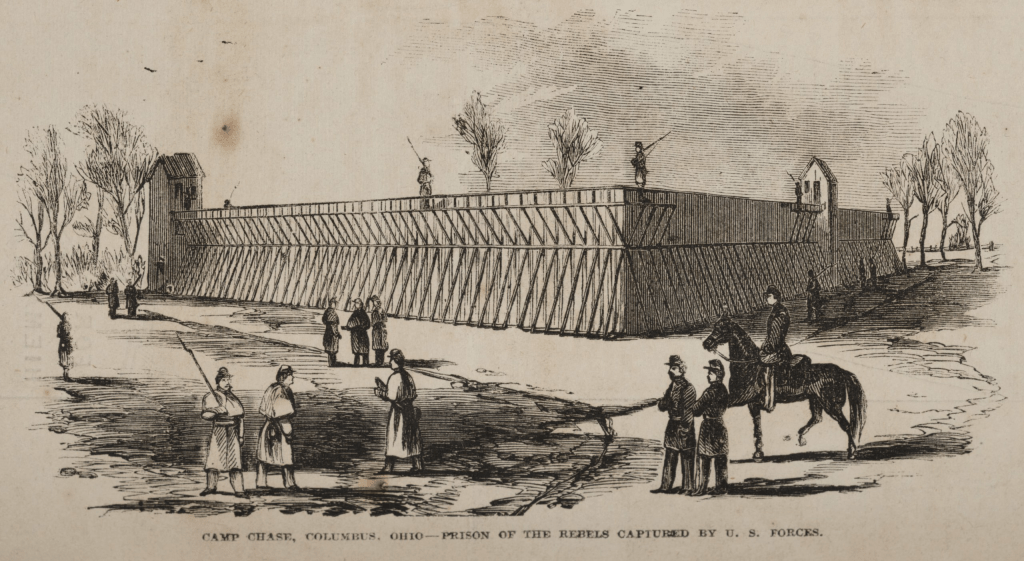
He was officially marked as a deserter on 1 Dec 1863. Federal forces captured Jackson on 6 Dec 1863 and sent him to Camp Chase in Columbus, Ohio before transferring him via Louisville to Rock Island, Illinois. He was paroled from prison in June 1865 after he took an oath of allegiance to the United States.

. Rock Island, Ill., C. Speidel, 1864. Map. https://www.loc.gov/item/99447349/.
Henrietta married Thomas B Jackson in October 1865, four months after he was paroled. She lived with her husband in Cooke County until his death in the 1895. In 1910, she was living with a younger daughter in Oklahoma and died in 1919.
Sources:
Stakemann, Max. Cooke County, map, March 1876; (https://texashistory.unt.edu/ark:/67531/metapth88459/:accessed June 27, 2022), University of North Texas Libraries, The Portal to Texas History, https://texashistory.unt.edu; crediting Texas General Land Office.
Lucas, Mattie Davis & Hall, Mita Holsapple. A history of Grayson County, Texas / Mattie Davis Lucas (Mrs. W. H. Lucas) and Mita Holsapple Hall (Mrs. H. E. Hall), book, 1936;Sherman, Tex.. (https://texashistory.unt.edu/ark:/67531/metapth24648/:accessed June 27, 2022), University of North Texas Libraries, The Portal to Texas History, https://texashistory.unt.edu; .
 Finding the Yellow Bricks