
Georg Volpp had emigrated from the Rhinelands in the 1750s to escape perpetual war as the dynastic powers around him continued to march across the countryside. A generation later, the British Crown and its colonists were about to engage in war again. The backcountry of North Carolina, where Volpp settled, was also home to the Regulators who fought against the colonial government for excessive taxes and corrupt officials in the late 1760s and early 1770s. The Regulators would often pass through Wachovia, the Moravian Settlement that the Volpps settled near in the 1760s.
“In the years 1769, 1770 and 1771, there was great unrest in North and South Carolina among the common people. They thought, and sometimes not without reason, that the sheriffs, lawyers and court officers defrauded them, and did not do their duty; and as always and everywhere there were those who stirred up the mob, and added to their anger, so all kinds of base men gathered together in these Provinces, called themselves Regulators, and undertook to call the officers of the land to account, and to force them to redress all fancied or real injustice” — Bethabara diary from the Wachovia Settlement
In 1771, the governor of North Carolina defeated the Regulators at the Battle of Almance and many dispersed, some fleeing to Tennessee. Five years later, there would be another call to arms as conflict between the colonists and the British government came to a head with the start of the Revolutionary War.
This time, the brothers Michael and Peter Fulp marched with the colonists against the crown. Peter joined first in the winter of 1776. A neighbor of Peter Fulp described Fulp’s departure as a “private horseman soldier” who rendezvoused at Dobson’s crossroads under Captain Goode from thence marched toward Fayettesville to set down the “Scotch Tories”.

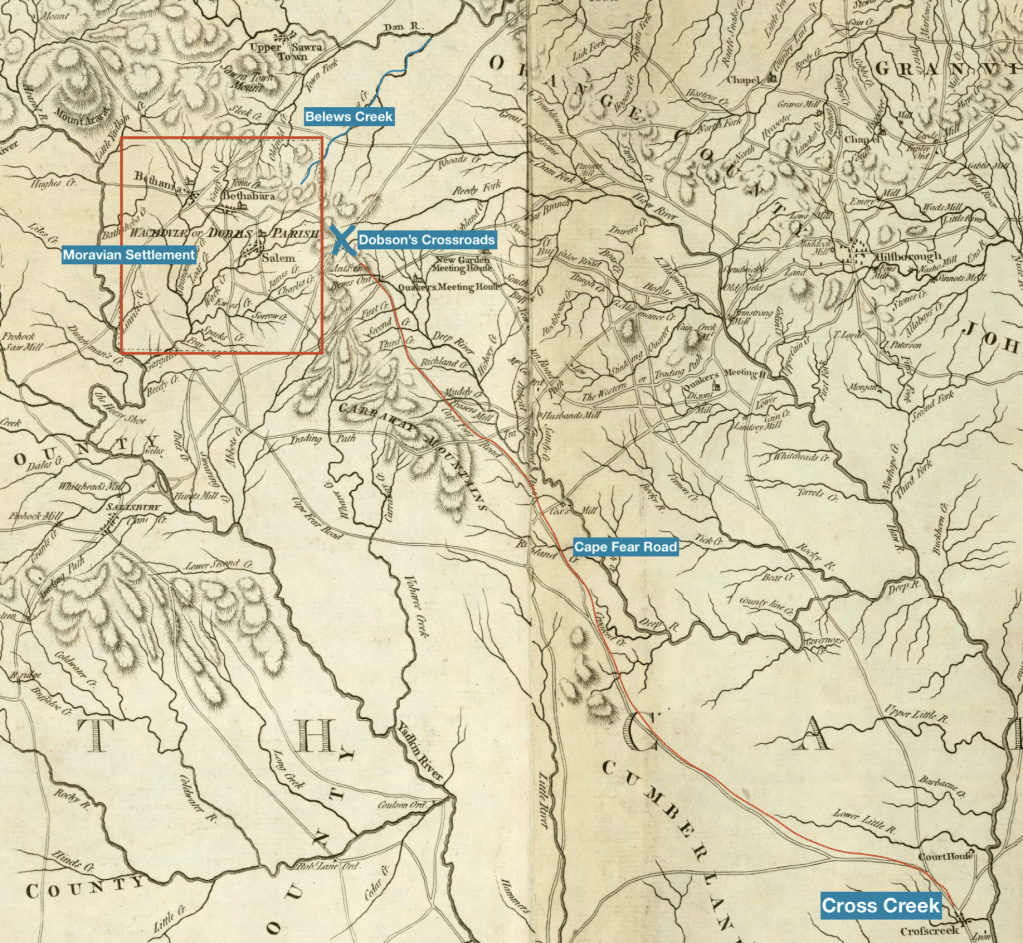
The Fulps had land along the Belews Creek, outside of the Moravian settlement of Wachovia and Dobson’s Crossroads, where the militia rendezvoused, was just south of where they lived, along the Cape Fear Road leading to Cross Creek (modern-day Fayetteville) where the Battle of Moore’s Creek Bridge was fought. Fayetteville was officially established in 1783 by the incorporation of Cross Creek (a trading post) and Campbelltown and was renamed in honor of La Fayette, the Frenchman who supported the American Revolution.
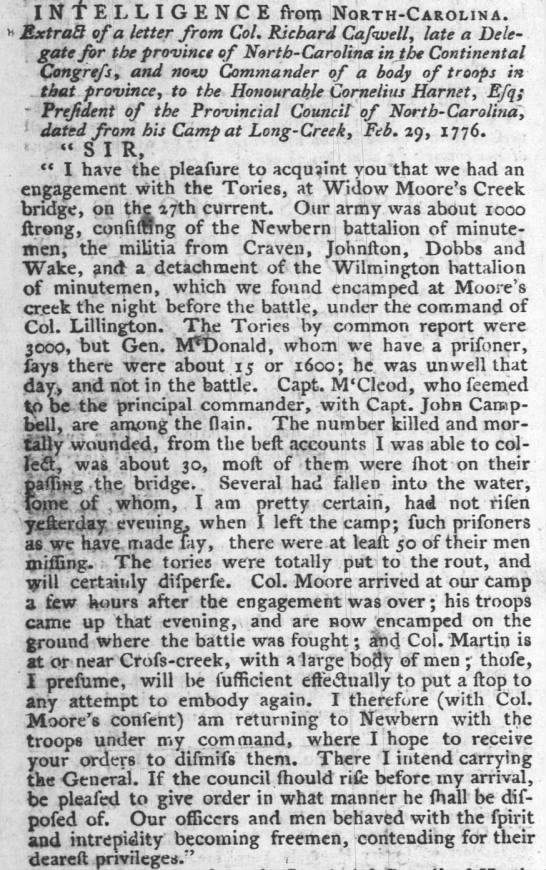
In the north, the battles of Lexington and Concord had been fought in April 1775, and as word of the battle traveled south to the Carolinas, the political parties of the Whigs and Tories faced off in the colonial capital with the Royal Governor, Josiah Martin, suspending the assembly, and the Whigs organizing committees of safety. As Martin, the Royal Governor, struggled to maintain control over the politics, he sought military support from Britain and exploited the forced allegiances of the Highlanders who had settled the Cape Fear area. The Scottish Highlanders had come to Carolinas after the Jacobite risings of the early 18th century and had been forced to swear allegiances to the British Crown– the colonial government used these forced oaths to enlist their support. Proclamations were sent calling for “all the King’s loyal subjects… repair to the King’s Royal Standard, at Cross Creek… in order to join the King’s Army; otherwise, they must expect to fall under the melancholy consequences of a declared rebellion, and expose themselves to the just resentment of an injured, though gracious Sovereign.” The later recalling the “year of pillaging” that occurred after the failed Battle of Culloden when the King’s Army had ravaged the highlands of Scotland.
As Martin prepared for the arrival of British regulars, he sought the organization of loyalists in the colony, drawing heavily on the Highlanders. He intended to use the assembled forces to march on Wilmington and regain control of the colonial government, maintaining loyalty to the Crown. His forces were ultimately met at Moores Creek Bridge, where the colonial militias outflanked the Loyalists marching toward Wilmington. The various militias from at least five different counties were headed by Colonel Richard Caswell.
The militias blocked multiple roads leading across the rivers and creeks in the area, forcing the Loyalists to come to Moores Creek Bridge where they had built earthen works for their cannons. As the loyalists approached, the militia fired their cannons and muskets, defeating them. The Highlanders were said to have shouted “King George and broadswords!” as they made their way across the bridge. How and where the Goode’s Company, with Peter Fulp, participated in the Battle is not known. The Revolutionary Pension only states he was gone for three months as they went to Fayetteville. Three companies from Surry County participated in the battle.
 Finding the Yellow Bricks