Miller
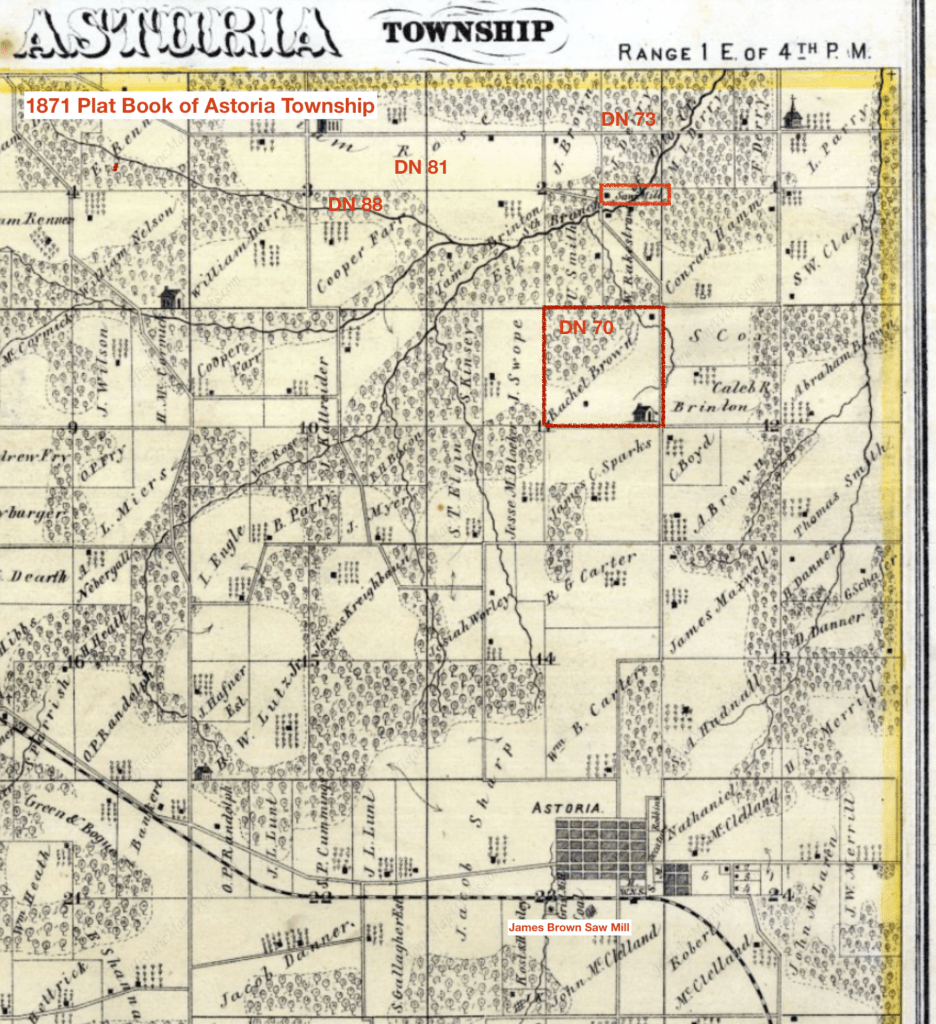
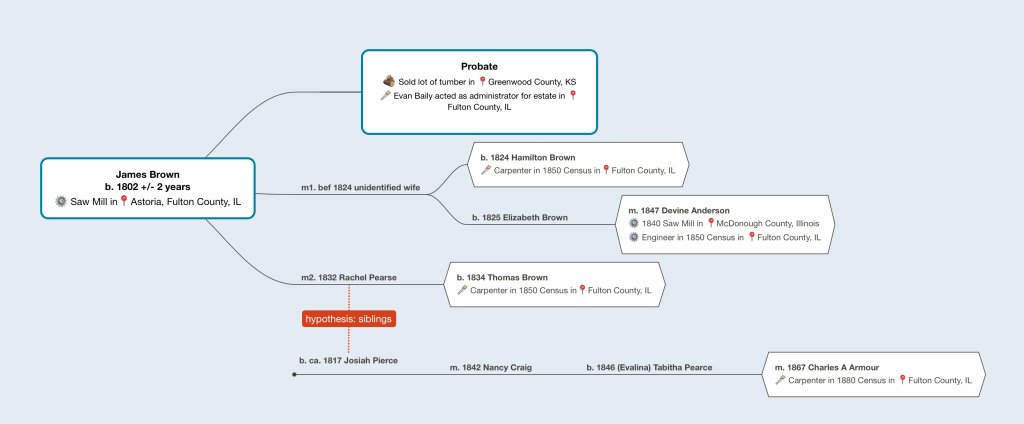
James Brown (ca. 1802-1867) is said to to have built the first saw-mill in Astoria, Fulton County, Illinois. The History of Fulton County details that “The first saw and grist-mill was built by James Brown. Mr. Brown and others ran it for about twelve years, when it fell into the hands of H. L. Mooney.” Astoria was established in 1837 and Brown migrated to Fulton County in 1841 according to his daughter’s obituary. The year prior, in Belmont County, Ohio, the 1840 US Census marked that Brown was engaged with manufacturing and trade, suggesting that Brown was in the lumber industry in Belmont prior to moving to Fulton County.
Engineer Son-In-Law
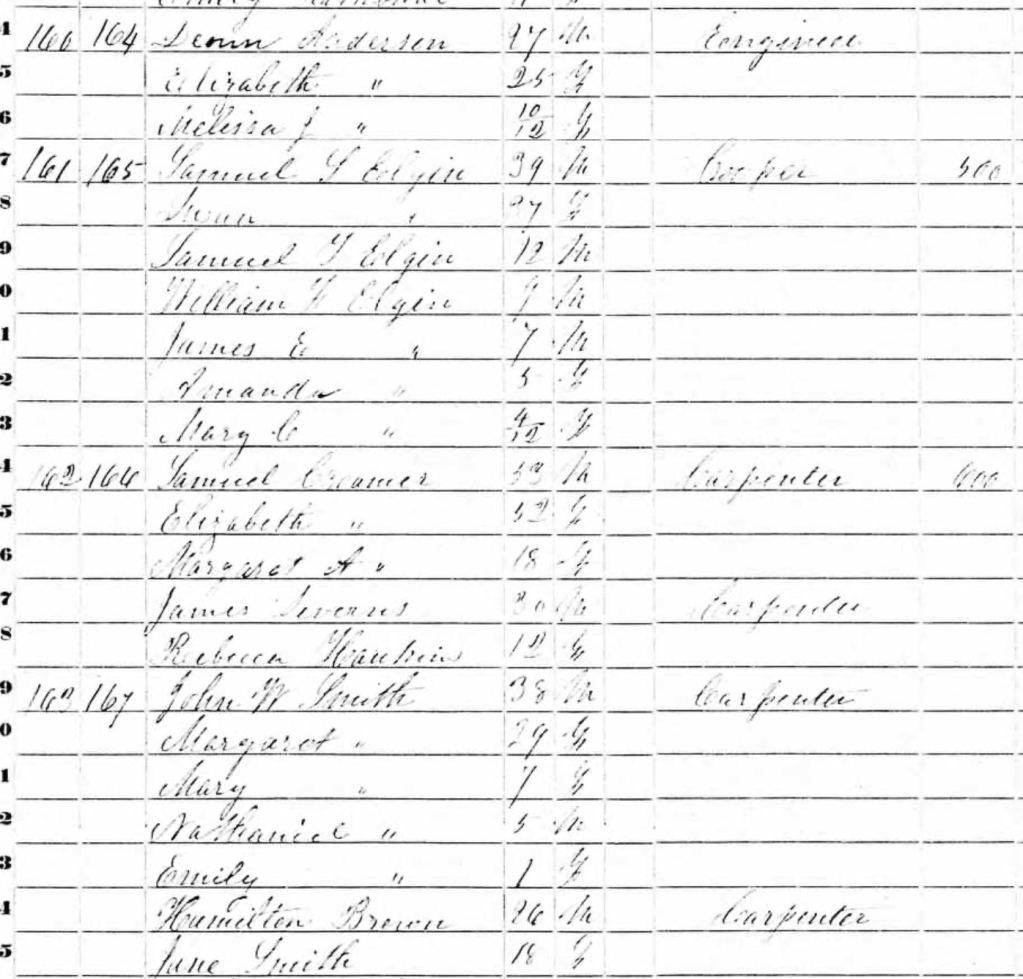
In 1847, Elizabeth Brown, the daughter of James Brown and his first wife, married Devine Anderson in Fulton County, IL. Devine Anderson is recorded in the History of McDonough County, Illinois on page 818 as having built a saw mill with J. O. C. Wilson on section 14 of Chalmers Township in 1840. More details about the mill can be read about in this post. McDonough County borders Fulton County on the west. In the 1850 census, Anderson and his wife, Elizabeth, are recorded as living in Astoria Township of Fulton County. Anderson is recorded as an engineer; listed on the same page is Hamilton Brown, in the household of John W Smith. Both Smith and Hamilton are carpenters.
Engineers were employed to run the engines of the steam saw-mills. These news article from the 1840s help paint a picture of running a saw mill (with or without mysterious injuries).
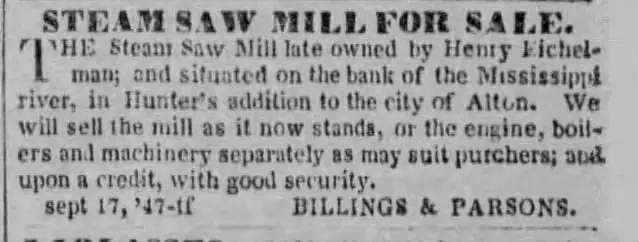
Alton, Illinois · Friday, September 17, 1847
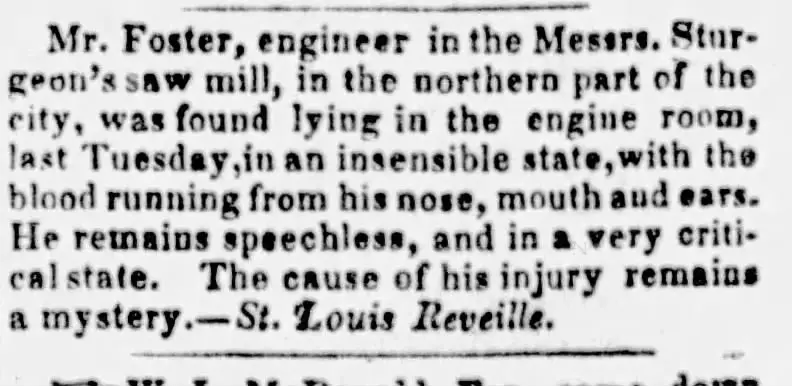
The Semi-Weekly Advocate
Belleville, Illinois · Thursday, July 23, 1846
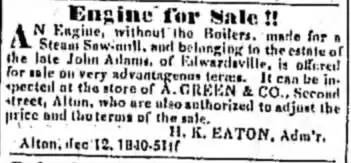
Alton, Illinois · Saturday, May 01, 1841
Carpenter Sons
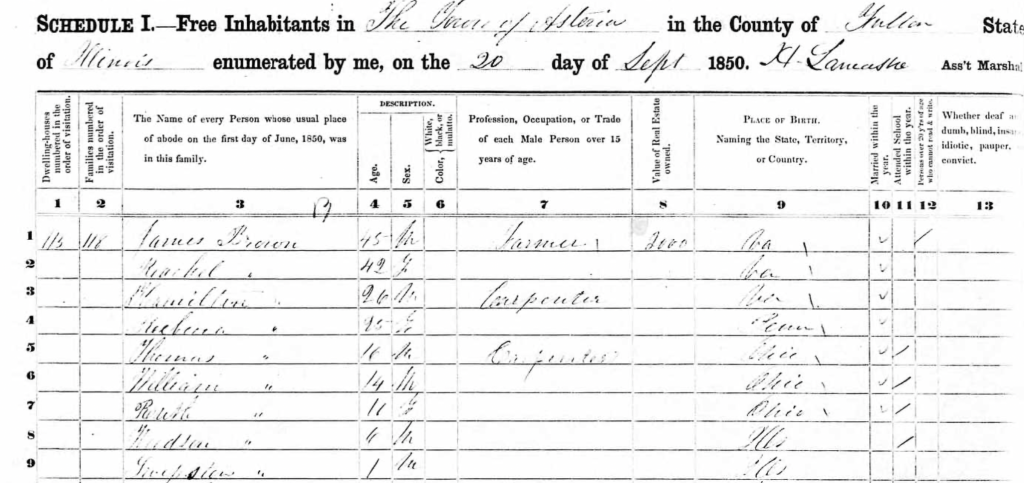
In the 1850 Census, James Brown and his household is listed twice in the census. The household enumerated as Dwelling 115 shows Brown and his sons (Hamilton and Thomas) with an occupation. While Brown is listed as a farmer, his sons are listed as carpenters. (Hamilton is also listed in the household of John W Smith as a carpenter). This is contrasted with the household enumerated as Dwelling 55; Hamilton is omitted and both James and his son Thomas are listed as farmers.
Carpenter Nephew
In a different post, the relationship between Josiah Pearce and James Brown is explored; the hypothesis is that they are brother-in-laws. One of Josiah Pearce’s daughters, Tabitha, married Charles A Armour, an immigrant from Canada. In the 1880 Census, Tabitha and Charles are living in Fulton County, Illinois, in the vicinity of the land worked by Brown’s son, Woodson.
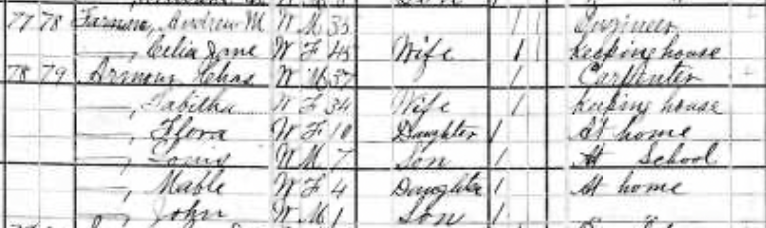
They are neighbors of an engineer and Armour is listed as a carpenter. Based on neighbors, it would suggest that the engineer and Armour work in and around the saw mill north of the land owned by the Brown family in section 11.
Carpenter Administrator
In 1868, Evan Baily served as the administrator of James Brown’s estate. He was a carpenter who lived in the neighboring township in Fulton County, Illinois. On the 1871 Map of Vermont Township in the Atlas for Fulton County, his land is marked north of the village of Vermont. Today, it is in the general location of the Bailey Cemetery, where he is buried. James Brown’s wife and children (including Hamilton) were buried in Vermont Cemetery.

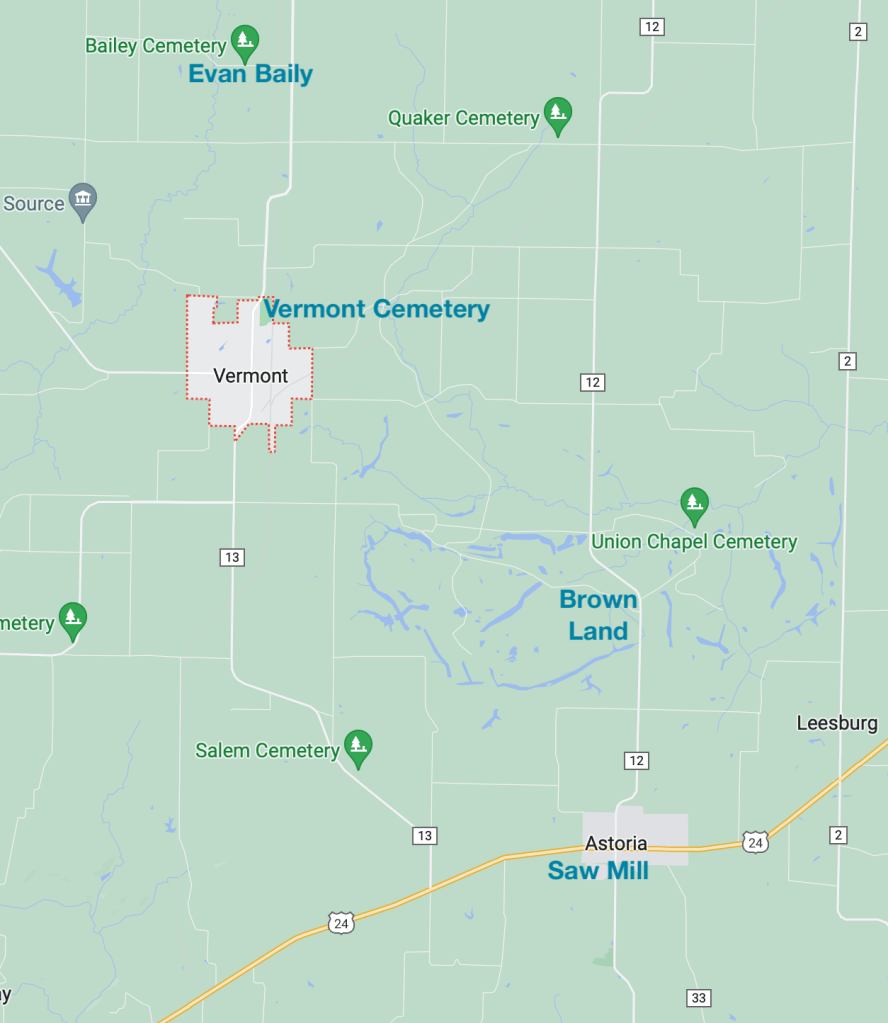
Evan Baily was born around 1807, just a few years after James Brown, making him the same generation. He was from Brooke County, Virginia (now West Virginia), which is adjacent to Belmont County, Ohio, where Brown migrated from in 1841. Bailey migrated to Illinois in the late 1830s.
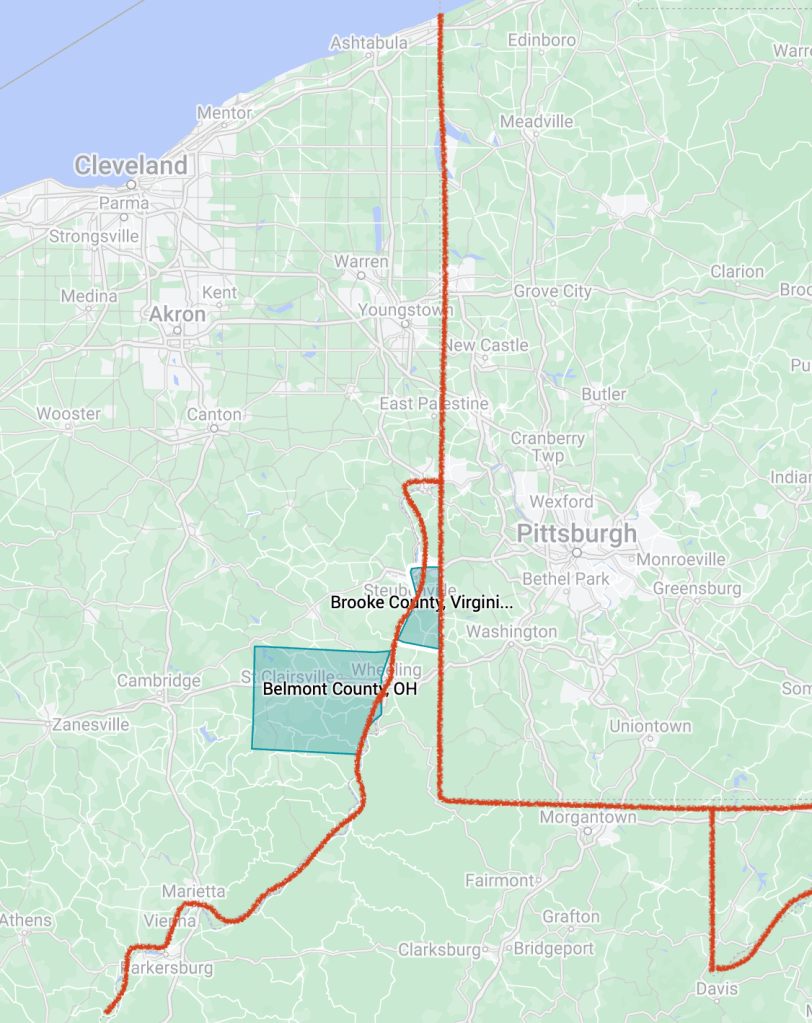
Baily’s daughter describes her father’s journey to Illinois is a set of short sketches given at a family reunion (ancestry.com); it is possible that the Browns came to Illinois the same way in 1841.
In 1836 father [Evan Baily] came to Illinois and purchased a tract of timber land of which only one acre was cleared with a one-roomed log cabin on it. He returned to Virginia and in company with some other pioneers built a keel boat by which they rowed themselves and their families down the Ohio River up the Mississippi and Illinois Rivers to Sharps Landing near Browning, Schuyler Co., Ill. Here they disembarked to complete their journey of seventeen miles in wagons.
Short Sketches of Evan Baily delivered by Sarah Ann Baily
Lumber in Kansas
Sarah Ann Baily also recounts that Evan Baily’s half-brother, Alexander Baily moved to Emporia, Kansas during the Civil War. Emporia is in the Flint Hills of Kansas, near Greenwood County, where Devine and Elizabeth Anderson moved in 1866 and where James Brown was visiting in 1867, when he died.

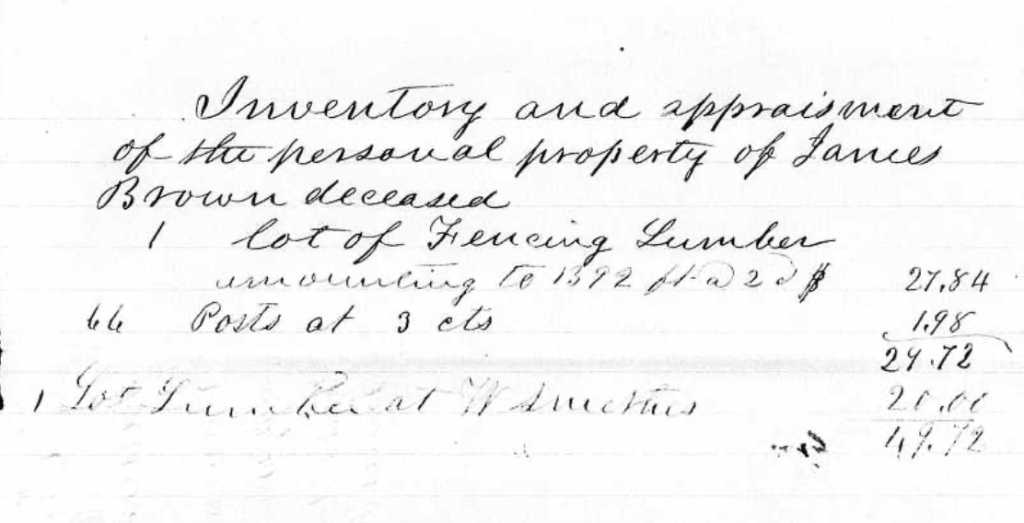
The probate records for James Brown includes his inventory of property in Kansas at the time of his death, which included lumber and posts. Presumably he brought the labor to help his daughter and son-in-law in their new homestead near Bachelor Creek in Greenwood County, Kansas.
Conclusion
James Brown had multiple connections with the production and use of lumber throughout his lifetime. These connections suggests that James was the child of a father who was also involved in milling and/or wood working in Virginia. The association with the Baily family as well their geographic proximity in Ohio as well as Illinois suggests that there is a connection that has yet to be discovered.
 Finding the Yellow Bricks