Devine Anderson married Elizabeth Brown in 1847 and is listed in the 1850 US Census with his new wife and infant daughter — and not in his parents’ household. As the 1850 US Census was the first census to list the names of household members beyond the head of household, this has made it difficult to identify other siblings or parents of Devine Anderson.
At the time of writing this post, his parents are yet unidentified, however, a sister has been identified as Jane Anderson, who also married in 1847. She married Isaac Webster on 14 Mar 1847, a few months before Devine Anderson married Elizabeth Brown. In the 1850 Census, Isaac and Jane Webster are enumerated in Lafayette Township, Fulton County, Illinois with two young daughters. Lafayette was shortly renamed Woodland Township and is directly east of Astoria Township where Devine Anderson was living.
1870 Map of Fulton, Mason, Casss, Menard Counties | davidrumsey.com
Like Devine, Jane Webster in the 1850 census listed her birthplace as Virginia. By 1860, Isaac and Jane Webster had left Illinois for Kansas. She and her husband settled in Coffey County, Kansas, which is the Flint Hills. An 1859 Kansas State Census records that Isaac Webster moved to Kansas from Illinois in 1857. Isaac died in 1863, and Jane Webster remarried to Dr. Joseph Jenks, a physician also living in Coffey County.
Family Connection
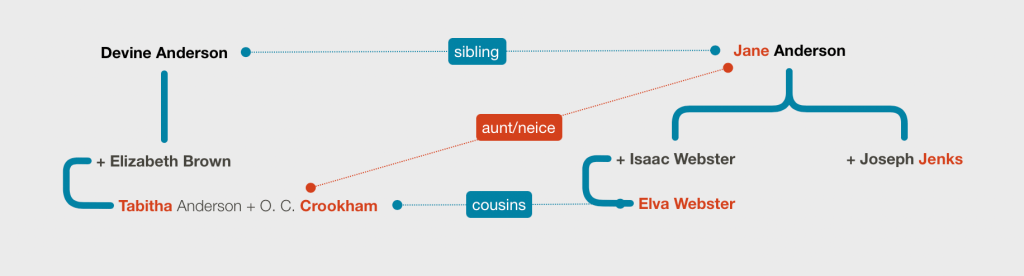
A series of newspaper articles from Greenwood County, Lyon County, and Coffee County detail the relationship between a Elva Webster, Mrs. Jane Jenks, and Tabitha Crookham.
In 1891, the Hartford News announced that “Miss Elva Webster left Monday for a month’s visit with [unnamed] relatives and friends at Eureka. The little daughter of E. B. Webster will stay with Grandma Jenks during Miss Webster’s absence.”
In Oct 1895, the Democratic Messenger in Greenwood County reported that “Miss Elva Webster is at the home of her cousin, Mrs. Tabitha Crookham, quite low with typhoid fever. Dr. Grove is in attendance. Mrs. Jinks [sic], mother of Miss Webster is expected daily.”
In 1896, the Democratic Messenger reported that “Miss Elva Webster, of Eureka, spent Sunday with her cousin, Mrs. Crookham. ”
In 1909, the Hartford Times, a newspaper published in Lyon County, announced the visit of Miss Tabitha Croockham [sic], who “left Wednesday for her home in Eureka after a visit with her aunt, Mrs. Jane Jenks, and cousin, Miss Elva Webster”.
Birthplace
Both Jane and Devine Anderson list their birthplace as Virginia in the US Censuses for 1850 and 1860.
In 1904, the Hartford Times ran an article about the “Old Folks Reception” held by the Epworth League. The article ran a list of people who attended, their ages and their native state, among them, Jane Jenks, age 78 from “Loudon County, VA”
1827 Map of Virginia by Finney | davidrumsey.com
Devine’s birth year, derived from the 1850 US Census and his headstone, is 1823. Jane’s birth year, inscribed on her headstone, is 1825, which is consistent with census records that estimate a birth year of 1824/1825.
In 1820, the following Anderson households were identified as living in Loudoun County, Virginia:
Head of Household
Residence
Jno. Anderson
Leesburg, Loudoun, Virginia
Eliza Anderson
Leesburg, Loudoun, Virginia
Robt Anderson
Waterford, Loudoun, Virginia
Abraham Anderson
Waterford, Loudoun, Virginia
Jno. R Anderson
Aldie, Loudoun, Virginia
In 1830, the following Anderson households were identified as living in Loudoun County, Virginia. We would expect to see at least one male child between 5 to 9 and one female child 5 to 9 or under 5; households with at least one male and one female of the right age are marked as “likely” in the notes column.
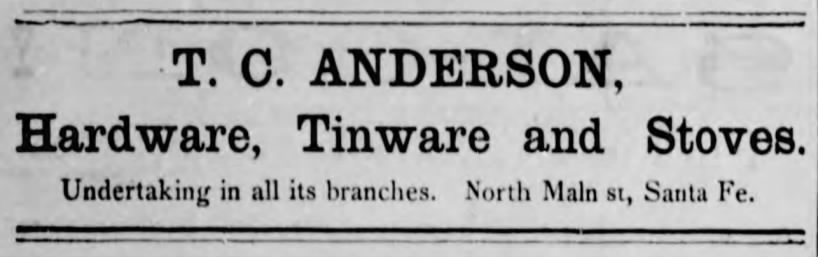
T. C. Anderson, the middle son, of Devine and Elizabeth (Brown) Anderson had a tricky given name. More often than not, he went by his middle name, Clinton, or his initials:
Eureka Herald and Greenwood County Republican, 21 Oct 1892, page 1 | newspapers.comNewkirk Democrat, 15 Nov 1893, page 4 | newspapers.com
When his given name is used, more often than not, it is mis-spelled as the writer attempt a phonetic spelling of his unusual given name:
Theutus (1860 US Federal Census)
Theudas (1895 Oklahoma Marriage Record)
Thadious (1900 US Federal Census)
Theudis (1905 Obituary in Roosevelt, Oklahoma)
Theudies (1905 Obituary in Hobart, Oklahoma)
Possible Historical Origin
Theudis was the King of the Visigoths in Hispania. This would have been an interesting choice politically and historically. Spanish-American relationships in the 19th century were strained as there was competition for territory in the Western Hemisphere. The US was able to gain Florida from Spain and pressed into the former Spanish colony of Mexico, winning the Mexican-American War in 1848. And in the early 1850s, when T. C. Anderson was born, the US and Spanish were in conflict over American trade in Cuba. Pro-slavery Americans wanted to annex Cuba to expand territories were slavery was legal. The Andersons were Republicans, which in this historical period meant they were anti-slavery.
Portrait of Theudis from Retratos de los reyes de España (1788) | wikipedia
The question remains, as well, did the Anderson family know of the obscure historical King Theudis? T. C. Anderson’s sister and mother served on the school board for Greenwood County, suggesting that the family valued education. Laura McCombs, T. C. Anderson niece, enrolled in a “Normal Institute” to become a teacher in the 1890s. Newspapers in the 1800s occasionally referenced Theudis. For example, the Alexandria Gazette ran an article in May 1809 that detailed Spanish Revolutions from Rome. It is possible that the family read about the King in an article or history book. While possible, it is more likely that the name is form another source.
Possible Biblical Origin
Theudas made a brief appearance in the New Testament:
“For before these days rose up Theudas, boasting himself to be somebody; to whom a number of men, about four hundred, joined themselves, who was slain; and all, as many as obeyed him, were scattered, and brought to nought.”
Acts 5:36, KJV
The funeral of T. C. Anderson’s mother, Elizabeth Anderson, was presided over by Elder J. Kenner, a leader in the Christian Church (Christian Brethren) in Greenwood County. Newspaper articles from Greenwood identify Kenner as an Elder of the “Christian Church”.
Eureka Herald and Greenwood County Republican, 31 Jul 1868, page 3 | newspapers.com
The “Christian Church” came out of the Restoration Movement, that began during the Second Great Awakening (1790-1840). Barton Stone, a Presbyterian Minister, began preaching its precepts in the 1800s, and Thomas and Alexander Campbell, Baptist preachers, began in the 1810s and 1820s. The men united in 1832 and the movement grew to 200,000 members by 1860. Members of the movement wanted to reform the church by unifying all Christians patterned after the church of the New Testament. Members used the Bible to recreate aspects of the early church, emphasizing the Bible over creeds and other guides. The churches reject denominational labels, going by Christian, Church of Christ, Disciples of Christ, etc.
If Elizabeth Anderson were a member of this Church, then it would suggests that she was inspired by her reading and study of the New Testament. This naming choice is reinforced by the selection of Tabitha for her daughter. Tabitha was born in 1861, five years after T. C. Anderson. If Elizabeth used the New Testament for the names of some of her children, then Tabitha may have been named after Tabitha, a woman brought back to life by the apostle Peter in Acts.
Now there was at Joppa a certain disciple named Tabitha, which by interpretation is called Dorcas: this woman was full of good works and almsdeeds which she did. And it came to pass in those days, that she was sick, and died: whom when they had washed, they laid her in an upper chamber. And forasmuch as Lydda was nigh to Joppa, and the disciples had heard that Peter was there, they sent unto him two men, desiring him that he would not delay to come to them. Then Peter arose and went with them. When he was come, they brought him into the upper chamber: and all the widows stood by him weeping, and shewing the coats and garments which Dorcas made, while she was with them. But Peter put them all forth, and kneeled down, and prayed; and turning him to the body said, Tabitha, arise. And she opened her eyes: and when she saw Peter, she sat up. And he gave her his hand, and lifted her up, and when he had called the saints and widows, presented her alive.
Acts 9:36-41
Peter Heals the Crippled and Raises Tabitha, Masolina
Elizabeth’s other children do not appear to be given New Testament names:
Melissa Jane (1849-1932) was given an infrequent name from the 19th century (though a popular 20th century name). Generally, the name may have been used in the 19th century as a result of the Scottish poem “Ode, on Melissa’s Birth Day” written in the late 18th century. Melissa’s middle name, Jane, is the same as Devine Anderson’s sister, Jane.
George A (1852-1870) was given a common English name. If Elizabeth was using traditional naming patterns, the first son was usually named for the father’s father, meaning, Devine’s father may also have been called George. No documentation has been found, however, to identify Devine’s parents.
James H (1858-1868), the third son, was also given a common English name; he shares the name with Elizabeth’s father, James Brown.
Josephine (1865-unknown) is given a feminine version of Joseph. Historical associations are with Napoleon’s wife, Josephine rather than Biblical.
In a previous post, the potential connections between Josiah Pearce and Rachel Pearce, wife of James Brown were explored based on similar migration patterns and the presence of T. J. Brown in both households.
Since the publication of that post, a deed has been located in Belmont Count Records (Book X, page 316–317) that confirm the family connection. (Deeds on belcolgis.com; Indexed on familysearch.org)
Know all men by these presents that we James Brown & Rachel Brown (formerly Rachel Pearce) and Josiah T Pearcehave made constituted and appointed and by these presents do make constitute and appoint and in our place and stead put and depute Sanford C Hill of Liverpool, Ohio our true and lawful attorney for us and in our names to sell or demise a certain lot of ground lying and being in the town of Liverpool township of Liverpool in the County of Columbianna and numbered on the plat of the town of Liverpool 186 and lately owned by Joseph Pearce, decd…. 1839
Deed Book OOX, page 316, Belmont County, Ohio
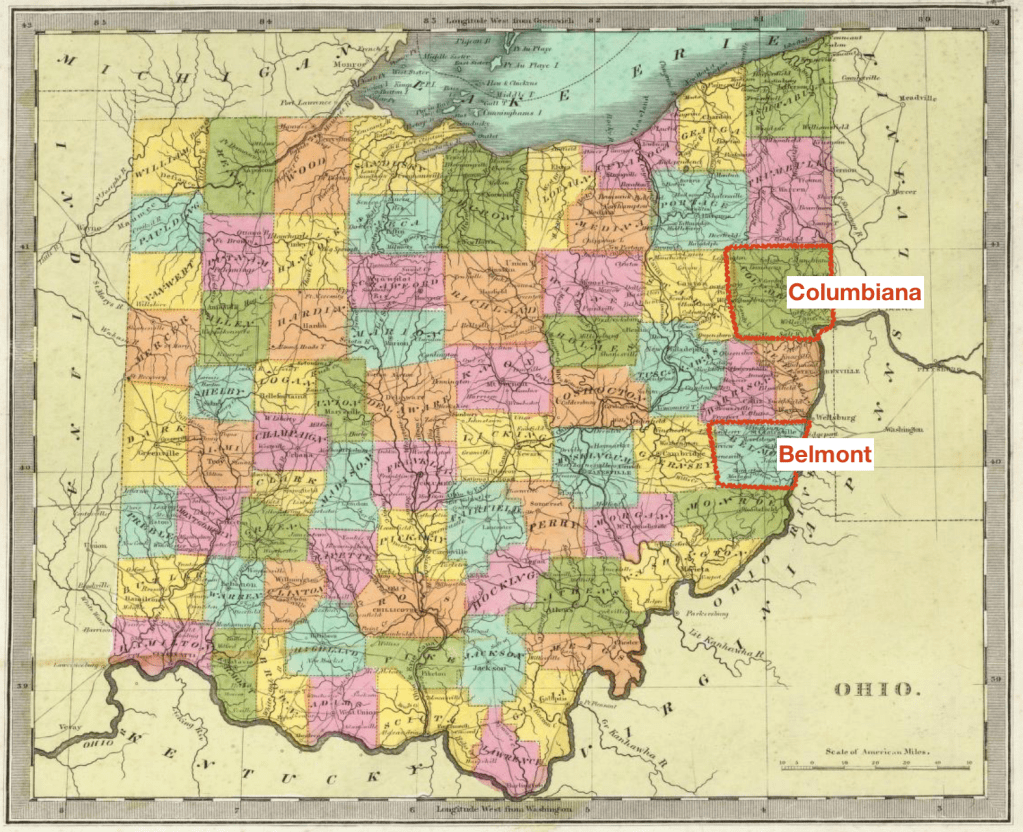
The County of Columbiana is north of Belmont County, along the border with Pennsylvania. Liverpool Township is along the southern border next to the Ohio River, as it connects (then) Virginia and Pennsylvania. The township was established in 1834.
1835 Map of Ohio | davidrumsey.com
In 1842, the same year Josiah T Pearce married Nancy Craig in Belmont County, Pearce sold lot 186 in Liverpool to Edward DeBarenne (Columbiana Deed Index | family search.org) Sanford C Hill acted as a witness to the deed. (Deed Book 34, page 600; familysearch.org)
Joseph Pearce bought the lot in 1832 from Cleaburn Simms. (Columbiana Deed Index | family search.org). The lot was in “East Liverpool”. Both men were said to be residents of Columbiana.
In 1832, Rachel Pearce married James Brown in Belmont County, OH, and in the marriage license, Dr. Thomas Carroll attested her age as above 21; Joseph Pearce did not. Thomas Carroll was from an Irish Quaker family that had migrated to the States in 1801, where they settled in Columbiana County, Ohio. As an adult, Carroll moved to Belmont County, Ohio. Thomas Carroll is listed in the 1830 Census for Belmont County as a man in his thirties. (Belmont Chronicle, 23 Mar 1871 | newspapers.com). It is possible that he knew the Pearce family from Columbiana County and they had connections with his parent’s family.
James Brown (ca. 1802-1867) is said to to have built the first saw-mill in Astoria, Fulton County, Illinois. The History of Fulton County details that “The first saw and grist-mill was built by James Brown. Mr. Brown and others ran it for about twelve years, when it fell into the hands of H. L. Mooney.” Astoria was established in 1837 and Brown migrated to Fulton County in 1841 according to his daughter’s obituary. The year prior, in Belmont County, Ohio, the 1840 US Census marked that Brown was engaged with manufacturing and trade, suggesting that Brown was in the lumber industry in Belmont prior to moving to Fulton County.
Engineer Son-In-Law
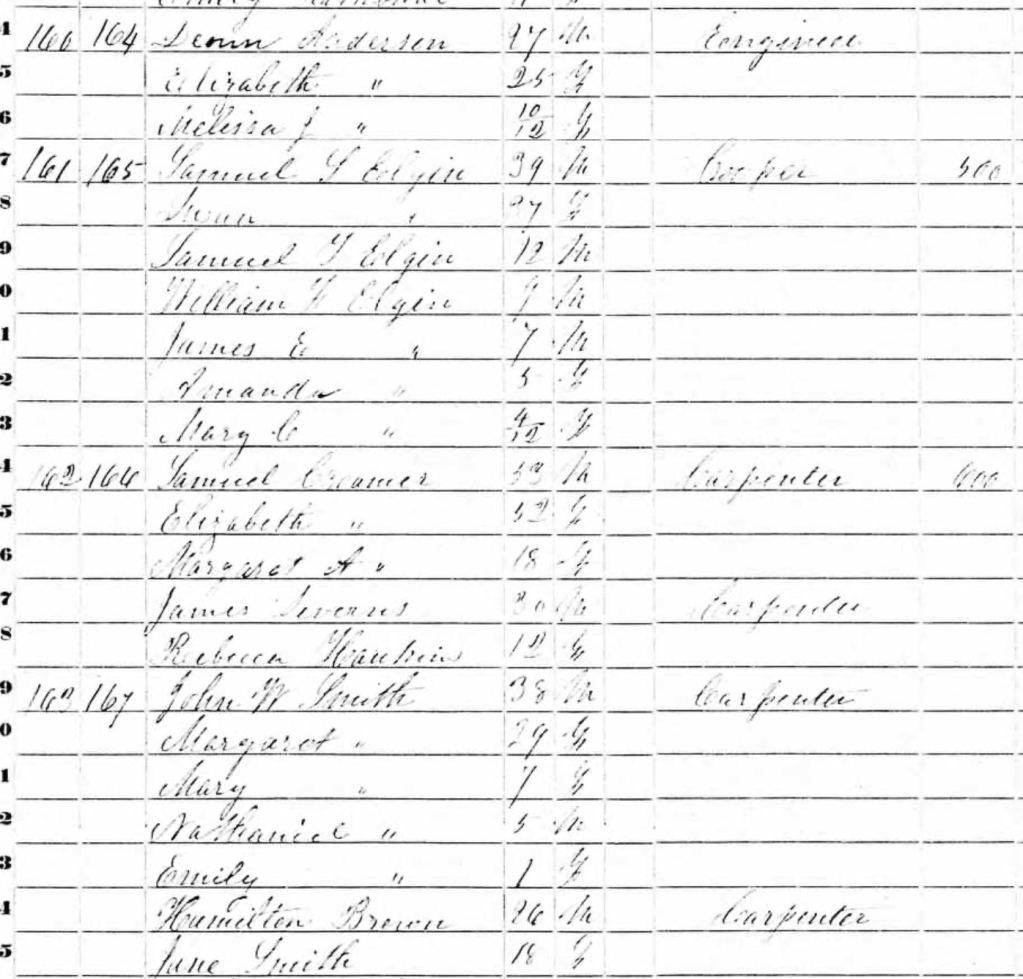
In 1847, Elizabeth Brown, the daughter of James Brown and his first wife, married Devine Anderson in Fulton County, IL. Devine Anderson is recorded in the History of McDonough County, Illinois on page 818 as having built a saw mill with J. O. C. Wilson on section 14 of Chalmers Township in 1840. More details about the mill can be read about in this post. McDonough County borders Fulton County on the west. In the 1850 census, Anderson and his wife, Elizabeth, are recorded as living in Astoria Township of Fulton County. Anderson is recorded as an engineer; listed on the same page is Hamilton Brown, in the household of John W Smith. Both Smith and Hamilton are carpenters.
1850 US Census, Astoria, Fulton County, Illinois | ancestry
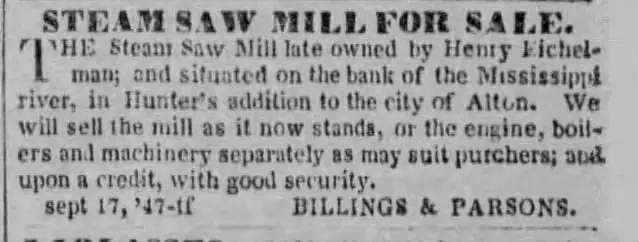
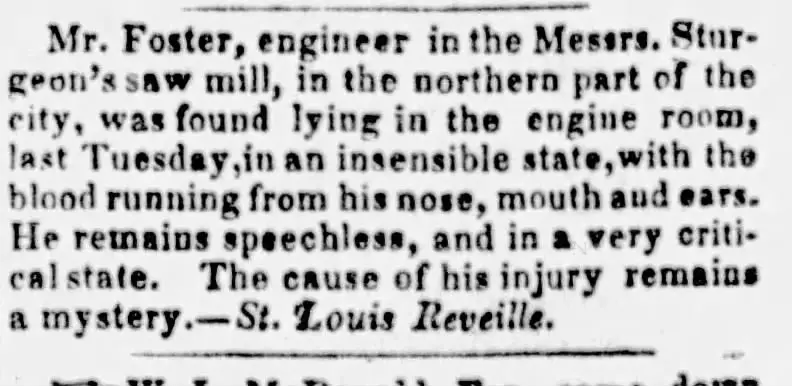
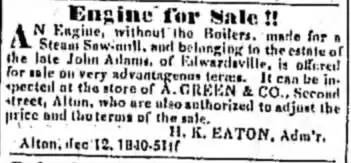
Engineers were employed to run the engines of the steam saw-mills. These news article from the 1840s help paint a picture of running a saw mill (with or without mysterious injuries).
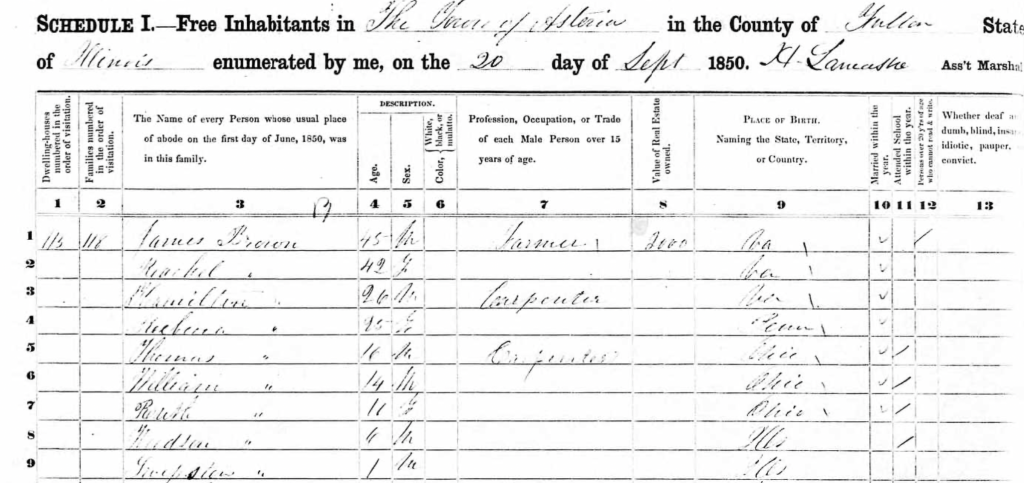
In the 1850 Census, James Brown and his household is listed twice in the census. The household enumerated as Dwelling 115 shows Brown and his sons (Hamilton and Thomas) with an occupation. While Brown is listed as a farmer, his sons are listed as carpenters. (Hamilton is also listed in the household of John W Smith as a carpenter). This is contrasted with the household enumerated as Dwelling 55; Hamilton is omitted and both James and his son Thomas are listed as farmers.
1850 US Census, Astoria, Fulton County, Illinois | ancestry
Carpenter Nephew
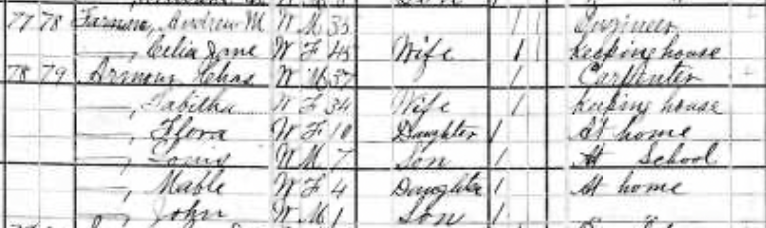
In a different post, the relationship between Josiah Pearce and James Brown is explored; the hypothesis is that they are brother-in-laws. One of Josiah Pearce’s daughters, Tabitha, married Charles A Armour, an immigrant from Canada. In the 1880 Census, Tabitha and Charles are living in Fulton County, Illinois, in the vicinity of the land worked by Brown’s son, Woodson.
1880 US Census, Astoria, Fulton County, Illinois | ancestry
They are neighbors of an engineer and Armour is listed as a carpenter. Based on neighbors, it would suggest that the engineer and Armour work in and around the saw mill north of the land owned by the Brown family in section 11.
Carpenter Administrator
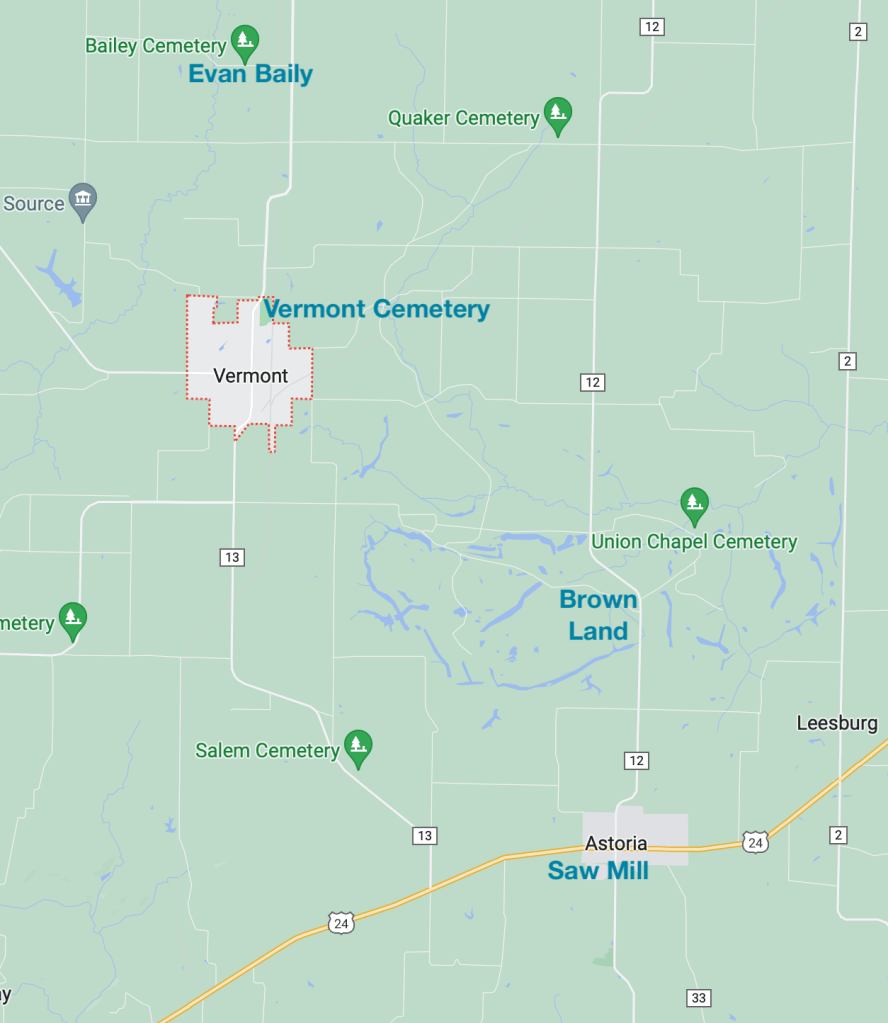
In 1868, Evan Baily served as the administrator of James Brown’s estate. He was a carpenter who lived in the neighboring township in Fulton County, Illinois. On the 1871 Map of Vermont Township in the Atlas for Fulton County, his land is marked north of the village of Vermont. Today, it is in the general location of the Bailey Cemetery, where he is buried. James Brown’s wife and children (including Hamilton) were buried in Vermont Cemetery.
1871 Plat Map of Fulton County, Illinois
Google Maps, Annotated by Author
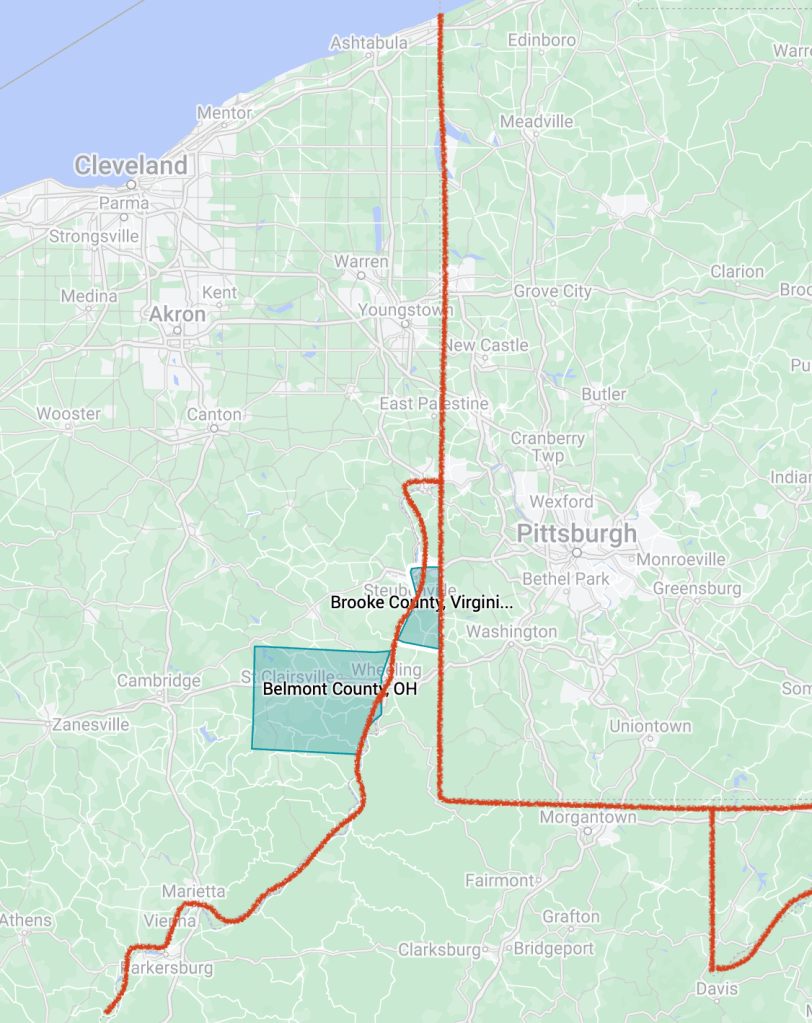
Evan Baily was born around 1807, just a few years after James Brown, making him the same generation. He was from Brooke County, Virginia (now West Virginia), which is adjacent to Belmont County, Ohio, where Brown migrated from in 1841. Bailey migrated to Illinois in the late 1830s.
Baily’s daughter describes her father’s journey to Illinois is a set of short sketches given at a family reunion (ancestry.com); it is possible that the Browns came to Illinois the same way in 1841.
In 1836 father [Evan Baily] came to Illinois and purchased a tract of timber land of which only one acre was cleared with a one-roomed log cabin on it. He returned to Virginia and in company with some other pioneers built a keel boat by which they rowed themselves and their families down the Ohio River up the Mississippi and Illinois Rivers to Sharps Landing near Browning, Schuyler Co., Ill. Here they disembarked to complete their journey of seventeen miles in wagons.
Short Sketches of Evan Baily delivered by Sarah Ann Baily
Lumber in Kansas
Sarah Ann Baily also recounts that Evan Baily’s half-brother, Alexander Baily moved to Emporia, Kansas during the Civil War. Emporia is in the Flint Hills of Kansas, near Greenwood County, where Devine and Elizabeth Anderson moved in 1866 and where James Brown was visiting in 1867, when he died.
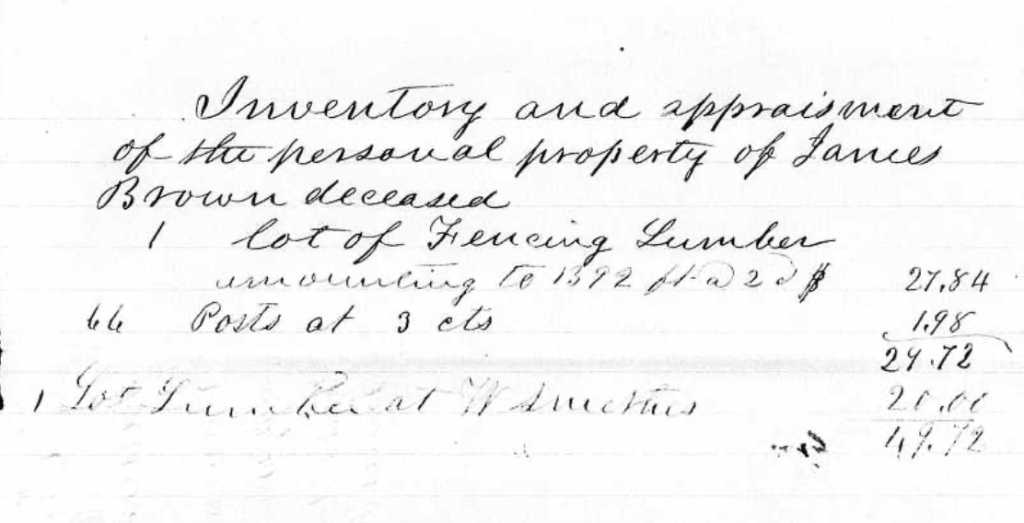
The probate records for James Brown includes his inventory of property in Kansas at the time of his death, which included lumber and posts. Presumably he brought the labor to help his daughter and son-in-law in their new homestead near Bachelor Creek in Greenwood County, Kansas.
Kansas, U.S., Wills and Probate Records, 1803-1987 | ancestry.com
Conclusion
James Brown had multiple connections with the production and use of lumber throughout his lifetime. These connections suggests that James was the child of a father who was also involved in milling and/or wood working in Virginia. The association with the Baily family as well their geographic proximity in Ohio as well as Illinois suggests that there is a connection that has yet to be discovered.
Hamilton Brown was the oldest son of James Brown (ca. 1802-1867) and older brother of Elizabeth (Brown) Anderson. In the 1850 census, Hamilton is listed with his wife Rebecca Ramsey, in the household of James Brown. Hamilton and Rebecca were relative newlyweds, having married in 1849 and Hamilton and his half-brother, Thomas J, were working as carpenters. They were living near Astoria in Fulton County, Illinois.
Hamilton is not only enumerated in the Brown household with his wife, but is also enumerated in the John W Smith household (DN 163), near the household of Elizabeth Anderson, his sister (DN 160). Smith was listed as a carpenter. It is possible that Hamilton was living with Smith to learn the carpentry trade as an apprentice or journeyman. In 1859, the average wage per day for a carpenter in Illinois was $2.00.
Murder
In 1857, Hamilton Brown was killed in Astoria by William Tate. The 1879 History of Fulton County recorded the killing in its text:
In November, 1857, Wm. Tait was indicted for the killing of Hamilton Brown at Astoria. One night while passing along the street Brown was struck upon the head with a stone or a piece of iron. From the wound inflicted he died. Tait was supposed to have thrown the stone and therefore was indicted for the murder. He was liberated upon bail fixed at $500. He was tried and acquitted. Cyrus Walker was his attorney.
Ancestry.com. History of Fulton County, Illinois [database on-line]
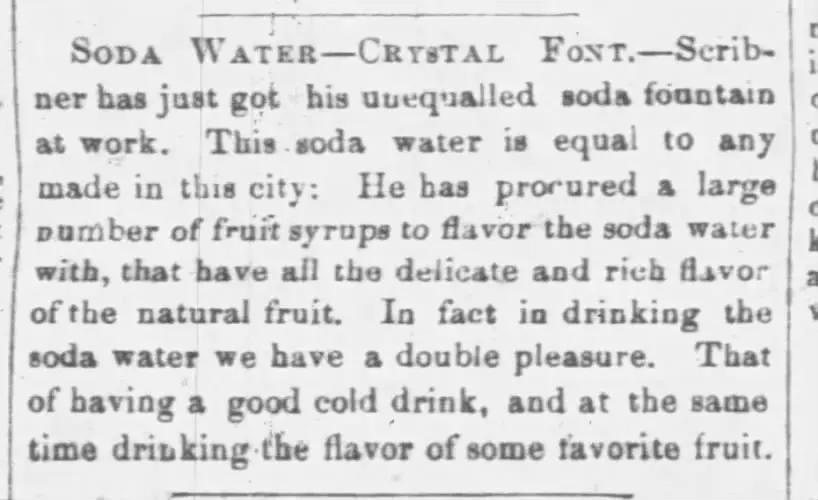
The story was reported in the Lewiston Democrat and picked up by the Weekly Chicago Times. The killing was reported to be a result of a dispute over drinking soda at a saloon in Astoria.
This story contrasts with the description of Astoria in the History of Fulton County:
Generally speaking, Astoria has borne a good reputation as a quiet orderly town, doubtless greatly shielded by the ennobling influence of her strong religious organizations. Occasionally, however, the town has been disgraced by a street brawl. In an early day intoxicating liquors were freely dispensed, but now there is no saloon here, thanks to the order-loving community who have voted down the hellish traffic and driven the liquor-venders from their midst.
Ancestry.com. History of Fulton County, Illinois [database on-line]
United States. Bureau of Labor Statistics , Stewart, Estelle M. (Estelle May), 1887-1938 and Bowen, Jesse Chester, 1865-1948. History of Wages in the United States From Colonial Times to 1928 : Bulletin of the United States Bureau of Labor Statistics, No. 499 , Washington, D.C: G.P.O., October 1929, https://fraser.stlouisfed.org/title/4067, accessed on April 10, 2023.
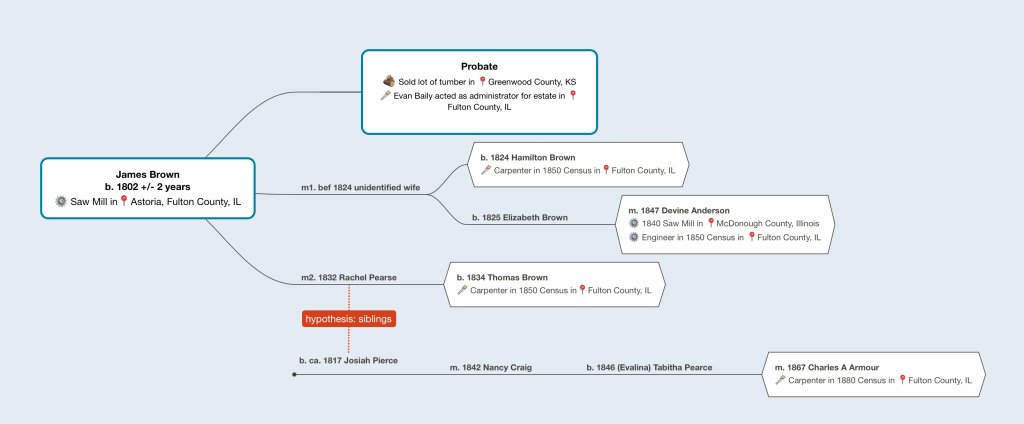
Very little is known about the family of James Brown (ca. 1802-1867) outside of his children and his second wife, Rachel Pearse. (Note on spelling: earlier records typically used a Pearse/Pearce spelling; later records typically used a Pierce spelling)
Tree created by author based on information known at time; not all details are included and subject to change based on newer information
A rough outline of Brown’s life can be reconstructed through census records and his daughter’s obituary. Elizabeth Anderson died in 1886 in Greenwood County, Kansas and her obituary outlines her birth in Virginia (consistent with the birthplace provided for James in the 1850 & 1860 census), the family migration to Ohio in 1826 and later to Fulton County, Illinois in 1841.
Belmont County, Ohio has been identified as the county of residence for the family from the birthplaces listed for Thomas J Brown and William Brown, the sons of James and Rachel Brown. They mustered into the 84th Illinois Infantry during the Civil War and both list LLoydsville, Belmont County, Ohio as their birthplace.
Pearse Family
An 1832 marriage record for James Brown and Rachel Pearse exists for Belmont County, Ohio, suggesting that his first wife died after the 1830 census and prior to 1832. Rachel Pearse, James’ second wife, was born around 1810 according to the US Federal Census records from 1850-1880; she would have been 22 when she became the wife of James and stepmother to the Brown children. The census records from 1850-1870 provide her birthplace as Ohio, while the 1880 census provides her birthplace as Maryland.
A decade later, in 1842, Josiah T Pierce married Nancy Craig in Belmont County, Ohio, one year after the Brown family left Belmont and migrated to Fulton County, Illinois. Like the Brown family, Pearce and his family migrate to Fulton County from Belmont County.
Josiah and his family disappear from the census records until 1860, when he is living in Astoria Township, Fulton County, Illinois, the same township as the Browns. His family is enumerated as Dwelling Number 2562, which is likely in the vicinity of Devine and Elizabeth Anderson, James Brown’s daughter, who are enumerated at Dwelling Number 2557 while James Brown is enumerated at 2381.
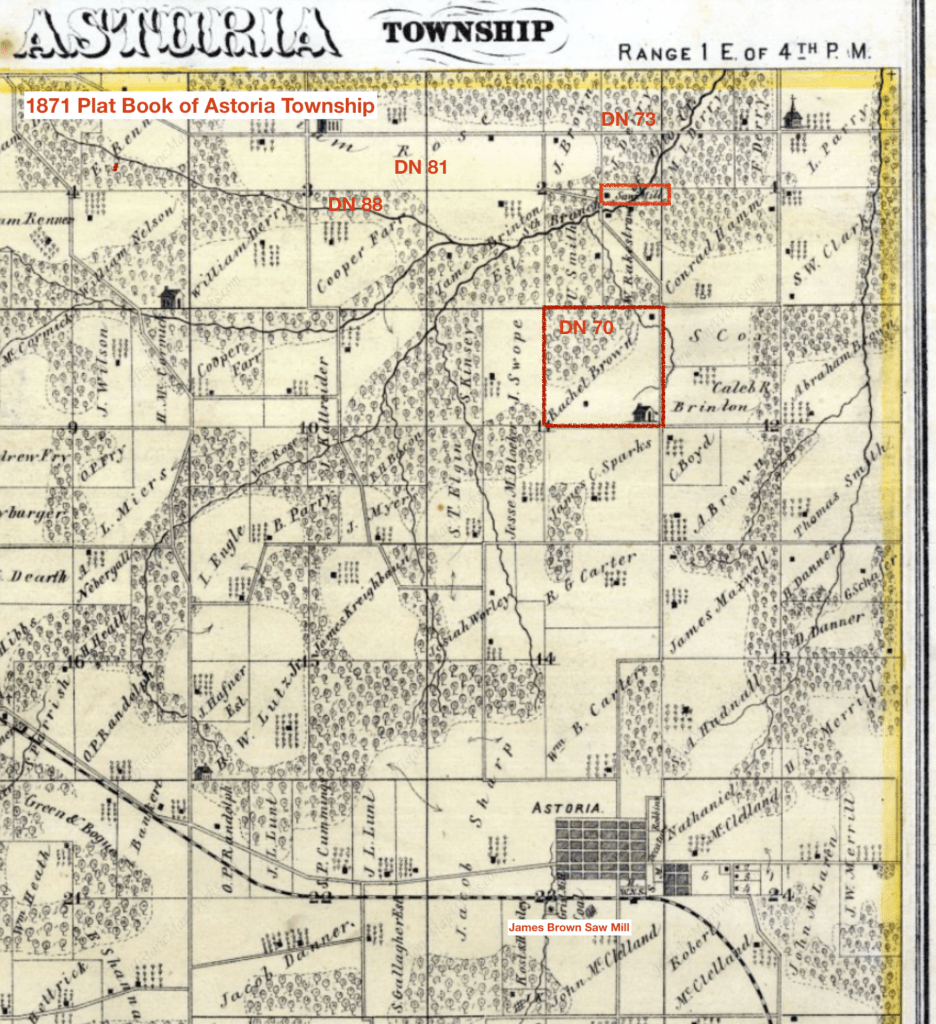
The dwelling numbers for the 1860 Census allows us to tentatively place the Brown, Anderson and Pearce Family on the 1871 Plat Map for Astoria Township, Fulton County, Illinois (historicmapworks.com). The red numbers of the map reference the Dwelling Numbers for the Head of Households in the 1860 census.
Devine Anderson, enumerated as DN 2557, is likely living in the vicinity of the land marked with Rachel Brown’s name on the 1871 map (the land could have been sold to the Brown family when the Anderson family left in 1866 or the Andersons lived on her father’s land).
JamesBrown, enumerated as DN 2381, is likely living in the vicinity of the grist mill marked southwest of the Astoria Town. History of Fulton County, Illinois recorded James Brown as one of the first operators of the saw and gristmill of Astoria who operated it for about 12 years. In 1867, when Brown died visiting Greenwood County and his daughter, he left behind an estate lumber that was sold to pay off his debts. The Fulton County probate records the value of the lumber as $795.
Josiah Pearce, enumerated as DN 2562 would likely have been north of the Devine Anderson household in the southeast quarter of Section 2.
There is an additional piece of documentary evidence that suggests that Josiah Pearce and Rachel Pearse were relatives beyond the geographic reasons (i.e., same path from Belmont County to Fulton County and close proximity in the 1860 Census).
1860 Census and later
In 1860, Thomas Brown appears in the US Census twice. He appears with his father and mother and siblings in the James Brown household at DN 2381, as a twenty-six year old farmer. He is also enumerated in the Josiah Pearce household at DN 2562 as T. J. Brown as a twenty-seven year old farmer. His birthplace is consistently given as Ohio and the initials T. J. are consistent with Thomas Brown in other documents, namely the 1850 Census and his Civil War pension for his service in Company F of the 84th Illinois Infantry, both of which lists his name as Thomas J.
After 1860, Josiah T Pearce is not identified in the census again. Many of his children (Narcissa, Tabitha, Mary E) marry in the late 1860s and move out of Illinois. Narcissa and her husband, Lewis Purnell, moved to Vernon County, Missouri and were enumerated there in the 1870 Census with Minnie Pierce. By 1880, Minnie Pierce has moved back to Fulton County and is living near Rachel Brown (DN 225) and Swepston Brown (DN 226), working as a servant in a nearby household (DN 222). Tabitha (Pearce) Armour had also returned to Fulton County after migrating with her husband to Michigan and Missouri by 1880, living near Woodson Brown.
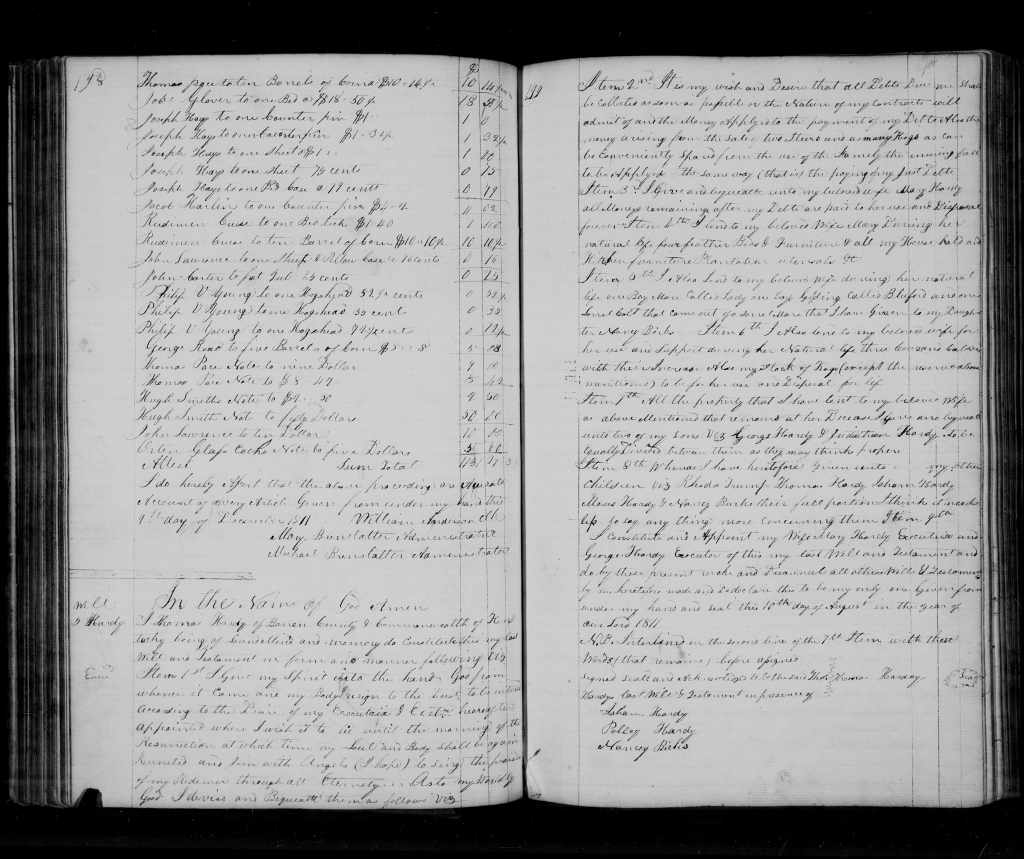
Thomas Hardy wrote his last will and testament in the summer of August 1811 and by the next spring (May 1812), it was probated in court:
To his wife, Mary, he lent “four feather beds and furniture, and all my household and kitchen furniture, plantation utensils, &c.” He also lent “one bay mare called Lady, one bay gelding called Bluford, and one sorrel cold that came out of the sorrel mare that I have given my daughter Nancy Burks”. He also lent her “three cows and calves with their increase; also stock of hogs (except the reserve for selling off to pay debts) to be for her use and disposal for life.”
At her decease, the property let to his wife was to be divided between his two sons: George and Jeduthun Hardy.
He mentioned that he had previously given to his other children: viz. Rhoda Trump, Thomas Hardy, Isham Hardy, Moses Hardy, Nancy Burks, their full portion.
The will was witnessed by his wife Polley (Mary) Hardy, and his children Isham Hardy and Nancy Burks.
familysearch.org
Land Transactions
In 1811, Thomas Hardy recorded four land transactions in Barren County, Kentucky, where he transferred 714 acres of land to four of his children near Big Blue Spring:
Geo Hardy, 200 acres (B:394)
Isham Hardy, 114 acres (B:395)
Nancy (Hardy) & Thomas Burks, 200 acres (B:420)
Jeduthun Hardy, 200 acres (B:421)
The lands were adjacent to each other as evidenced by the descriptions in the land records. From Geo Hardy’s Deed: “part of Marshall Cowen survey of the Big Blue Spring beginning at a sugartree Isham Hardy’s corner thence…to Nancy Burks thence…to Jeduthun Hardy thence….” (B:394)
Each of the tracts for 200 acres cost each child ten dollars and for the “love and regard” he had for the child named in the deed. Isham’s smaller 114 acres cost him two hundred dollars and no comment was made about love or esteem for him. Gifts for the other children named in the will (Rhoda Trump, Moses Hardy, Thomas Hardy) have not been located.
Three years prior, Thomas Hardy “of Barren County” purchased 1,000 acres from James Hughes “of Fayette County” for seven hundred pounds (C:15). The land was described as part of the “Marshall Cowen” survey and at the Blue Spring Grove in Barren County. The sale in 1811 left 286 acres in Thomas Hardy’s possession.
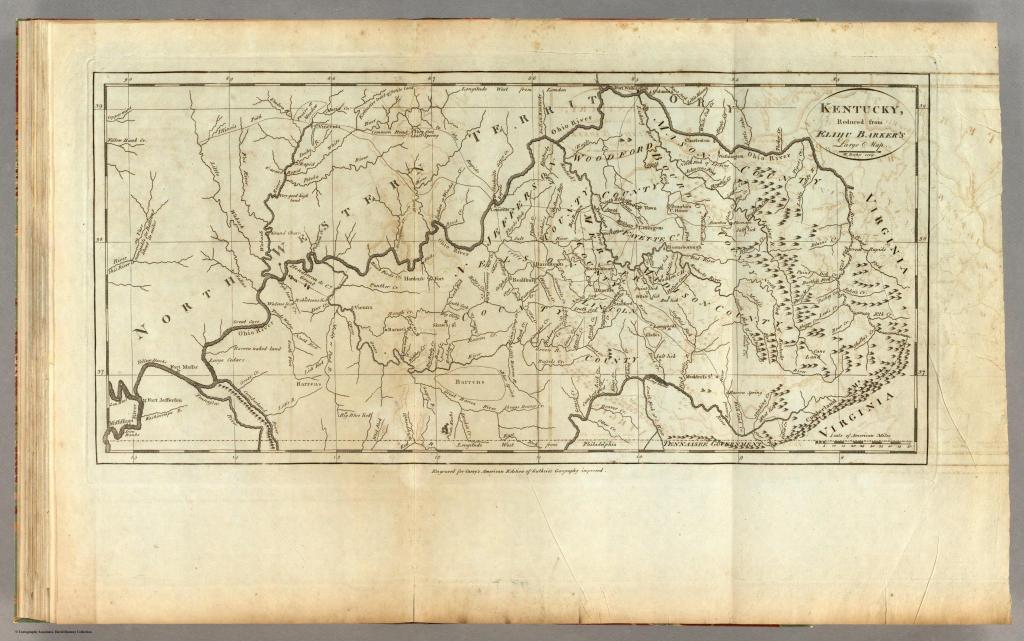
Barren County was named for the “Barrens” , a large tract of land “barren of timber”. John Filson written on his 1782 Map of Kentucky: “Here is an extensive Tract, call’d Green River Plains, which produces no timber, and but little water; mostly Fertile, and covered with excellent Grass and Herbage.” Carey’s 1795 map of Kentucky shows the Barrens and Blue Spring, where there was a grove of trees. This part of Kentucky had been held in reserve for Virginians who had access to military warrants. As Hardy purchased his land from Hughes, it is likely to be Hughes who had the military service.
1795 Carey Map of KentuckyDetail from the 1795 Map of Kentucky
Taxes
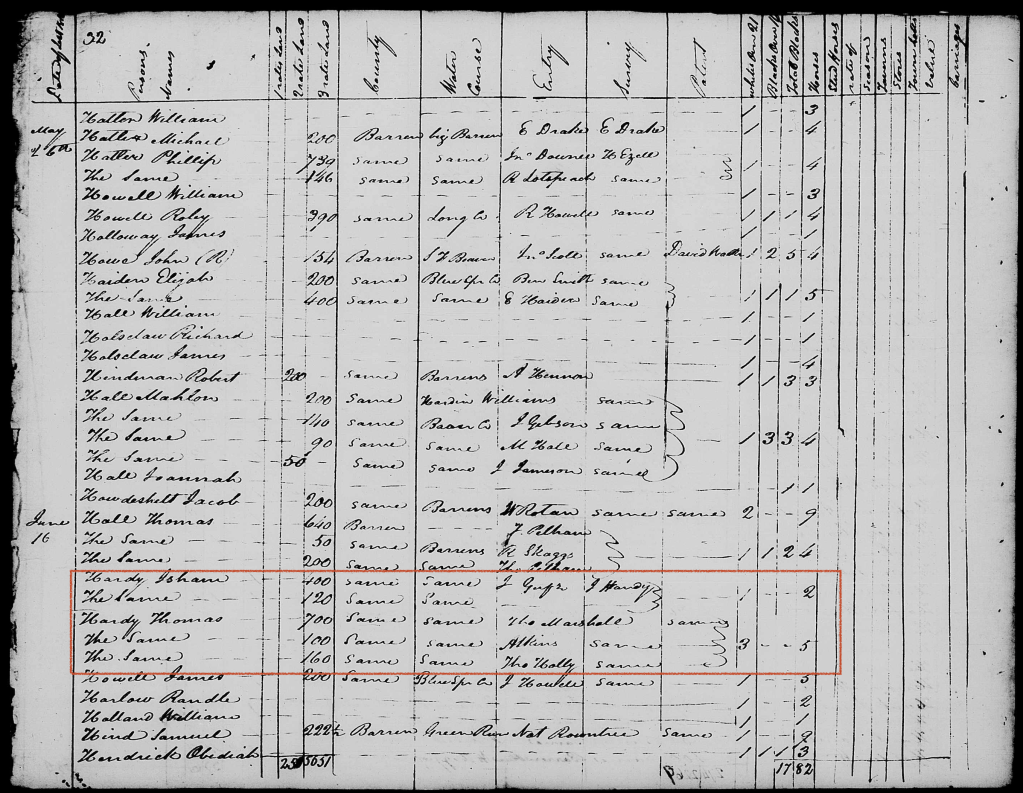
In 1809, Thomas Hardy is taxed for 700 acres, while his sons Jeduthun and George are listed near him. Isham is not listed.
1809 Barren County Tax List | familysearch.org
In 1810, Isham is listed with 500+ acres of land, while Thomas is listed with 800+, and three adult males in his household, suggesting he collapsed his sons (George and Jeduthun) into his household.
1810 Tax List for Barren County | familysearch.org
They were not listed in the 1808 tax lists, suggesting that Thomas purchased land very soon after their arrival in Barren County.
Both pension applications for Michael and Peter Fulp describe their participation in the 1776 Cherokee Expedition. The Cherokee Expedition was the combined efforts of militias from multiple colonies to exterminate the Cherokee and open up land for Euro-American settlers.
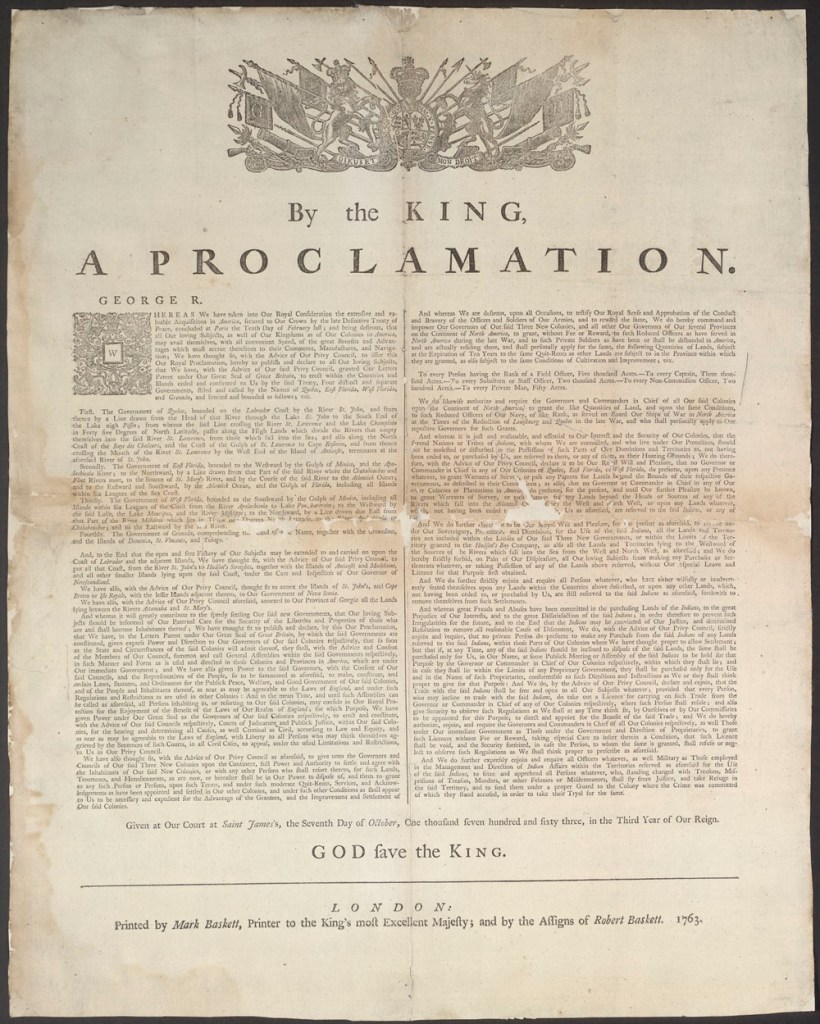
At the end of the Seven Years’ War (commonly known as the French and Indian War in the Americas), King George proclaimed the land west of the Appalachian Mountains as land reserved for Indian Nations and therefore off limits to Euro-Americans, upsetting settlers who sought land.
The Royal Proclamation of 1763, Library and Archives Canada | wikipedia.com
The Fulp family lived on the eastern side of the Blue Ridge Mountains and the Appalachian, near the line of demarcation made by the King. As settlers illegally crossed into the “Indian Reserve” established by King George, the tribes resisted their intrusions with raids on the Euro-American settlements. The settlers came indifferent to the fact that they were settling on the farming and hunting lands used by the Cherokee.
Euro-Americans had settled in the Watauga, Nolichucky, and Holston river valleys in the late 1760s and early 1770s, in defiance of the King’s Proclamation. Settlers in the Watauga river valley created their own government separate from the British Crown. The King and his officials considered the settlements illegal. As the British officials tried to uphold the agreement between the Crown and the Indian Nations and allowed the Indian Nations to remove illegal settlers, the settlers saw the British as encouraging warfare between the Indians and the colonists. The 1836 map of the area shows the conquest of the region by the Euro-Americans with counties like Servier and Carter named after the Euro-Americans who was instrumental in the creation of Watauga settlement.
Annotated excerpt from an 1836 Map of North Carolina | davidrumsey.com
With the onset of the American Revolution, this created two fronts for the militias in the western backcountry. The tribes across the mountains as one front, and the British army in the east as the other front. As a result, the colonial leaders sought to rid the western front of Indian tribes. Militias from Georgia, South Carolina, North Carolina and Virginia joined on a united expedition. Col. Joseph Williams, writing of the expedition in the 1820s and from the settler-colonial perspective, justified the expedition, giving as an example: “The people who had settled on the Watauga and Holstein Rivers were compelled to abandon their houses and plantations and to seek safety in their forts and garrison”. He omitted that from the American Indian perspective, “We never thought the white man would come across the mountains, but he has, and has settled on Cherokee land. He will not leave us but a small spot to stand on. Should we not therefore run all risks, and incur all consequences rather than submit to further laceration of our country?” Indeed, Dragging Canoe, one of the leaders for the Cherokee tribes, felt that the only way to save his people from oblivion was to fight the Euro-Americans, while other Cherokee leaders tried to trade and negotiate peace.
The 1776 Map of the British Southern Colonies reveals no drawn western border for North Carolina which appears with Virginia to extend indefinitely west. Indeed, the Virginian and Carolinian surveyors were squabbling over the border in the west, with settlers unsure if they were in Virginia or North Carolina. The lands of the Cherokee are marked on the map, showing what would be called the Over Hill Towns..
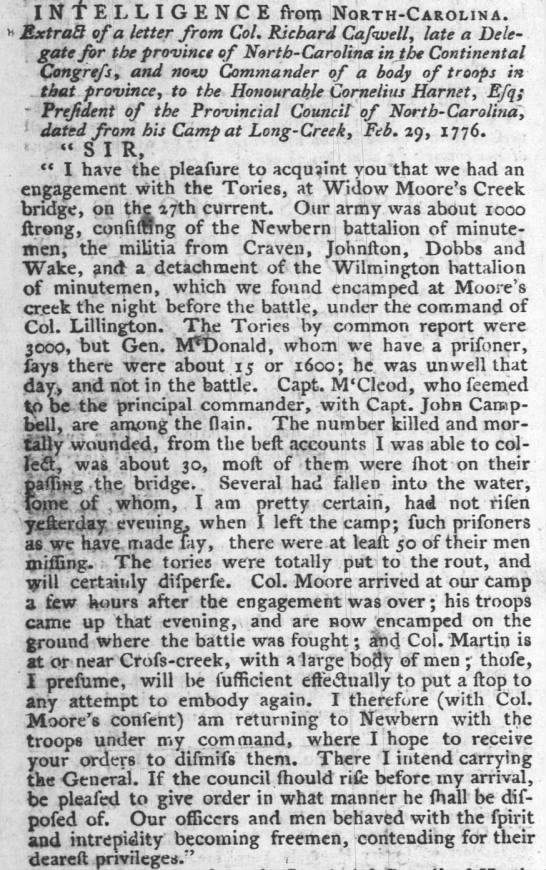
Richard Caswell, the colonial victor at the Battle of Moores Creek Bridge, and now the governor of the independent Carolina colony sent Col. Joseph Williams and others to support the expedition, among them Michael and Peter Fulp. A detailed description of the journey is outlined in both William’s memoir of the expedition as well in Michael Fulp’s application for a Revolutionary War petition.
Excerpt from 1776 British Map of the Southern Colonies | New York Public Library (A general map of the southern British colonies in America: comprehending North and South Carolina, Georgia, East and West Florida, with the neighbouring Indian countries, from the modern surveys of Engineer de Brahm, Capt. Collet, Mouzon, & others, and from the large hydrographical survey of the coasts of East and West Florida)
Williams, with his militia from Surry County, marched to join the Virginia militia. Both Williams and Michael Fulp recollect the start of the expedition. Williams wrote that it began in the month of September while Fulp does not recall the exact month, only that it was during “warm weather”. Both William and Fulp state that they marched to Flower Gap across the Blue Ridge Mountains. Williams wrote it as “Flour”, while Fulp’s application records it as “Flower Gap”. Today, there exists Flower Gap Road, immediately to the west of Cana, Virginia, just north of the Virginia/Carolina boundary, suggesting that the militia marched north and west from Surry County.
They crossed the New River, near Poplar Camp according to Fulp and at Herbert’s Ferry according to Williams, where they went to lead mines in Wythe County, Virginia. William Herbert, a Welshman, operated the lead mines, making shot, as well as the ferry on the New River. Apparently, Poplar Camp Creek Road led to Herbert’s Ferry.
On the other side of the river, they waited for a few days at Fort Chiswell before marching “slow marches” to the Long Island of the Holston River. Fort Chiswell was an outpost built during the Seven Years’ War at the junction of the Great Trading Path and the Richmond Road near New River. Long Island of the Holston river is located in what is modern-day Kingsport on the Holston River. The Long Island was a sacred council and treaty site for the Cherokee. And Euro-Americans had used it since the 1760s as a landmark for starting expeditions (e.g., Boone started clearing the Wilderness road from the Long Island in 1775; and the 1760s Timberlake Expedition used it as a starting place). The Long Island is likely what Fulp called the “Boat Yard” as it was a starting place for settlers moving west on the Tennessee River once the Revolution was over. Near here, the expedition built Fort Patrick Henry (name after the Virginia governor) and used it as a base for its forays into Cherokee Territory, suppressing resistance and eliminating food sources.
The march was slow for Euro-Americans who were traveling through a “wilderness” where there were “impenetrable” forests, with canes, bushes, brambles and briers. The Euro-American militias marched over 120 miles toward the Over Hill Towns of the Cherokee, coming to the French Broad River. Here, a Euro-American tried to negotiate peace on behalf of the Cherokee, however, the Col. Christian (the leader of the Virginia regiment, to whom Williams was joined) would not believe the treaty. Williams wrote, unironically, that “the answer [to consider peace] was dictated by a knowledge of the Indian character, and the insincerity of all their propositions of peace, unless when you have effected a complete conquest over them.” Williams, writing from the Euro-American perspective, failed to recognize how he and the others were protecting settlers who had ignored the terms of the Treaty of Paris and the Proclamation of 1763, and had invaded lands that were protected by a peace treaty.
Micheal Fulp wrote that they “marched in various directions till we reached home”. His description avoids detailing the scorched earth policy of the Euro-American militia which burned towns, crops, livestock and killed Cherokee people. Betsy Fulp, the wife of Peter Fulp, was succinct in her husband’s role in the expedition: “and the next service he entered a volunteer under the same Capt Goode in the summer of the same year 1776 and marched from Surry County aforesaid under Col. Williams and Major Winston to the Cherokee Nation of Indians and in which expedition he said he served four months.”
Both Peter and Michael Fulp died in Stokes County, North Carolina. Their children and grandchildren, however, migrated west into Claiborne County, Tennessee, past the Holston River.
Sources:
Williams, S. C. (1925). COL. JOSEPH WILLIAMS’ BATTALION IN CHRISTIAN’S CAMPAIGN. Tennessee Historical Magazine, 9(2), 102–114. http://www.jstor.org/stable/42637527
Georg Volpp had emigrated from the Rhinelands in the 1750s to escape perpetual war as the dynastic powers around him continued to march across the countryside. A generation later, the British Crown and its colonists were about to engage in war again. The backcountry of North Carolina, where Volpp settled, was also home to the Regulators who fought against the colonial government for excessive taxes and corrupt officials in the late 1760s and early 1770s. The Regulators would often pass through Wachovia, the Moravian Settlement that the Volpps settled near in the 1760s.
“In the years 1769, 1770 and 1771, there was great unrest in North and South Carolina among the common people. They thought, and sometimes not without reason, that the sheriffs, lawyers and court officers defrauded them, and did not do their duty; and as always and everywhere there were those who stirred up the mob, and added to their anger, so all kinds of base men gathered together in these Provinces, called themselves Regulators, and undertook to call the officers of the land to account, and to force them to redress all fancied or real injustice” — Bethabara diary from the Wachovia Settlement
In 1771, the governor of North Carolina defeated the Regulators at the Battle of Almance and many dispersed, some fleeing to Tennessee. Five years later, there would be another call to arms as conflict between the colonists and the British government came to a head with the start of the Revolutionary War.
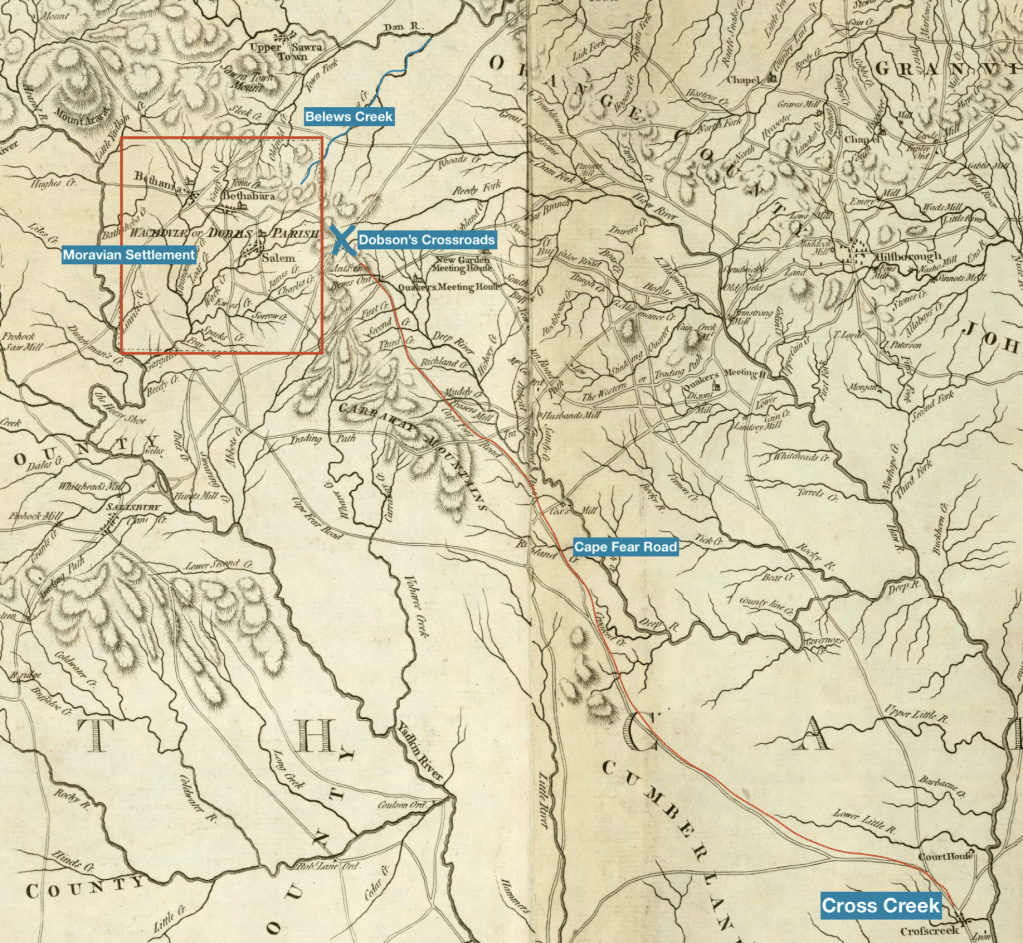
This time, the brothers Michael and Peter Fulp marched with the colonists against the crown. Peter joined first in the winter of 1776. A neighbor of Peter Fulp described Fulp’s departure as a “private horseman soldier” who rendezvoused at Dobson’s crossroads under Captain Goode from thence marched toward Fayettesville to set down the “Scotch Tories”.
Annotated Excerpt from the 1776 Mouzon and Jeffrys map of North and South Carolina | davidrumsey.com
The Fulps had land along the Belews Creek, outside of the Moravian settlement of Wachovia and Dobson’s Crossroads, where the militia rendezvoused, was just south of where they lived, along the Cape Fear Road leading to Cross Creek (modern-day Fayetteville) where the Battle of Moore’s Creek Bridge was fought. Fayetteville was officially established in 1783 by the incorporation of Cross Creek (a trading post) and Campbelltown and was renamed in honor of La Fayette, the Frenchman who supported the American Revolution.
In the north, the battles of Lexington and Concord had been fought in April 1775, and as word of the battle traveled south to the Carolinas, the political parties of the Whigs and Tories faced off in the colonial capital with the Royal Governor, Josiah Martin, suspending the assembly, and the Whigs organizing committees of safety. As Martin, the Royal Governor, struggled to maintain control over the politics, he sought military support from Britain and exploited the forced allegiances of the Highlanders who had settled the Cape Fear area. The Scottish Highlanders had come to Carolinas after the Jacobite risings of the early 18th century and had been forced to swear allegiances to the British Crown– the colonial government used these forced oaths to enlist their support. Proclamations were sent calling for “all the King’s loyal subjects… repair to the King’s Royal Standard, at Cross Creek… in order to join the King’s Army; otherwise, they must expect to fall under the melancholy consequences of a declared rebellion, and expose themselves to the just resentment of an injured, though gracious Sovereign.” The later recalling the “year of pillaging” that occurred after the failed Battle of Culloden when the King’s Army had ravaged the highlands of Scotland.
As Martin prepared for the arrival of British regulars, he sought the organization of loyalists in the colony, drawing heavily on the Highlanders. He intended to use the assembled forces to march on Wilmington and regain control of the colonial government, maintaining loyalty to the Crown. His forces were ultimately met at Moores Creek Bridge, where the colonial militias outflanked the Loyalists marching toward Wilmington. The various militias from at least five different counties were headed by Colonel Richard Caswell.
The militias blocked multiple roads leading across the rivers and creeks in the area, forcing the Loyalists to come to Moores Creek Bridge where they had built earthen works for their cannons. As the loyalists approached, the militia fired their cannons and muskets, defeating them. The Highlanders were said to have shouted “King George and broadswords!” as they made their way across the bridge. How and where the Goode’s Company, with Peter Fulp, participated in the Battle is not known. The Revolutionary Pension only states he was gone for three months as they went to Fayetteville. Three companies from Surry County participated in the battle.
The Pennsylvania Gazette | 7 Mar 1776, Wed • Page 3 | newspapers.com
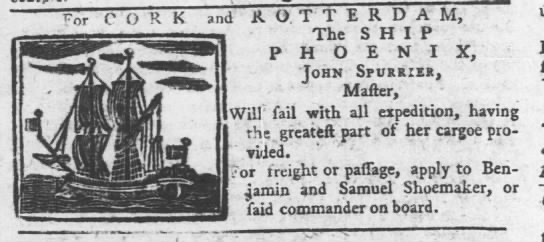
Georg Volpp arrived in Philadelphia in 1751 as part of a wave of German migration to the British Colonies. His ship, the Phoenix, sailed from Rotterdam via Portsmouth, to Philadelphia.
The Pennsylvania Gazette | 24 Oct 1751, Sun • Page 4
Flight
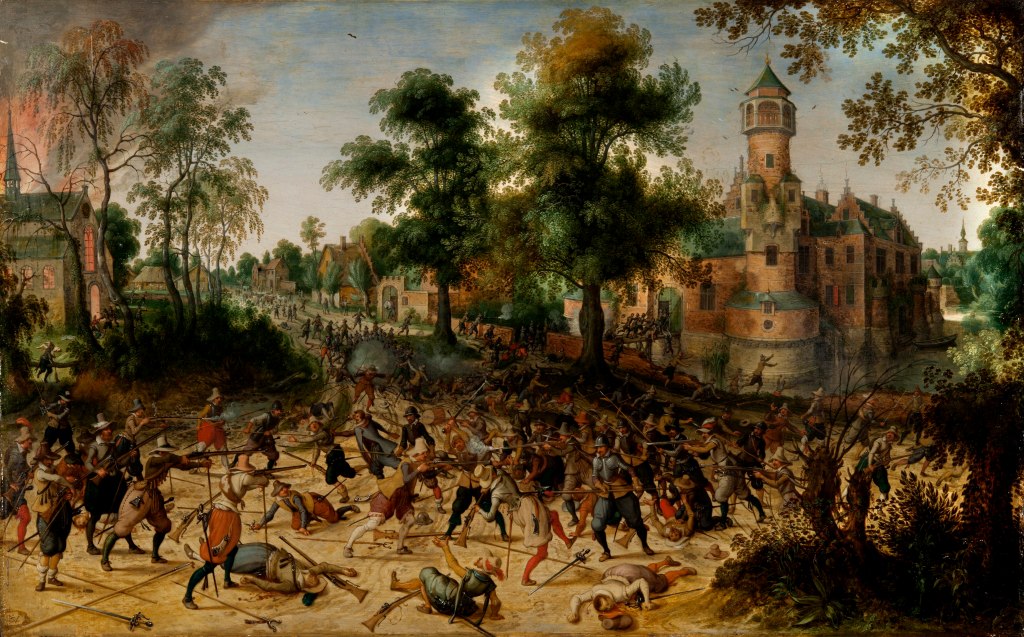
Religious wars had decimated the central Europe, with Catholic and Protestant forces battling for control. The aftereffects of the Thirty Years War was still reverberating through the communities, almost a century later. Some areas of the conflict experienced population declines of over 50% and the impact of destroyed lives and destroyed property brought famine and disease. And peace had not come with the Treaty of Westphalia as subsequent conflicts came.
Sack of a Town (Sebastiaen Vrancx) – Gothenburg Museum of Art | wikipedia.com
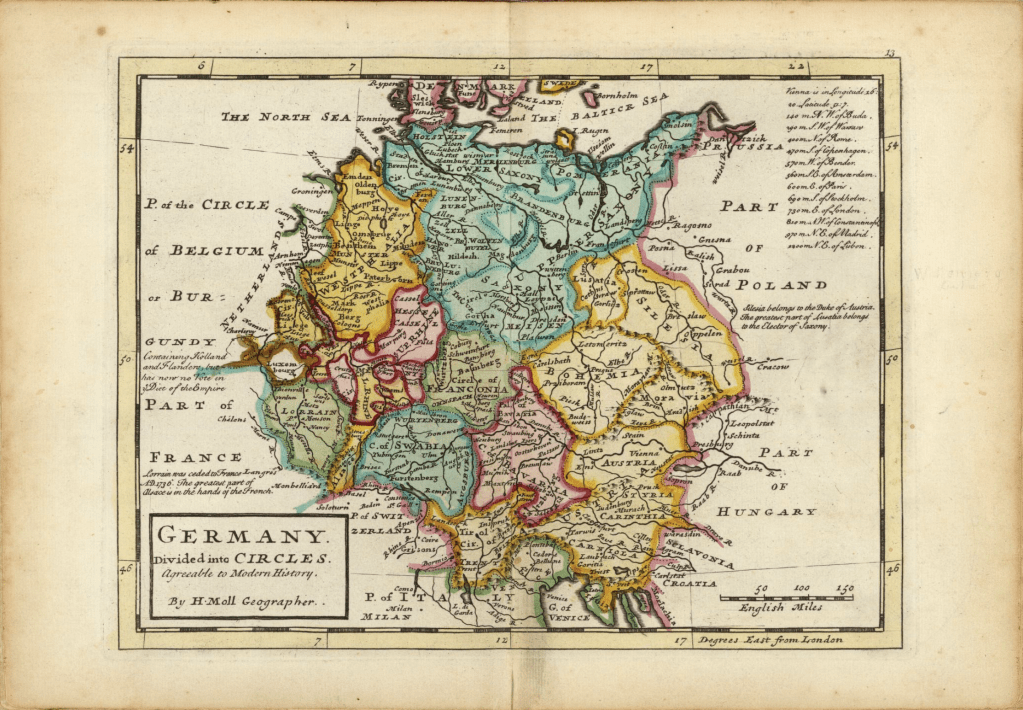
In the late 17th and early 18th century, the British government offered refugees opportunities in Britain, Ireland and the colony of New York. Additionally, in the late 17th Century, William Penn, the proprietor of Pennsylvania, traveled to the Rhineland to advertise his colony as a new world free from religious persecution. As a result, non-English speaking people from the continent began to immigrate to the colonies. Many coming from the southwest region of Germany, the areas known as the Rhineland, Palatinate, Wurtemberg, Baden, and German Switzerland. Many were tradesmen and artisans.
1736 Map of Germany by Herman Moll | davidrumsey.com
Georg Volpp’s arrival in 1751 corresponded with a peak in immigration of settlers from the Rhineland that occurred at the end of the War of Austrian Succession (1740-1748) in which European powers fought for dynastic control of the Hapsburg Empire, and another war where the armies marched across the countryside of Central Europe and the Rhinelands.
Louis-Nicolas Van Blarenberghe: The Battle of Fontenoy, 11th May 1745 | wikipedia.com
Oath
The Atlantic seaboard had been primarily colonized by agents of the British crown and were subject to the British Government. When Penn sailed to the Rhineland to advertise his proprietary colony as a haven from religious persecution, they followed him back. The influx of non-English speaking “foreigners” frightened the authorities and in 1727, began to require adult males to take oaths of allegiance.
“It’s requisite that in the first Place they should take the Oath of Allegiance, or some equivalent to it to his Majesty, and promise Fidelity to the Proprietor & obedience to our Established Constitution” — Patrick Gordon, Governor of Pennsylvania
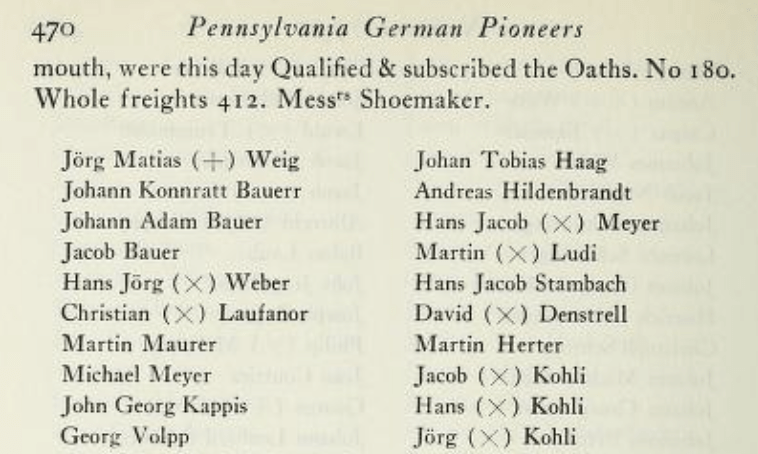
As a result, there are ship lists of “foreign” passengers arriving in the colonies. In 1751, Georg Volpp was recorded taking the oath of allegiance upon his arrival on the ship commanded by John Spurrier.
The Pennsylvania Gazette | 26 Sep 1751, Sun • Page 2 | newspapers.com
Pennsylvania German pioneers; a publication of the original lists of arrivals in the port of Philadelphia from 1727 to 1808
As they only listed the males who took the oath, we do not have direct record of whether or not Georg Volpp travelled with his family or if he travelled as a single man. There were no other adult males Volpps on the ship, suggesting that he and any family were the only of their direct kin group.


















 Finding the Yellow Bricks