Levi Garrison | Whiskey Rebellion

Levi Garrison moved from Cumberland County, New Jersey, to Wheatfield Township in Westmoreland County, Pennsylvania in the 1780s.

1792 Map of Pennsylvania by Reading Howell | davidrumsey.com

Westmoreland County was in Western Pennsylvania, on the western edge of the Allegheny Mountains. In the early decades of the nation, the county borders changed as newer counties were created when the populations grew. In the 1790s, most of the population of Pennsylvania lived east of the mountains. Today, the land that made up Wheatfield Township is part of Indiana County. It is situated in the Ligonier Valley and provided land for extensive grain farming.

Western Halves of 1792 and 1811 Map of Pennsylvania both by Reading Howell | davidrumsey.com

Garrison appears on the tax lists for Cumberland County throughout the 1770s and is suspended from the Presbyterian Church in 1782 for becoming a Methodist.

By 1786, Levi Garrison appears on the Pennsylvania Septennial Census for Wheatfield Township.
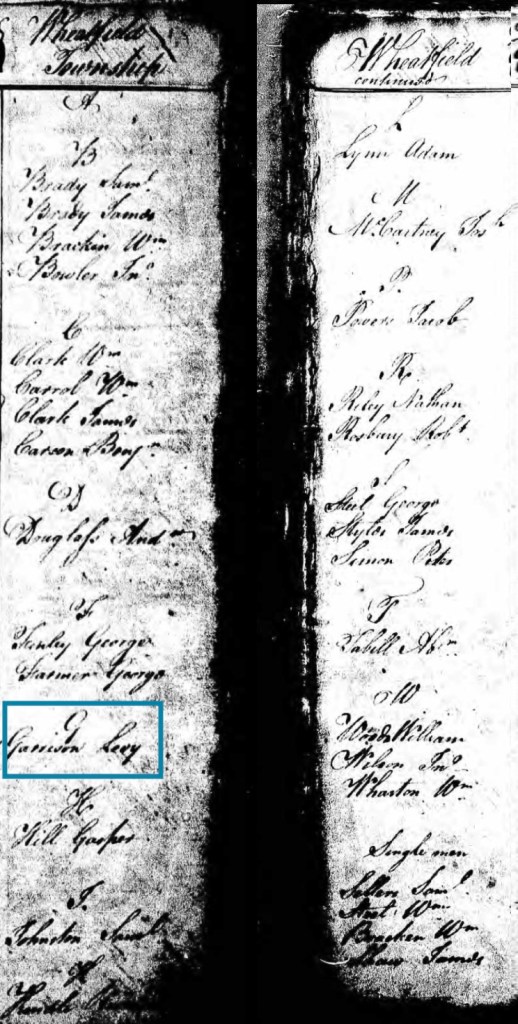
1786 PA Septennial Census | ancestry.com

He appeared on the tax lists for the late 1780s. He had some land, some livestock and his property was usually valued in the middle to high range.

Category1786 Tax List1787 Tax List1789 Tax List
Land300 Deed300 Improvements200 Warrant
Horses232
Cows133
Value£136£65£41
Tax Lists | ancestry.com

Two facts suggests that Levi Garrison was a farmer. First, the majority of the population west of the Allegheny Mountains were farmers and he continued to acquire cows, likely used by him and his sons to plow the land and grow the wheat that his township was named for.

Whiskey Rebellion | 1791-1794

Sale of the wheat was not profitable if sold locally. However, converting the grain to whiskey and transporting east was more profitable because the distillery grain weighed less, took up less space and didn’t spoil. Additionally, as there was little cash in the western frontier, the whiskey was used as a currency. Western Pennsylvania produced 25% of the countries whiskey.

Therefore, when the federal government chose to issue an excise tax on whiskey in 1791 to pay for debts incurred during the Revolution ($25 million) and founding of the new nation, the farmers of western Pennsylvanian were angry.

1791 Sketch | wikimedia commons

The farmers of Western Pennsylvania took exception for multiple reasons. First, it was like taxing money itself, as the product was often used in lieu of cash. Second, because cash was rare, it was difficult to pay the tax as it was required to pay the tax in cash. Third, the tax was the same for both large and small distillers, meaning that small distillers had more of tax burden than larger distillers, and finally as the whiskey distillers were concentrated in Western Pennsylvania, one region was footing the repayment of the nation’s debts.

As a result, the farmers of Western Pennsylvania resisted the federal tax and harassed the local excise men, tarring and feathering like the colonists had done to British tax men.
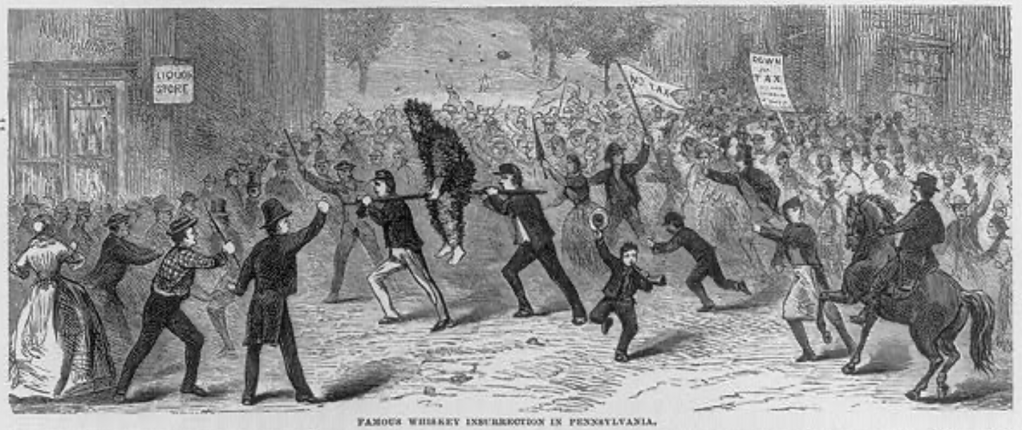
Famous Whiskey Insurrection in Pennsylvania. , 1794. Photograph. | loc.gov

The rebellion came to a head in 1794, when thousands of militiamen from Washington County, Fayette County, Allegheny and Fayette County came to Braddock’s field to openly rebel against the tax. Moderates were able to pacify the militia men, and even as Washington was leading troops to Western Pennsylvania, a battle was averted and the insurrection quelled.

Braddock’s Battlefield. , ca. 1908. Nov. 23. Photograph | loc.gov

Many of those participated in the rebellion moved west to avoid arrest.

It is unclear what role Levi Garrison played in the Whiskey Rebellion. From his tax lists, he had land and a sizable farm, suggesting that he had enough whiskey production that the tax’s burden was not a huge as it was on smaller distillers. Many of the militiamen were said to be landless and small distillers, and that larger landowners were moderates.

That said, in the 1790s, Garrison left Western Pennsylvania and moved to the Symmes Purchase in Ohio in 1798. Levi Garrison is in Hamilton County, Ohio in 1799, suggesting he was living in Pennsylvania in 1794. However, that would have been 4-5 years after the rebellion was squashed, suggesting he did not see the need to leave immediately.

Levi Garrison | Convert to Methodism

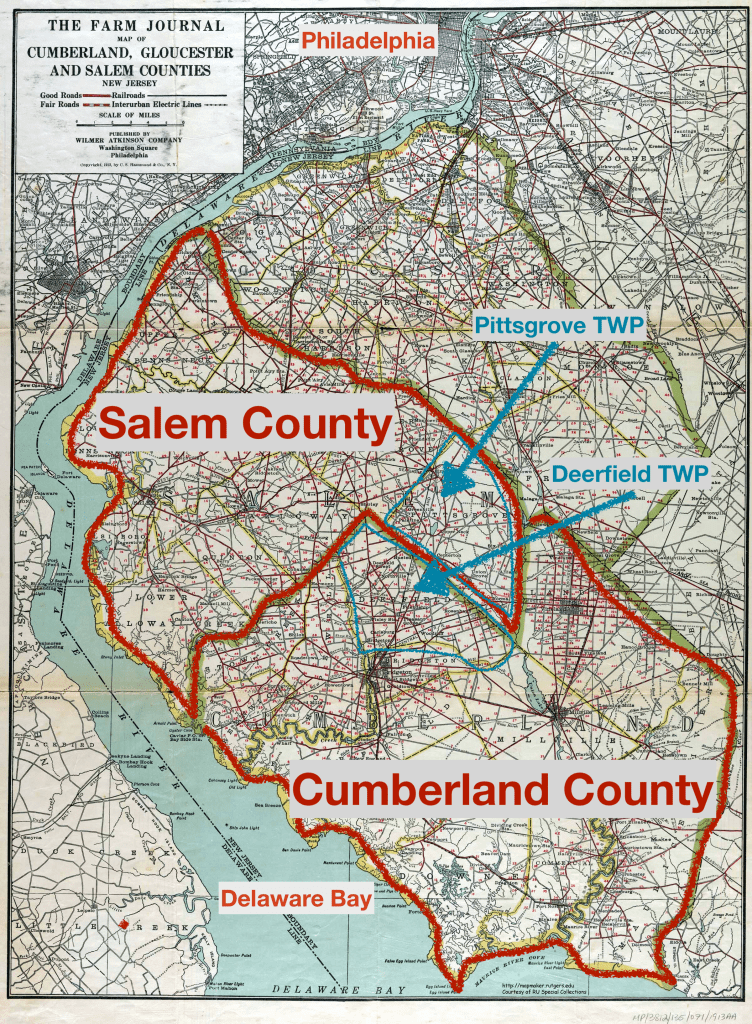
Levi Garrison is said to have been born in 1743 in the colony of New Jersey. Living in southern New Jersey, he grew up in Salem County and resided in Cumberland County during the Revolutionary War. Both Salem and Cumberland County border the Delaware Bay. The two townships, Pittsgrove and Deerfield border each other, and it is possible the borders shifted over time.

After the War, Levi Garrison migrated west, through Pennsylvania to what would become Cincinnati, OH, to Indiana.

Prior to his migration west, Levi was expelled from the Presbyterian Church in Deerfield, Cumberland, NJ for “adhering to the Methodists”. He was suspended from the Presbyterian Church on 11 March 1782.

1913 Map of Salem and Cumberland County [annotations mine] | Rutgers Special Collections

The earliest European settler colonists were Swedes and Dutch. In the late 1600s, William Penn and other English settler colonists began to settle in and around Philadelphia. The English crown granted large land patents and the English began to “purchase” lands from the Indigenous tribes, effectively removing them from their lands. A John Garrison is recorded in 1697 as settling on a land tract called “Coffin Point” near Muddy Branch (near Bridgeton), the he built a house of cedar logs. In 1794, a John Ambler bequeathed “8 acres purchased of Levi Garrison and a piece of cedar swamp on Pond Muddy Run” to his sons. While the relationship between the two have yet to be determined, this suggests a geographical connection between the individuals.

Presbyterian in Deerfield

The upper part of Deerfield, and other townships along the Cohansey River, was said to be settled by Presbyterians. The English settler colonists were organizing churches “as early as 1732”. An Abraham Garrison (relation to Levi not determined, though possibly his father, based on a 1766 will), granted land to the Presbyterians to build their first log meeting house.

Presbyterians were likely from New York and New England, breaking away from the Puritans of Massachusetts Bay Colony. Puritans believed that church membership was limited to “saints” and each congregation had its own authority. While both Puritans and Presbyterians were Calvinistic in believe, Presbyterians, on the other hand, believed in the unity of the church, including more than “saints” into its church membership and believed that the congregations worked together as a whole.

On 27 Sept 1771, Rhoda, the daughter of Levi Garrison, was baptized by the Reverend Enoch Green in the Presbyterian Church in Deerfield. In April 1774, Reverend Enoch Green recorded the death of a child of Levi Garrison. In March 1775, he recorded the death of another child of Levi Garrison as well as the deaths of Abraham Garrison and John Garrison (unknown relations). On 14 Jan 1776, Levi (II), son of Levi Garrison was baptized. Enoch Green was the pastor of the Deerfield Presbyterian Church from 1767 until 1776, when he died.

Adhere to the Methodism

In 1782, Levi Garrison was dismissed from the Presbyterian Church for adhering to Methodism. In the 1700s, Methodism was a new religion. Its founder, John Wesley, began his preaching career in 1735. He inspired other Euro-American preachers, including George Whitefield. By 1769, itinerate Methodist preachers were in Middle American. Wesley and his preachers were critical of colonists resistance to the Crown and its policies and engaged in missionary preaching to those on the margins of Euro-American colonial society: women, African slaves, and American Indian tribes, as well as Euro-American males who were in the lower middle-class. The History of Cumberland County describes an early convert:

He was a good specimen of an old-fashioned Methodist. An illiterate man, knowing very little bit what he learned from the Bible, and his own experience as a Christian, of good practical sense in all matters not too much influenced by his prejudices, an earnest exhorter, and maintaining a character above suspicion

page 115

As part of the Great Awakening, Methodism in the 1700s had a wide and inclusive membership and encouraged “religious experience”– “emotions and enthusiastic responses to evangelical preaching were increasingly accepted”. Its itinerant preachers first found great success in the Middle Atlantic colonies, where religious pluralism was accepted and a part of life.

Benjamin Abbott of Pittsgrove Township converted in 1772 and worked with another resident to establish a society. His work within his community to spread Methodism allowed it to spread into Cumberland County soon after. Abbott was a “reformed drunkard” and upon his conversion to Methodism became an “inflammatory” preacher whose sermons would cast a spell and cause listeners to fall to the floor.

The church record lists at least twelve people who adhered to the Methodists. In Dec 1781, John Ambler, Levi Riley, Sarah Stratton and a scratched out name were listed. In March 1782, Levi Garrison with Priscilla Tarble were listed. Then updated, Fithian Stratton, Abraham Tarble, Sarah Foster, Phebe Swain, Benjamin Kenard were listed.

John Ambler

The name John Ambler likely represented multiple generations of the Ambler Family, who were connected with the Garrisons as neighbors and friends. In 1765, a John Ambler witnessed the will of Abraham Garrison, a yeoman of Deerfield Cumberland County; Abraham bequeathed land on the east side of the Burlington Road to his son, Levi. Fithian Stratton was named executor; his name also appears along those who adhered to Methodism. In 1766, John Ambler along with Daniel Garrison made an inventory of Garrison’s estate. A John Ambler also mentioned 8 acres that he had purchased of Levi Garrison in his own will thirty years later, in 1796, suggesting that this was a son of the John Ambler mentioned in 1766.

In 1799, a John Ambler filed a complaint on behalf of a Johnathan and Lewis Garrison. Lewis Garrison was studying medicine under the auspices of a Joseph Brewster, and Ambler and the Garrisons contended that Brewster was not upholding his contract and had failed in his duties as teacher. The Presbyterian Church in Deerfield held the meeting to discuss the charges.

Migration West

Shortly after his conversion to Methodism, Garrison moved his family west. First to Westmoreland County, Pennsylvania, outside of Pittsburg. Then to the Northwest Territory near what is now Cincinnati. Finally, across the Indiana border into Dearborn County.

Sources:

“How American was Early American Methodism” accessed from princeton.edu

Elmer, L. Q. C. (2020). History of the Early Settlement and Progress: Of Cumberland County, New Jersey: and of the currency of this and adjoining colonies.

“History & Cemetery” of Deerfield Presbyterian Church accessed from deerfieldpres.org

“Religion” from Historic Themes and Resources within the
New Jersey Coastal Heritage Trail Route accessed from nps.gov

Honeyman, A. V. D. (1997). Calendar of New Jersey wills: Volume IV. Westminster, Md: Family Line Publications. accessed from donquigley.net

Transactions of the Medical Society of New Jersey. (1871). United States: The Society. accessed from Google Books

Cader Edwards | Battle of Kings Mountain

Cader Edwards, b 1705 in Wales, was a sea captain who settled on the Tennessee/North Carolina frontier in the 1770s. Despite his frontier residence, he “kept in touch with the outside world to some extent, and was generally well posted in regard to the various political developments, both in the colonies and the mother country, which preceded the Revolution.” (p.13) He subscribed to newspapers from Philadelphia, Baltimore, and Williamsburg.

Edwards was “an ardent patriot and a supporter of the colonies against the mother country”. When the Revolution first started, he rode to Williamsburg to offer his services and refused on account of his age. “Like many others, and at the beginning of all wars it is the same, he thought that the struggle would be over in a short time, before his boys would be of military age, but it lasted until three of them were sold enough to serve against Cornwallis in the Carolinas, and were present at King’s Mountain, at the Cowpens and at the siege of Yorktown.” (p. 14)


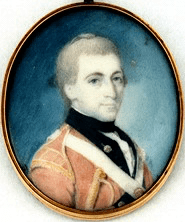
Patrick Ferguson

Scottish officer in the British Army sent to the Carolinas to recruit Loyalists.

The southern colonies were thought to have a considerable Loyalists population, and Ferguson was sent out by Cornwallis to recruit them to the British Army while intimidating the colonists who supported Independence.

In Sept 1780, Ferguson sent out a message from his camp “to the officers on the Western Waters” that if they did not “desist from their opposition to the British Army, and take protection under his standard, he would march his army over the mountains, hang their leaders, and lay their country waste with fire and sword”.

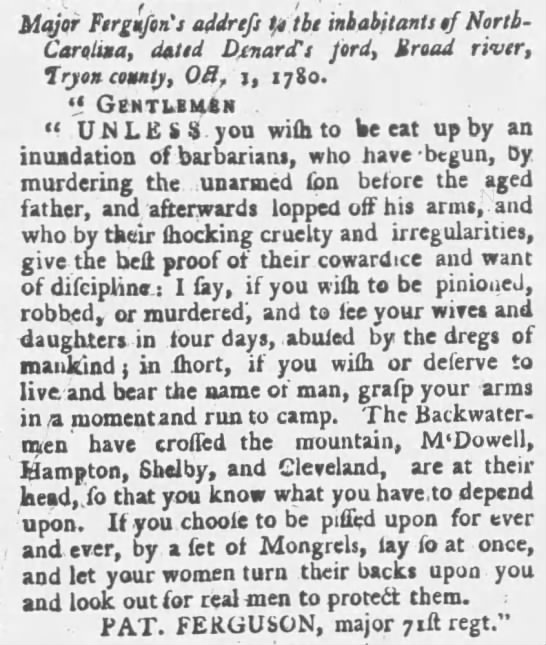
Below is an address by Ferguson to the inhabitants of North Carolina on 1 Oct 1780, a week prior to the Battle of Kings Mountain. Denard’s Ford was near Gilbert Town, where Ferguson was stationed before he marched to King’s Mountain.

24 Nov 1780 | Maryland Gazette | newspapers.com

Unless you wish to be eat up by an inundation of barbarians, who have begun, by murdering the unarmed son before the aged father, and afterward lopped off his arms, and who by their shocking cruelty and irregularities, give the best proof of their cowardice and want of discipline: I say, if you wish to be pinioned, robbed and murdered, and to see your wives and daughters in four days abused by the dregs of mankind in short, if you wish or deserve to live and bear the name of man, grasp you arms in a moment and run to camp. The Backwatermen have crossed the mounts, McDowell, Hampton, Shelby, and Cleveland, are at their head so that you know what you have to depend upon. If you choose to be pissed upon for ever and ever, by a set of Mongrels, say so at once, and let your women turn their backs upon you and look out for real men to protect them.

Battle of Kings Mountain

The Battle of Kings Mountain is unique in that the battle was between the formal British Army and a loose confederacy of 1,000 militiamen who came from “over the mountains”. Among them were 240 militia men under the leadership of Isaac Shelby, among whom rode Cader Edwards, his two sons and his son-in-law. They joined the militia raised by Shelby at Sycamore Shoals of the Watuaga, along with militias raised from Washington County, Virginia, as well as Washington, Burke, and Rutherford Counties, North Carolina. They were later joined with militia from Wilkes and Surry Counties, North Carolina.

These men were frontier Euro-Americans who showed up with their hunting gear: leather pants, moccasins, white shirt and rifles. They had settled in the 1760s and 1770s on the western side of the mountains, which meant they had invaded territory that the British considered to be off-limits for Euro-Americans, having made treaties with the Indigenous tribes. Like the Edwards Family, many were not English settlers, rather Irish and Scottish settlers. Some had fought against the English in the Jacobite rebellion or their fathers had. Most of their time leading up to the Battle of Kings Mountain had been spent fighting tribes who had allied with the British against the settlers.

When Ferguson sent out his call to lay waste to those across the mountains, militias from both sides of the mountains reacted quickly, forming the 1,000 men strong militia and marched to Ferguson. Upon hearing that the Backwatermen were coming, Ferguson began to march toward Cornwallis, to rejoin the troops, and yet he stopped when he reached Kings Mountain (a hill with a plateau top). There he stationed his men on top of the plateau and thinking he has a strategic defensive position, allowed himself and his men to be surrounded by the militia. He and his army was shot. Ferguson and 120 of his men died and the rest wounded and/or captured.

Due to his age, Cader Edwards acted as a volunteer aide for Shelby.

He had the best horse in the little army, and he managed to be of much service, though no duty was required of him except such as he volunteered to perform; and it was said afterward by Colonel Shelby and the other officers, that the presence among the men of the old white headed sailor; his well known exalted patriotism; his silent and cheerful endurance, without complaint of fatigue, rain, cold and hunger, and his constant exhortations around the camp fires to the young men to stand up like men, and never to turn back until Ferguson’s army was overtaken and utterly destroyed was worth more to the expedition than would have been the services of quite a number of able bodied men. (p. 17)

While marching to Kings Mountain, Cader Edwards was struck by a limb. The night before the battle was described as “dark and rainy”. The limb struck him as he was riding his horse at daybreak, and he fell from the horse to the ground, where he struck a small log. He was helped back on his horse, and the continued to take part in the battle. However, the injury was severe, became infected. Upon his return to home (200 miles across the mountains) after the battle, he took to his bed. His injury in his side never fully healed.

Source:

Edwards, C., & Gorin, S. K. L. (1997). The Edwards family of Barren County, Kentucky: History and traditions. Glasgow, KY: Gorin Genealogical Pub.

Joseph Bateman | Vermont

In Joseph Bateman’s 1832 Revolutionary War Pension Application, Bateman stated that he “came to Vermont about 40 years ago + he lived in Middletown, Poultney, + Rutland. He now lives in the latter place where he has lived about twelve years. He is known to Rev. W. Walker, Proctor + Rice, clergyman, and to most inhabitants of Mill Village.”

1823 Map of Vermont by Fielding Lucas, Jr. | davidrumsey.com
Rutland County is circled

Middletown, Poultney and Rutand are all smaller communities within the county of Rutland, in Vermont. The county is along the border of New York and near Fort Ticonderoga and Fort George.

Excerpt from 1823 Map of Rutland County

Joseph Bateman is listed in the 1790 Census for Middletown along with Eleazer Bateman. He had 8 members in his household, suggesting that he and his wife had had 6 children by 1790: one son and five daughters.

By the 1800 Census, which has detailed age brackets, his household had 12 members.

Age BracketFemaleMale
26-4411
16-2510
10-1521
Under 1014

He had four children living with him in 1800 that would have been born in 1790, suggesting that either two daughters died, or they had married and left his household. His wife gave birth to five additional children between 1790-1800.

By 1810, he had left Middletown and moved to Poultney. There, he is living with wife, and three children. 2 sons and 1 daughter. He is listed as over 45, suggesting that in 1810, he was closer to 44 than 26.

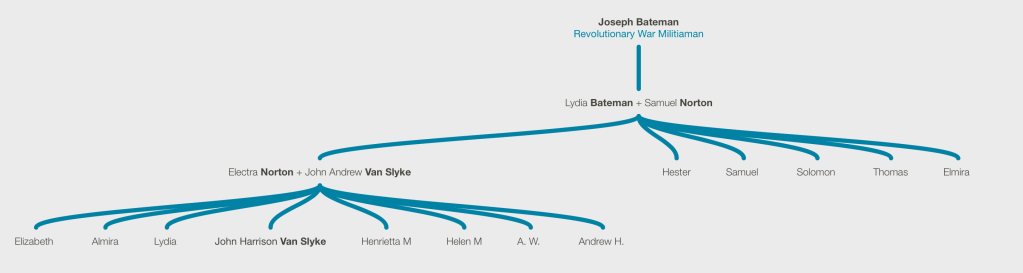
By 1820, he is listed in Rutland, and is listed without other family, although in 1830 he is listed with his wife and an adult child. His daughter, Lydia Bateman, had married Samuel Norton and migrated to Illinois.

The 1823 map of Rutland County shows the settlement in Rutland (City) without corresponding towns in Poultney and Middletown. This suggests that the villages were much smaller. In 1824 & 1833, the post office advertised a letter for him among other residents.

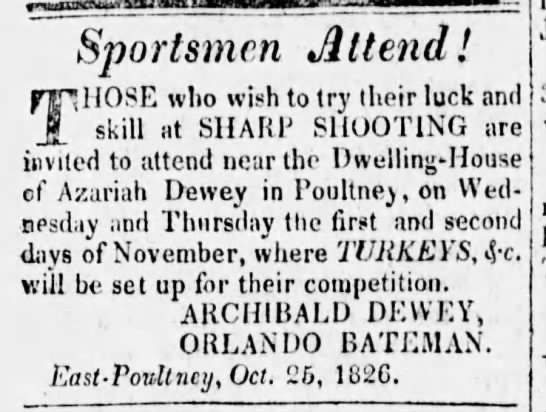
Orlando Bateman ran this ad in the 25 Oct 1826 Northern Spectator, published in Poultney, where Joseph Bateman lived prior to moving to Rutland (city). It is possible that Orlando is one of his sons, or possibly a child of Eleazer Bateman, Joseph’s neighbor in 1790.

Joseph Bateman’s pension application makes reference to Mill Village which encompassed a saw and grist mill. Joshua Reynolds built the mills in the 1770s on East Creek north of Rutland City. A settlement grew around the mills which was called Mill Village.

Rutland County Herald

Bateman’s pension application records that he was born in Killingly, Connecticut, a town in eastern Connecticut which was also a mill town.

Rev. Hadley Proctor witnessed his affidavit that he had served in the Revolutionary War. In Feb 1830, the Rutland Weekly Herald ran the Town and Village Record, showing that Rev. Hadley Proctor was the clergyman for the Baptist church. Charles Walker was the clergyman for the Congregational Church. Rev. Proctor also served as president and Rev. Walker as Vice President of the the Rutland Temperance Society. Both men also served on the Superintendent Committee of Schools.

Joseph Bateman | Revolutionary War

Abbreviated Family Branch for Joseph Bateman

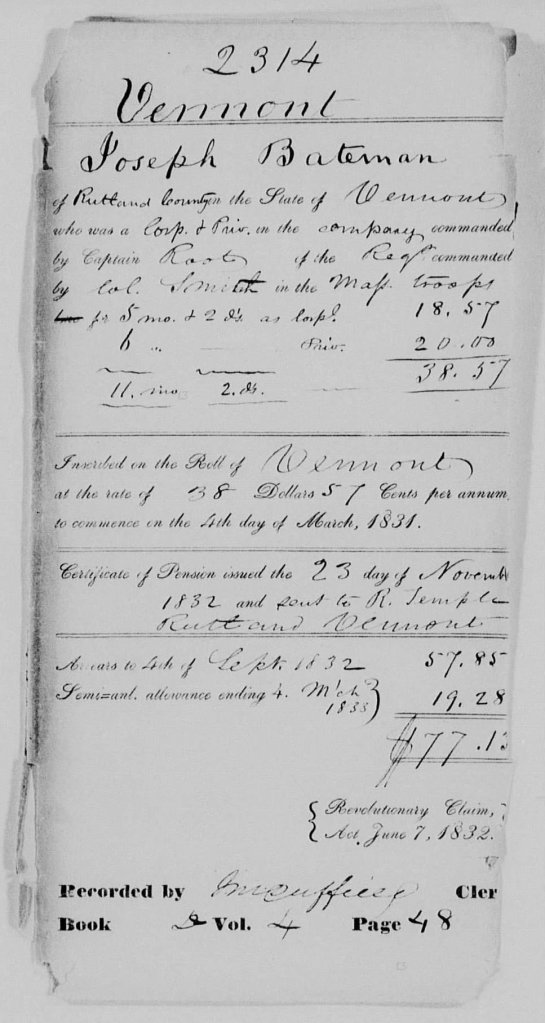
In 1832, living in Rutland County, Vermont, Joseph Bateman applied for a Revolutionary War Pension based on his service in the Massachusetts Militia as a private and a corporal. He served almost a full year in the war, the first six months as a private, the remaining five months and a quarter as a corporal.

Joseph Bateman | fold3.com

In 1776, Bateman was living in Hancock, Massachusetts. He enlisted and marched to “the city of New York where he was when Independence was declared. He was at N. York when it was captured by the British and retreated to Harlem Heights and was discharged at Croton Bridge.”

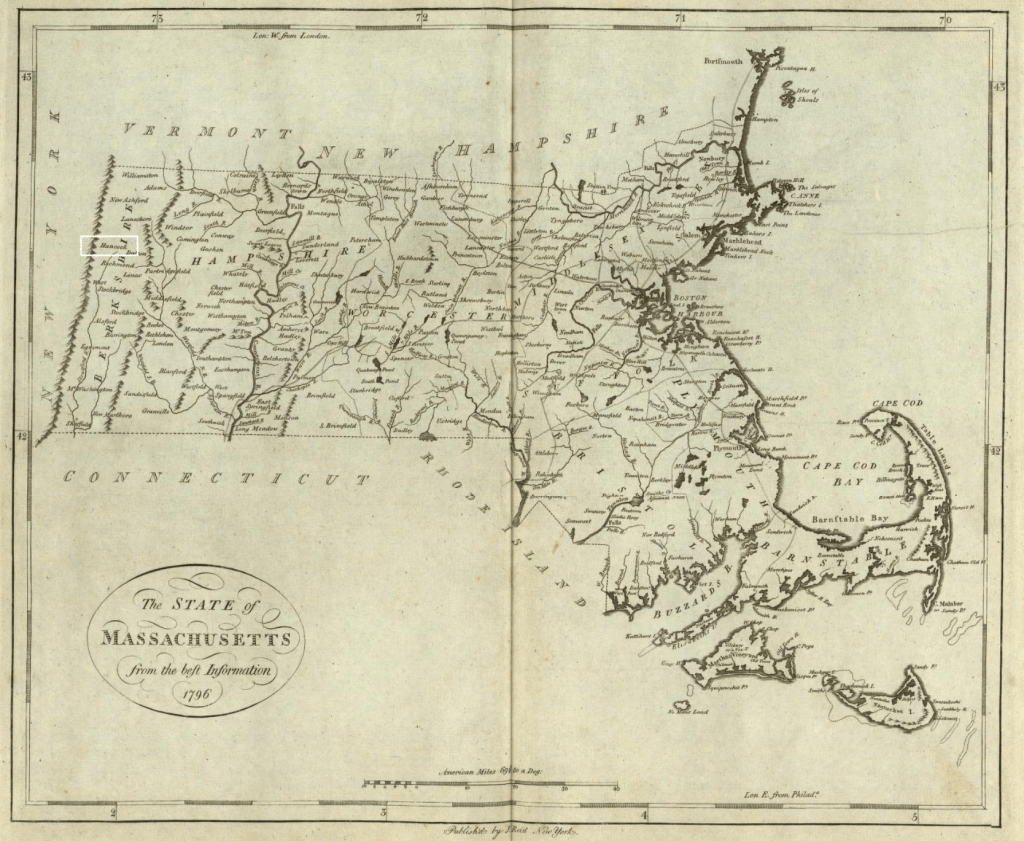
His pension application includes an affidavit from Zadock Bateman who states that he was living at his father’s residence in “the Town of Hancock in the County of Berkshire”. Hancock, Massachusetts is in the western part of the colony, near the New York Colony border. After the Revolutionary War, several families living in and around Hancock converted to the Shaker religion and it became a Shaker community. It does not appear that Bateman was living there at that time.

State of Massachusetts | 1796 | davidrumsey.com

The British captured New York City in late August 1776 and occupied the city for the next seven years. Zadock Bateman’s affidavit details that “when the British Army took possession of New York, said Joseph was on guard and was compelled to escape in such haste when the guard was taken off by Gen Putnam that he abandoned his pack … his Father on that news went immediately to the Army to carry him another change of clothing.”

“The British Fleet in the lower bay” depicts the invasion fleet under Admiral Howe assembling in lower New York Harbor off the coast of Staten Island in the summer of 1776, in preparation for the Battle of Long Island from Harper’s Magazine, 1876 | wikipedia.com
1951 Stamp | Bureau of Engraving and Printing | wikipedia.com

September 1776 | Battle of Harlem Heights

Washington withdrew his troops from Long Island at the end of August and gathered them in Manhattan. By mid-September, the British again attacked the gathered troops on the eastern short of Manhattan along the East River. The arrival of British troops caused the Americans to flee. Despite the initial chaos, the battle was a victory for Washington and revived morale in colonists.

1897 Textbook rendition of the Battle of Harlem Heights; Johnston Henry Phelps | wikipedia.com

White Plains

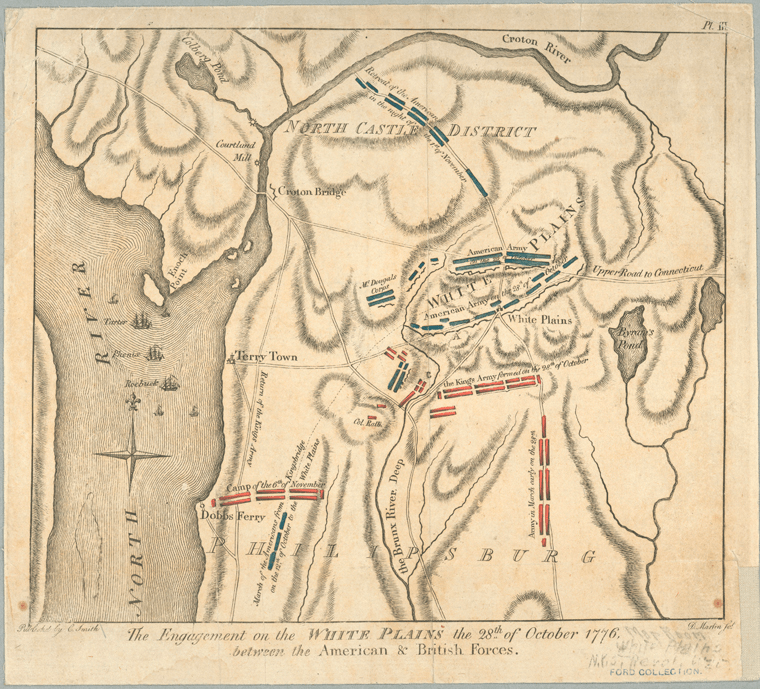
After the Battle of Harlem Heights, Washington took his troops north of New York into Westchester County and to White Plains. Here, near the Croton River, Bateman was discharged from his first round of service in the war.

1796 Map of Battle of White Plains | wikipedia.com

After his first discharge from the Massachusetts Militia, he joined the Army again as a “regular” and served at Albany and in Vermont, where he would settle after the war.

Jonathan Walden | Brother, Lewis

Jonathan Walden’s obituary states that his parents died when he was young and he converted to the Baptist faith, shortly before moving to Ohio. It gives no other indication to his family.

The earliest records located for Jonathan show that he married Sarah Millikin in Jackson County, Ohio in 1832 (Ohio, County Marriage Records, 1774-1993 | ancestry.com) and that he lived in Liberty Township, Jackson County, Ohio with his wife and five children in 1840 (1840 census | ancestry.com).

Records for Lewis Walden

Also living in Liberty Township, is Lewis Walden. He is roughly the same age as Jonathan, with his age recorded in the census in the same age bracket: 40-49. His household appears to contain two family groups. He is living near John Milligan, the brother-in-law of Jonathan Walden.

Age RangeFemaleMale
40-4911
30-3901
5-92
under 51
1840 Census Age Ranges | ancestry.com

The similar age bracket and geographical proximity suggests the likelihood that Lewis Walden is the brother of Jonathan.

In 1850, Lewis has 100 acres (US Non Population Schedule) and the farm is valued at $1200. He has two horses, five milk cows, six other cattle, 24 sheep, and ten pigs. He also has a sizable amount of butter and wool. He is living with his wife, Mary A Walden and James McCormic (age 20), who is most likely one of the males listed in the 1840 census. He is listed as a teacher who was born in Ohio. Lewis Walden, like Jonathan, was born in Virginia, supporting the theory that Lewis came with Jonathan from Campbell County, Virginia.

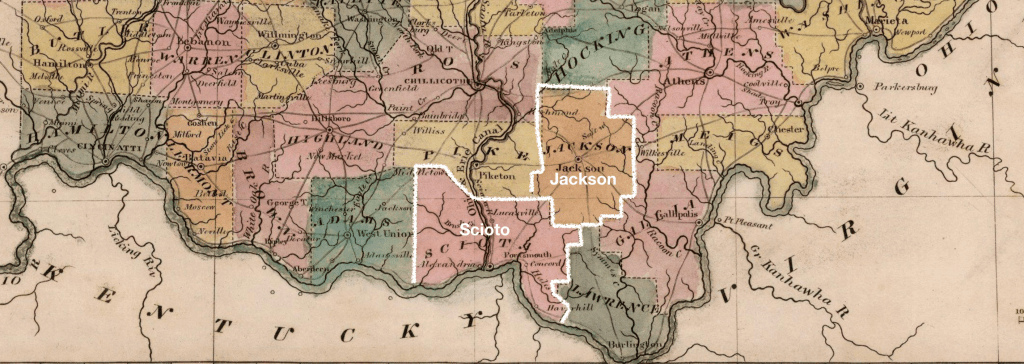
Annotated excerpt showing southern Ohio | 1831 David Burr Map of Ohio | davidrumsey.com

Lewis married Mary McCormic in Scioto County, Ohio, in 1834. This suggests that the 30-39 male in the household was a relative of Mary rather than Lewis, and that James was the son of the relative.

Will of Lewis Walden

Lewis D. Walden died in 1870 and he left a will in which he bequeathed multiple items to his extended family: [the will has two Item 4s, so the numbering is off from the will]

  1. Lewis D. McCormick, son of James McCormick, grandson of my wife, received money to aid education
  2. To children of James McCormick: James William McCormick (second son), Sarah S McCormick and Mary A. McCormick received money
  3. Harriet McClure, wife of John B McClure, and mother of above children (wife of James McCorcmick, dec.) received money
  4. Mary A Yerian, wife of Charles F Yerian, and daughter of Charles W McCormick and granddaughter of wife, money and possession of a promissory note.
  5. William H Walden, son of my half-brother Robert Walden, dec. money
  6. Mary Jones, the daughter of John Jones and Martha Jones, money.
  7. Mary J Hawk, granddaughter of my wife & Izord Hawk, youngest child of Elisabeth Work de and daughters of Samuel Hawk, money
  8. Mrs. Margaret Day, wife of James R Day, in consideration of kindness to me during my sickness at the house of John Burt, money
  9. Brother, Richard Walden, the note, dated 1869, release him from payment of the note.
  10. Mrs. Nancy Davis, daughter of half brother Robert Walden, and wife of James Davis, money
  11. Nieces, the daughters of my brother Jonathan, dec, to wit Miss Euclid How, wife of Archibald how, Elizabeth Walden of Mo, and Sarah E Walden, money
  12. Nephew, Charles W Walden, son of my brother Jonathan, dec. and to Mrs Sarah Walden, his mother, money
  13. He has a new tombstone erected with the correct spelling of his name
  14. James Tripp made executor.

(Source: Wills (Jackson County, Ohio), 1819-1885; Probate Place: Jackson, Ohio | ancestry)

Review of Census Records for Identified Siblings

The following family for Jonathan can be reconstructed from the will:

Brother1840 Census1850 Census1860 Census
JonathanLiberty, Jackson, OHLick, Jackson, OHdeceased
Lewis DLiberty, Jackson OHLiberty, Jackson OHLiberty, Jackson OH
Richardnot locatedHarrison, Scioto, OHHarrison, Scioto, OH
RobertBloom, Scioto, OHLick, Jackson, OHnot located

John Walden | Morgan’s Raid

Jonathan & Sarah Walden Family Group

In 1867, William A. Walden posted an Executor’s notice in the Jackson Standard that he had been appointed as the executor of John Walden’s last will and testament.

The Jackson Standard | Jackson, Ohio | 07 Mar 1867, Thu |  Page 2 | newspapers.com

His will was recorded in the Probate Office of Jackson County, where his mother and most of his siblings were residing. He bequeathed “all the interest I now own in the farm heretofore owned by my father in the Jackson County Ohio” to his brother Charles Walden, and his “beloved mother” money to be paid by his brother from the land bequeathed to him. Additionally, he bequeathed his mother six acres of land conveyed to by his brother, William Walden in 1863. He also bequeathed to his mother a promissory note executed to him by Charles Dickason (relatives on his mother’s side of the family).

He also bequeathed to his bother a “claim against the US for a horse taken from me by the Rebel General Morgan or the men under his command, and which was afterward recaptured by the Union forces.”

The Will was signed and dated August 1866 and witnessed by James Baker, OC Crookham and Mary J Crookham.

The Crookhams were living in Greene County, Missouri in 1866. The obituary of Sarah (Crookham) Wyant states that she moved with her parents (OC and Mary Jane Crookham) to Ash Grove, Missouri, in 1865. (Eureka Herald, 10 Sep 1942, p 3 as cited in findagrave.com) Ash Grove was in Greene County, Missouri, where Springfield is located. That they witnessed John Walden’s will suggests that Walden moved with them to Springfield after the Civil War.


Morgan’s Raid

Morgan’s Raiders Enter Washington, Ohio (now Old Washington) during the American Civil War| Harpers Weekly | Aug 1863 | wikipedia.com

Brigadier General John Hunt Morgan led a diversionary raid into Indian, Kentucky, Ohio and West Virginia in the summer of 1863. The raid covered over a 1,000 miles. During the raid, they destroyed bridges and railroads, while seizing property including supplies, food and other items. In Ohio, about 2,500 horses were stolen and over 4,000 homes were raided. He and his men raided Jackson County on July 16 and July 17th, 1863. There were a few clashes with Ohio Militia at Berlin and Hamden and he encountered the 9th Michigan Calvary in Centerville, Gallia County.

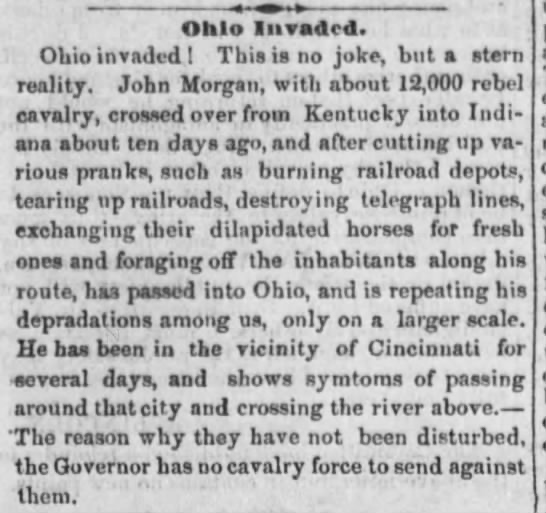
The Fremont Weekly Journal | Fremont, Ohio | 17 Jul 1863, Fri  | Page 2

Text from the newspaper article:

Ohio invaded! This is no joke, but a stern reality. John Morgan, with about 12,000 rebel calvary, crossed over from Kentucky into Indiana about ten days ago, and after cutting up various pranks, such as burning railroad depots, tearing up railroads, destroying telegraph lines, exchanging their dilapidated horses for fresh ones and foraging off the inhabitants along his route, has passed into Ohio, an dit repeating his depredations among us, only on a larger scale. He had been in the vicinity of Cincinnati for several days, and shows symtoms [sic] of passing around that city and crossing the river above.–The reason why they have not been disturbed. The Governor has not calvary force to send against them.

Daily Ohio Statesman | Columbus, Ohio | 18 Jul 1863, Sat  | Page 3 | newspapers.com

Text from the newspaper article:

Col. Runkle, with about fifteen hundred men, encountered Morgan’s forces at Berlin, Jackson County, this afternoon. The enemy lost four killed. No loss on our side. Morgan moved off in an easterly direction. It is supposed he is making for Pomery or for the ford below Buffington Island. The roads leading to Pomery are blockaded with trees for fifteen miles. Gen. Hobson’s advance reached Piketon to-day twelve houses after Morgan left. The Gazette’s Portsmouth dispatch says the rebels on Thursday burned the steam saw mill and the bridge across the canal at Jasper and the bridge across the Scioto above Piketon. This morning they burned a flour mill and railroad depot at Jackson, completely sacked the town and carried off all the horses found.

A historical marker is located in Jackson County and reports:

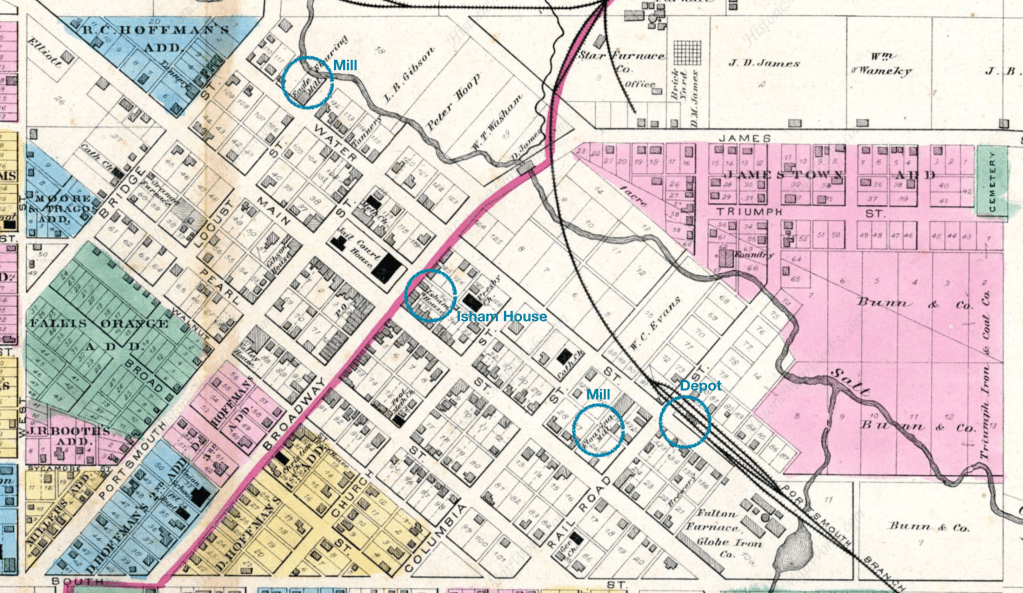
Late in the evening of July 16, 1863, Confederate General John Hunt Morgan entered Jackson with 2,000 cavalrymen, meeting with no resistence. Finding many townspeople assembled, the raiders took the men as prisoners and held them at the fairground. They then foraged the town at will, taking food and all available horses. The raiders also burned the Cincinnati and Marietta Railroad depot and destroyed the office of The Standard, the Republican newspaper. Morgan made his headquarters at the Isham House, directly across the street from this marker. He continued eastward on the afternoon of July 17. Strongly divided politically during the Civil War, Jackson received no speical consideration by Morgan. Both unionists and “Copperheads” (southern sympathizers) suffered equally.

Annotated Excerpt of 1875 Map of Jackson City, showing Isham House, some mills, and the railroad depot | historicmapworks.com

The letters of the Ford Family describe the preparations the town of Jackson took as they heard of the advance of Morgan and his men:

The stores were closed and such things as could be easily put away were secreted. We still hoped it was a false alarm. Mr. Dickerson left with the fund’s of the Treasurer’s Office. Mr. Matthews with the contents of the P.O. Most of or many of the good horses were taken to the woods with the hope of saving them.

Fannie Ford Latter, 23 July 1863 | ohiomemory.org

The letter detailed the plunder of homes and stables:

It is estimated that 200 horses were taken in a 10 mile area about J–. Squads came in by leading 2 or 3 each. They took sheaf wheat from the field to feed with.

Fannie Ford Latter, 23 July 1863 | ohiomemory.org

John Walden claimed one horse and saddle. The horse was valued at $100 and the saddle at $15. His uncle, Lewis D Walden claimed a horse valued at $80.00. The Crookhams and the Millikins did not make claims.

Sources:

Ford Family Letters Regarding Morgan’s Raid

For dates of raid: https://www.carnegie.lib.oh.us/morgan

Morgan’s Raid Losers Including An Abridged Reprint of the Report of the Commissioners of MORGAN’S RAID CLAIMS To the Governer of the State of Ohio December 15, 1864 – Page 87

George W. Lewis | Enslaver

George Washington Lewis, of Claiborne County, Tennessee, was married twice: first to Sarah “Sally” Bullard who died in 1840 and second to Cyntha Fulps, whose family was from Stokes County, North Carolina.

Cyntha’s father wrote his will in February 1850 and in his will transferred the legal authority to enslave Black people to his children:

  • Jeremiah was enslaved by William W. Fulp
  • Allen was enslaved by George V Fulp
  • Rose and her future children were enslaved by Peggy Dawson/Darson
  • Violet and her future children were enslaved by Polly Fulp
  • Samuel was enslaved by Cynthia Lewis wife of George Washington Lewis
  • Gideon Hill was enslaved by Emily Campbell
  • Sophia and her future children were enslaved by Eliza Ann Jones
  • Tomsley Atterline and future children were enslaved by his granddaughter Sarah Winfree
  • All other enslaved people were split among the children if they were not sold to pay off debts.

While the will formalized the legal transfer of authority to hold Samuel in bondage, family tradition maintains that Samuel was “given” to the Lewis’s upon their marriage in 1848. Either way, as George Washington Lewis and his wife Cyntha lived in Claiborne County, Tennessee, this required Samuel to leave any family and kin behind in North Carolina. The distance between the two counties is approximately 200 miles.

The 1850 Slave Schedule for the US Federal Census lists George Lewis in Claiborne County holding one male, age 15, in bondage. This suggests that the family tradition of Lewis enslaving Sam in 1848 is accurate, and the will formalized the arrangement.

The 1860 Slave Schedule for the US Federal Census lists names for those enslaved, which is unusual. George Lewis listed Sam, age 26 and Polly, age 75. The relationship between Sam and Polly is not stated.

After the Civil War and the 13th Amendment which abolished slavery except as punishment for a crime, Samuel Lewis is listed in the 1870 US Federal Census as living in District 11 of Claiborne County. He is listed with his wife, Cynthia Lewis, age 23 and their daughter Darcus. They do not have any real estate. George Lewis is enumerated on the previous page.

Sources

Probate Records (Forsyth County, North Carolina), 1833-1969; Author: North Carolina. Division of Archives and History; Probate Place: Forsyth, North Carolina | ancestry.com

The National Archive in Washington DC; Washington, DC; NARA Microform Publication: M432; Title: Seventh Census Of The United States, 1850; Record Group: Records of the Bureau of the Census; Record Group Number: 29 | ancestry.com

The National Archives in Washington DC; Washington DC, USA; Eighth Census of the United States 1860; Series Number: M653; Record Group: Records of the Bureau of the Census; Record Group Number: 29

Year: 1870; Census Place: District 11, Claiborne, Tennessee; Roll: M593_1518; Page: 321A

O. C. Crookham | Migration West

Oliver Cromwell Crookham was born to George and Sarah Crookham, old settlers of Jackson County, Ohio, in 1824. He was their tenth child.

Pickaway County, Ohio

In 1850, he married Mary Jane Walden in Jackson County. They moved from Jackson County, where both their parents lived, to Pickaway County, northwest of Jackson County, along the Scioto River. The Crookham farm was on the road to Chillicothe and from there, there was the Ohio & Erie canal to Pickaway County.

Annotated excerpt of the 1850 State of Ohio by Samuel Mitchell | davdirumsey.com

In the 1850 Census, they are living near Crookham’s brother, Lawrence Crookham. Lawrence has real estate valued at $18,000 and has four men marked at “Mulatto” living with him of free status. Oliver and his wife Mary are listed immediately after Lawrence.

By the 1860 Census, Oliver has acquired real estate almost equal in value to that of his brother. Lawrence in the 1860 census had real estate valued at $14350, and Oliver $11560. Living with Oliver is his sister-in-law Martha Waldon who is working as a teacher. Living next to the Crookham’s are free Blacks. Their father George L Crookham had been an abolitionist and had supported the Underground Railroad. It is unclear if the the families living near the Crookhams in Pickaway were connected with that work.

Greene County, Missouri

By the 1870 Census, Oliver left Pickaway, where his brother Lawrence still lived. He traveled to Greene County, Missouri. Springfield is located in Green County. Land records suggest he bought farmland near Ash Grove in the northwest part of the county. Crookham employed 4 people who had immigrated from Denmark, among them Jacob Knudson who married Amanda Crookham in 1871.

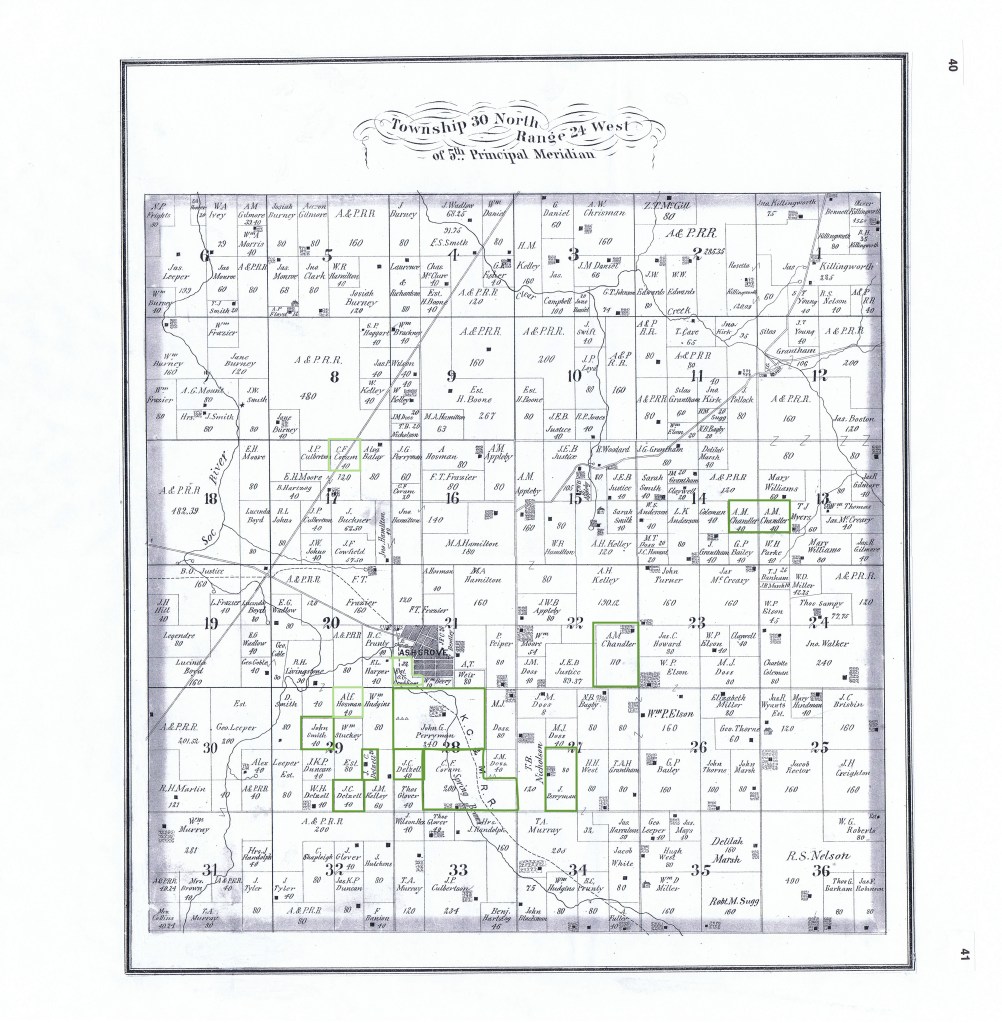
Land Records show that he began buying land in 1866. He made three purchases in 1866, and then one additional in 1867 and 1868. After 1870, he made two additional purchases in 1872 and 1873. Additional land records show that he sold multiple parcels of land, one of which to the Ash Grove Baptist Church and Turstees ME Church. (Greene County Deed Records)

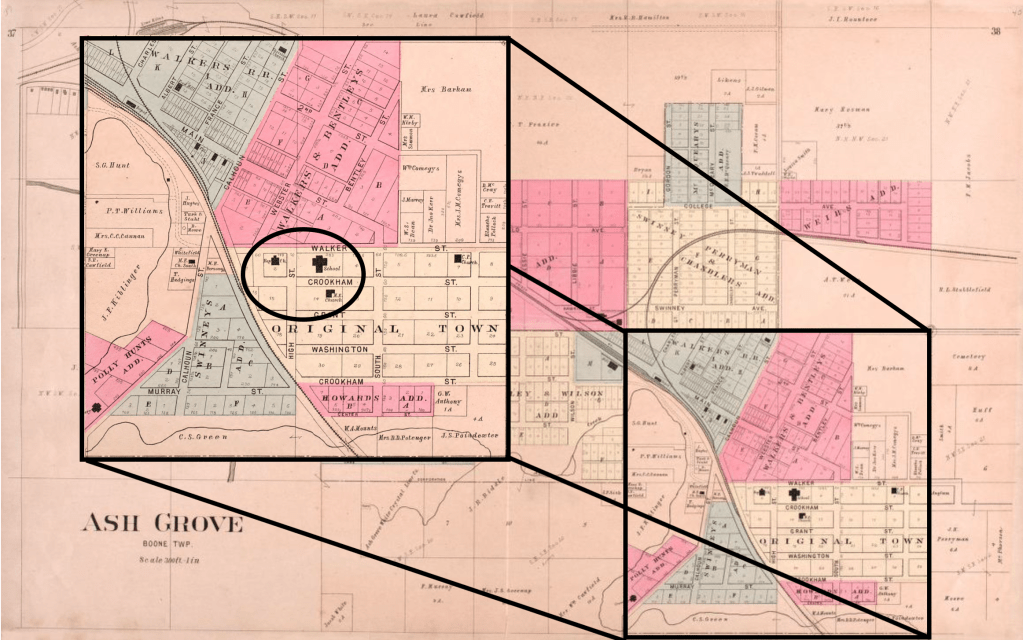
This map of Ash Grove shows that the Baptist Church and ME Church were near Crookham Street in the “Original Town”. Ash Grove was incorporated in 1871. The Baptist Church was built in 1871 and cost $971.

Plat book of Greene County, Missouri : compiled from county records and actual surveys | loc.gov

The map shows the names of the people who bought Crookham’s land highlighted in green. The records did not indicate which parcels and so the circled lands are best guesses based on records reviewed.

1876 Township Map of Green County (30NR24W) shows names of Buyers of Crookham’s land. | greenecountymo.gov

Greenwood County, Kansas

While Crookham was living in Greene County, Missouri in 1870, and was making multiple real estate transfers, he had also purchased large tracts of land in Greenwood County, Kansas in 1867. The Eureka Herald and Greenwood County Republican announced in July of 1871 that “Mr. Crookham intends to build soon. He will put a fine dwelling.”

1865 Johnson’s Missouri and Kansas | davidrumsey.com

Crookham purchased the land in Kansas using a “Agricultural Scrip Patent”. His sales were “in favor of West Virginia”, meaning that the proceeds of the sale of land went to West Virginia for the establishment of an agricultural and mechanical arts college.

Excerpt from Map of the county of Greenwood, Kansas [1877] | loc.gov
</iframe

O. C. Crookham died in 1874 when Alex Harman shot him over a wage dispute. The Crookham family remained in Greenwood County after his death.

George L Crookham | Methodist

George L Crookham’s son, O. C. Crookham married M. J. Walden, the daughter of Jonathan Walden, a founding member of Jackson’s Baptist Church. Jonathan and Sarah Walden, with her mother, Jane, were buried in the Pierce-Mather Cemetery, on land owned by W. W. Mather, also a founding member of the Baptist Church. Crookham, however, was a Methodist.

In 1872, the Methodist Church in Jackson appointed a committee to create a history of Methodism in the county. The first written evidence of Methodism in the county was in 1817 when a preacher was authorized to solemnize marriages, though tradition supports “that there were Methodist families, in what is not the town of Jackson, as early as 1805, and probably before that time.” (Jackson Standard, 16 Oct 1873, p 1 | newspapers.com)

The Standard History of the Hanging Rock Iron Region of Ohio writes that “Mother Sylvester, who with her sister, Mrs. John Martin, was converted at the camp meeting held near the Salt Works in 1801.” George L. Crookham worked at the salt works when he migrated to Jackson County in 1799 and likely attended the camp meetings, if he became a Methodist.

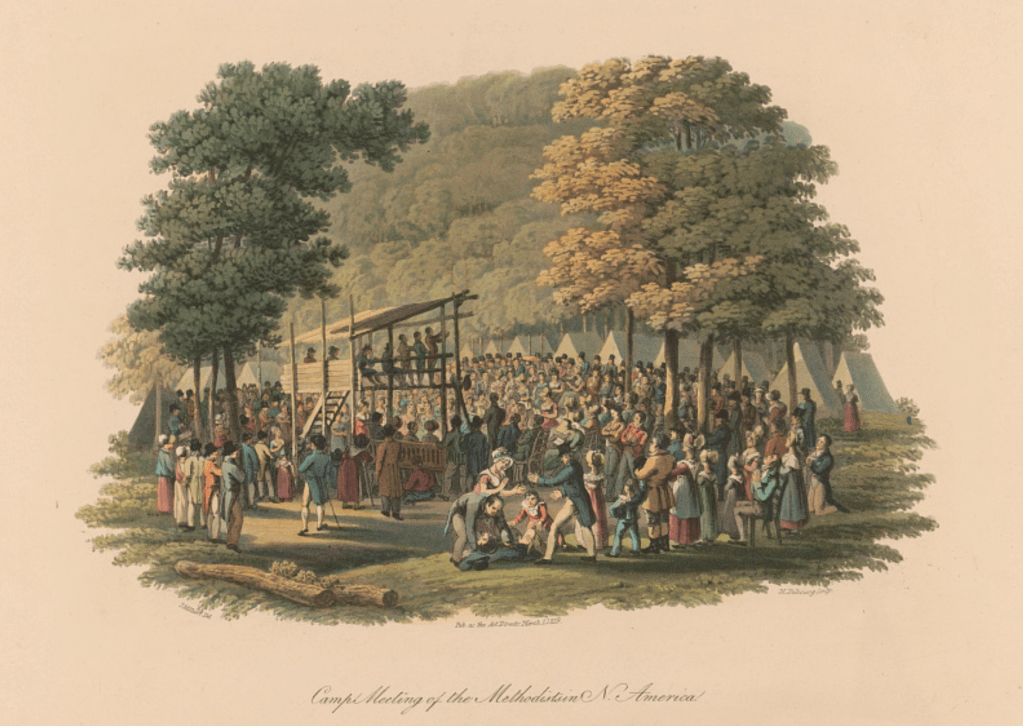
Camp meeting of the Methodists in N. America / J. Milbert del. ; M. Dubourg sculp. [1819] | loc.gov

Camp Meetings in the early 1800s were both social and spiritual events. Itinerant preachers would provide sermons and the attendees would sing hymns, pray and camp. They were common during the Second Great Awakening and organized by Baptists, Methodists and other denominations in the frontier where there were few established churches. In Jackson, the itinerant preachers recorded by the Methodist Committee in the Jackson Standard article were Laidley, Tevis, Westlake, Strother and others. “Occasional outdoor preaching was held and continued more or less for several years before any house was erected for that purpose.”

Until the courthouse was built in 1821, “preaching services were held in the woods in summer and in the homes in winter.” (Standard History, p 420) Early services were hosted in the homes of John James and Samuel Hall and in a log school house in Jackson until about 1835. The Methodist committee found an old class book from April 1830 and in the names recorded as members of the class were George Crookham, Sarah Crookham, Horatio Crookham, Euclid Crookham, Horace Crookham and other neighbors. Horatio, Euclid, and Horace are the children of George and Sarah and were born in the 1800s, making them in their 20s in 1830. It is likely the other children were not listed as they were likely in attendance with a younger class.

While the Crookhams are listed on the membership roll, the committee singles out others as faithful attendees and comments “the number of times that the other members were absent is not a cause for congratulations”. (Jackson Standard)

Sources

A Standard History of the Hanging Rock Iron Region of Ohio: An Authentic Narrative of the Past, with an Extended Survey of the Industrial and Commercial Development. (1916). United States: Lewis Publishing Company.

Dubourg, M. & Milbert, J. G. (ca. 1819) Camp meeting of the Methodists in N. America / J. Milbert del. ; M. Dubourg sculp. , ca. 1819. [Photograph] Retrieved from the Library of Congress, https://www.loc.gov/item/98508274/.

“Historical Sketch of the ME Church at Jackson CH Ohio.”, Jackson Standard, 16 Oct 1873, newspapers.com