Arthur Rexford

Baptism

Commanding the cliffs at the mouth of the river Dart, sits a squat Norman church with a square tower, overlooking the waters. Due to its position, watching the ships in the English Channel, the church had been fortified into the Dartmouth Castle, watching the ships from France during the Hundred Years’ War and the arrival of the Spanish Armada.
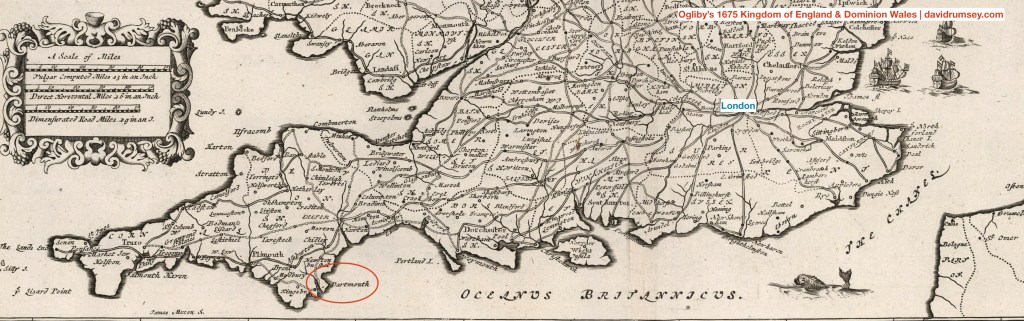
The church, called St. Petrox, is said to have been named for a religious Welsh prince who turned to a monastic life, and Peter, the rock of the church, is an apt name for the stone squat church that endured the wind and wave of the harbor. In July 1677, the Rexford family took their infant son, Arthur, to be baptized in that squat church.

Dartmouth, the town, sits north of the Castle, protected by a curve in the river, creating a harbor and haven from the English Channel.

A half-century earlier than Rexford’s baptism the Mayflower and Speedwell ships, carrying the first Puritan colonists away from the King and the Church of England berthed in Bayard’s Cove, between the castle and the town, as they awaited repairs. Soon after the colonies in Massachusetts were established, the town of Dartmouth engaged in trade with Newfoundland, as well as Spain and Portugal, due to rich cod beds nearby.

While in Dartmouth, the Rexford family disappears except for his 1677 baptism at the church overlooking the harbor.

Maritime Colonist

While many of the religious separatists who left England for the colonies were middle-class families, the emigrants from London and Devon tended to be young single men in search of a good fortune. By 1702, Arthur Rexford has crossed the Atlantic, following the path of the Mayflower. In the New World, he married Elizabeth Stevens in another harbor town: New Haven, Connecticut, where he continued to engage in maritime trade.

New Haven, located on the Long Island Sound, had been established by Puritans in the 1630s, seventy years before Rexford’s arrival, who were in search of sea port from which to grow an commercial empire. The founder viewed its spacious harbor in the Long Island Sound the epicenter of its hoped-for empire. While it conceded its dreams to Boston, the town became an agricultural center engaged in trade.

The Connecticut Colony was engaged in trade with West Indies, often sending merchants out twice a year, once in the fall and in the spring, to take the local agricultural products to the islands. There the enslaved Africans were forced to labor on the sugar plantations, which as the cash crop, supplanted other forms of agricultural and resource production. The enslavers sold the sugar for the meat and produce brought by the Connecticut colonists.

“When they had collected enough produce to fill a vessel they hired a captain and sent a ship to islands where they had agents, family members, or friends who assisted in disposing of the cargo and locating enough island products to return home with a full hold.” Connecticut and the West Indies: Sugar Spurs Trans-Atlantic Trade

Arthur Rexford commanded the sloop “Rose” which was recorded as traveling to Antiqua in 1711 and 1712. Sloops were described as the “tractor-trailer” of the colonial trade: “heavily built for bad weather and rough sea conditions, they were simple to sail, roomy for lots of cargo and passengers, easily handled by small crews, relatively swift, and usually armed for self defense wherever they might sail. They were also simple to build and inexpensive, so that if one were lost, it might not cause a crippling financial loss to its owners”, as described by the Smithsonian.

“The ship captain, who generally made two voyages a year, was responsible for the safety of the ship and the crew but also the profitable sale of the cargo. Working for different merchants, a captain would go once after the fall harvest and again in the spring after the harbor ice thawed. A voyage took from two to five weeks depending on the weather and port of call. Often, the ship’s commander had to visit several islands to sell the entire cargo. A profitable voyage depended on unknown market conditions, speed of delivery, local contacts, safe passage through often-fierce storms, fair prices, and reputable products. ” Connecticut and the West Indies: Sugar Spurs Trans-Atlantic Trade

In 1711, most likely after the return from the spring voyage, the customs man, a James Shackmaple, approached Rexford’s sloop and tried to impound it. Shackmaple reported to the crown that he was met with threats of violence as Rexford and others defended the sloop from the customs man. Despite Rexford’s resistance, the sloop was impounded for trial as Shackmaple called in reinforcements from the constable. This suggests that Rexford was not only engaged in legal trade, but also engaged in smuggling, though what he smuggled was unclear. The outcome of the trial was not recorded, yet, Rexford had command of the Rose again when he was recorded arriving in Boston in 1712, again from Antigua. The Public Records of the Colony of Connecticut [1636-1776]

His death is recorded in 1727, when he was 50.

Samuel Norton | Death on the Prairie

In 1820, Samuel Norton moved his family from Vermont to Crawford County, Illinois. In 1821, he died, leaving his wife and children behind on the prairie.


In 1820, Samuel Norton used credit to purchase the eighty acres of land about 5 miles of Lawrenceville, in the Allison Township. His son, Samuel Harris Norton, was issued the Credit Volume Patent in 1830 on behalf of Samuel Norton’s heirs, which suggests that in the interim, the family was able to save up money to finish paying for the land. The land was directly south of Centreville, one of the earliest communities in Lawrence County. His forty acres were located within the green markers.

The Norton family were neighbors with Andrew McClure and David Ruby as evidenced by both the 1820 census and the BLM related documents to the patent. Additionally, they lived in close proximity to other Nortons: Stephen Norton and Reuben Norton.

It is unclear how Samuel Norton died. In the “Combined History of Edwards, Lawrence, and Wabash County”, the author describes the “the difficulties incident to life in a new country”: and specifically names disease, wild animals, and American Indians. Two forts had been erected in the area by the Euro-American settlers as they continued to occupy the indigenous people’s land. Of these, disease is most likely the cause of Norton’s death.

In the book “Illinois in 1837” by Samuel A. Mitchell names the prairie where the Norton’s settled as Allison Prairie. “The eastern part, towards the Wabash, contains some wet land and purgatory swamps, but the principal part is a dry, sandy, and very rich soil, covered with well-cultivated farms. Few tracts in Illinois are better adapted for the culture of corn than this.” Yet, the presence of the purgatory swamps meant disease.

Death had thinned their numbers. The purgatory swamps, as they are called, around the prairie, had a deleterious influence, and retarded the progress of population.

After Samuel’s death, Lydia continued to live in Lawrence County. She was listed in the 1840 census as Widow Norton and living with her children.

The oldest son, Samuel Harris Norton continued to work the land that his father had purchased with a down payment. The “Combined History of Edwards, Lawrence and Wabash Counties” describe the Allison prairie as the “cotton-field of Wabash Valley” and coupled with the production of cotton, the Euro-Americans engaged in bee-hunting: “when the farmer wished a little “land office” money, this was an article that would readily command it.”

It is likely that Samuel Harris cared for hives and “would take their beeswax, deer-skins and peltries to the watercourses” to sell in markets like New Orleans. If so, it would have allowed him to complete the purchase of his father’s land in 1830 and to purchase additional land in 1839. An 1860 Agricultural Schedule shows that about half of his land was “improved” and the other half “unimproved”; he had 25 bushels of clover seed and had manufactured honey on hand. His crop, however, was not cotton, but rather corn, which he likely fed his 16 sheep and 10 pigs.

Samuel Harris Norton married twice: first, in 1835 to Elizabeth Johnston, who died in 1838; secondly to Adalia Atkins, who died in 1852. Both of his wives is buried in Howard Cemetery, north of the land his father purchased near what was Centerville.

It is unclear when he died.

Texas Mounted Volunteer

Andrew Vanslyke (1792-1852) moved his family from southeast Missouri to Texas shortly after Texas was annexed into the US. His son, Andrew H Vanslyke, (1827-1848) fought and died in the Mexican War.

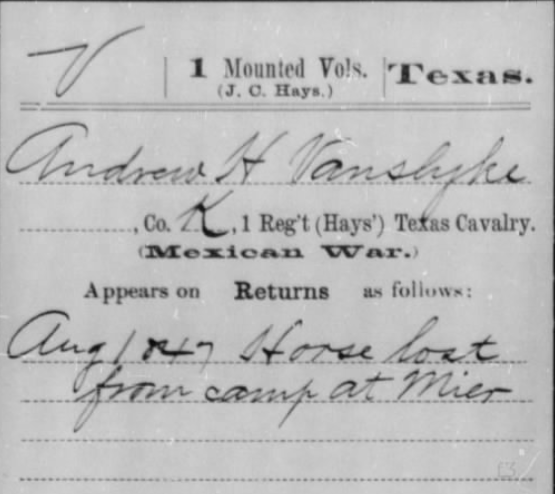
Andrew H. Vanslyke (1827-1848) enrolled as Private with Co K of the Texas Mounted Volunteers in July 1847; the war had only seven months remaining. He enrolled for a 12 month period.

Hay’s Texas Mounted Volunteers and its Companies guarded road between VeraCruz and Puebla. It took several months for the companies to travel from Texas to Mexico, leaving in August and arriving in October, where they protected the supply and communications line between Vera Cruz and Mexico City.

Notes on his service records indicate his horse was worn out from service and died in Aug 1847. He is said to have lost his horse at Mier.

Service Notes from fold3.com

The Texas Mounted Volunteers landed in October, after the Siege of Puebla and were security forces along the Vera Cruz lines. They fought the guerillas and provided rapid reaction forces to the remaining Mexican troops. As they were escorting soldiers to Mexico City in late November, there was a large skirmish with that resulted in mass casualties. It may have been this skirmish that caused Vanslyke to be sent to nurse the sick a Puebla which was along the Vera Cruze-Mexico City line.

Puebla had been held under siege in Sept-October, and at the beginning of the siege had had 2000 men left behind as sick and ill. By the end of the siege, 400 remained. Like in the Civil War, soldiers were more likely to die of infection and disease than on the battlefield; in fact, the likelihood was even higher than that of the Civil War.

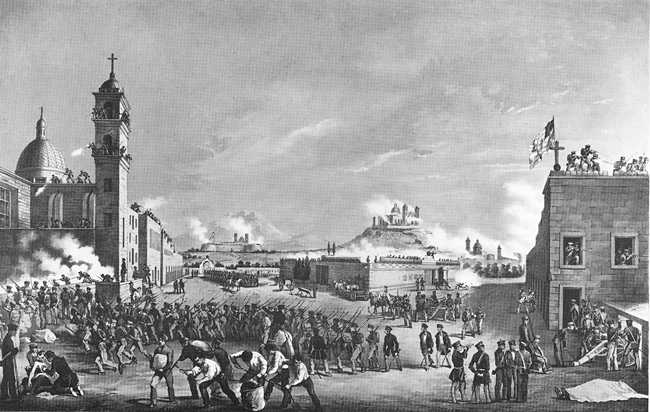
Image
14-09-1847 #Puebla combate al ejército norteamericano en el Cuartel de San José (2nte y 22ote) | https://twitter.com/PueblaAntigua
The Hospital in Puebla was located at the Cuartel de San Jose.

In 1850, Andrew Vanslyke claimed 320 acres on behalf of his son’s heirs in Cooke County, Texas.

Devine Anderson | Traveling to Kansas


Devine Anderson (1824-1867) lived in Illinois for most of his life. In 1865, he wrote a letter to a former neighbor about moving to Kansas. The obituary for his daughter, Tabitha Anderson (1861-1935), describes how she and her family moved from Illinois to Kansas in 1866 by covered wagon. The letter is transcribed below, with additional facts interspersed that connect to the letter contents.

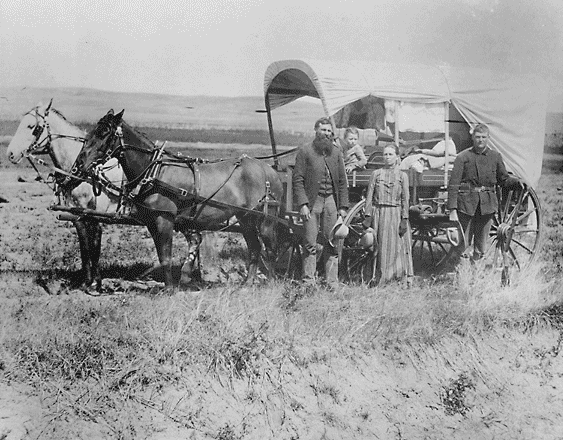
Image of a family traveling by covered wagon in Nebraska in 1866 | wikipedia.org
This picture is not of the Andersons, but illustrative of what it may have been like when they traveled to Kansas.

Letter to Mr. Anderson from Mr. Turner

Eureka, Kans. Nov. 29, 1865

Mr. Anderson —

Yours of Nov. 1st has just come to hand, and I hasten to give you what information I am able concerning the several items mentioned in your letter of inquiry.

First, you want the price of wild land. There is plenty of first quality of prairie land to be had a government price, $1.25 per acre; or you can get it under the homestead, which will cost you $16 for 160 acres. Most of the timber is taken though there are a few places to take yet with the timber to them. There could be some farms bought for near what the improvements are worth. One of my neighbors has a good farm with plenty of timber joining, 100 acres of cultivation, good well of water, good cellar and good Kansas cabins, etc. which he offers for $1,000. You can buy smaller places for a less price, or take up a place yourself, just as you like.

Excerpt showing T26E -R10E of a map of the county of Greenwood, Kansas, 1877 | loc.gov
Land Records for Devine Anderson

Land records for Devine Anderson shows he patented several acres of land in Greenwood county. The land purchased was in T26S and R10E, which is excerpted in the image from a 1877 Map of Greenwood County, digitized at the Library of Congress. The first purchase was for 40 acres in section 4 (NE1/4 of the SW1/4). The second purchase was for 40 acres in section 10 (SE1/4 of the NW1/4). The third purchase was for 80 acres in section 12 (the NW1/4 of of the SW1/4 and NE 1/4 of the SW 1/4). The fourth purchase was 160 acres of land originally granted to Joshua Turner for military service and was reassigned to Devine Anderson. This land was in the N1/2 of the SW1/4 of Section3 and the N1/2 of the SE1/4 of Section 4. The land was purchased for $1.25 per acre. Two of the purchases were commuted under the 8th section of the Homestead Act which allowed them to take ownership for $2.50 without waiting the necessary 5 years. To do so they would have to prove settlement and cultivation.

In the 1870 Census, real estate values were listed next to names. Elizabeth Anderson, his wife, had land valued at $900. George A, her son, had land valued at $600 and Clinton, her son, had land valued at $600.

There is not much coal of good quality discovered yet. There is an abundance of building rock of the finest quality, both sand and limestone. Corn is not a sure crop, though we always make some. The seasons have been irregular for several years, about every second year only making about half crops, or 20 to 30 bushels per acres — this year’s crop will average 50 bushels per acre. Wheat and rye is a sure crop in this part of Kansas; 30 bushels per acre of each is about an average crop in our county. Rye often comes self-sown and does about as well as first crop. Our wheat compares favorably in quality with any of the best grown in any of the states.

 -
The Eureka Herald and Greenwood County Republican
Eureka, Kansas
25 Oct 1877, Thu  •  Page 4

Coal Bank Discovered

There were about six household in Greenwood County in the 1880 Census with the last name of Anderson. There are no other articles in the paper that indicate which Anderson household this may have been. However, in the article posted with the letter, it claims that “in the spring [following the letter] he with his family removed to this county and settled on a farm near Bachelor Creek”, which coincides with the Obituary of Tabitha Anderson, which stated that they located “northeast of Eureka” which is consistent with the Bachelor Creek location.

There is not a thrashing machine owned in this county and we were much troubled the past season to get thrashing done — price, 8 cents per bushel.

Vegetables of all kinds does well here. Potatoes (sweet and Irish), onions, beets, parsnips, carrots, melons, etc. all do well. I raised the largest beets this year I ever saw; one common red beet weighed 17 1/4 pounds.

We have the healthiest portion of the state by a great odd. I left Illinois on account of the bad health of myself and family, and have lived in several places in Kansas and still had more or less sickness until we came to Fall River and we have not had occasion to call a doctor as yet, and the past season we have not had need of even a dose of medicine, and I have a large family — though some of our neighbors had some chills.

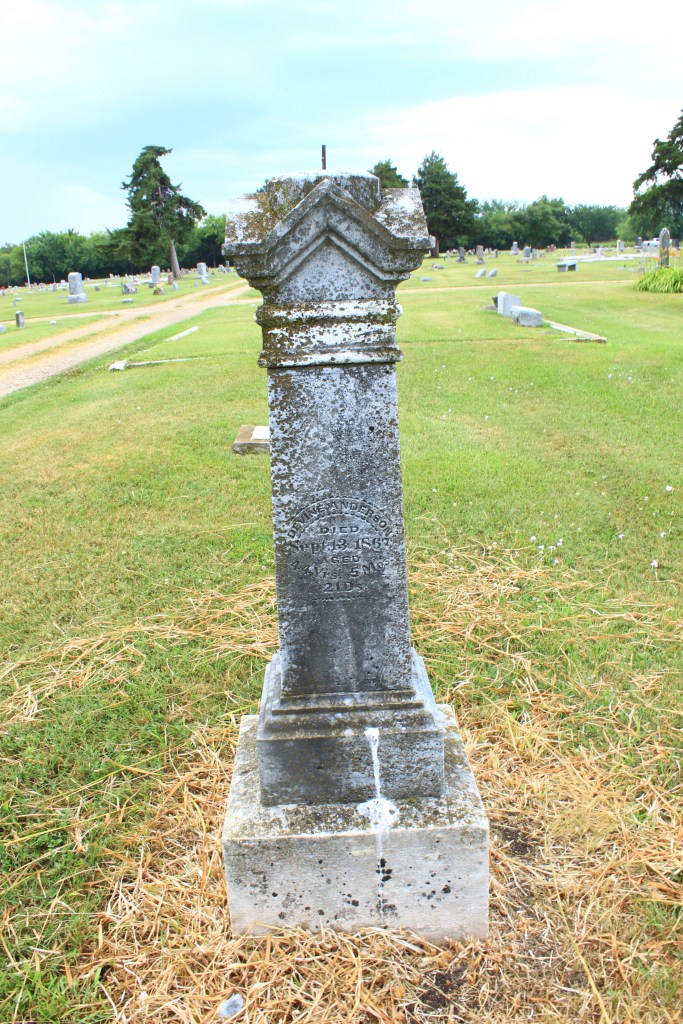
Picture of Tombstone for Devine Anderson at the Greenwood Cemetery | Picture by JEM

Death of Devine Anderson

“Within a few years following his settlement in the county, he sickened and died.” Devine Anderson died in 1867. In addition to Devine dying, his father-in-law, James Brown who was visiting from Fulton County, Illinois, died also around Sept 13, 1867, his death date recorded in the Greenwood County Probate records.

The article also mentions two sons who died. One was George A Anderson who was 19 years old and died in 1870. Her other son, James H Anderson, died in the summer of 1867.

We are 100 miles from any railroad now but will soon have one in 45 miles.

Map of Greenwood County, 1877, showing Railroad Lines | Library of Congress

Railroads come to Greenwood County

This map from 1877 shows proposed railroads in Greenwood County with some very near the land that the Anderson’s received under the Homestead Act. The proposed railroad line south out of Eureka through the section of land near the Anderson’s patents were in fact laid.

This is great stock growing country. Stock of all kinds grow well here with very little feed and some stock growers never feed at all.

Well, I believe I have touched on the items mentioned in your letter, and as I have been riding very hard for several days and am very tired and sleepy, you will excuse me for this time, and if there is anything more you wish to know, speak out and I will tell you in my next.

I am yours truly,

R.R. Turner

Crookham | In the Limelight


Tabitha Anderson Crookham (1861-1935) and her children, William Crookham (1882-1955) and Ella Crookham (1890-1972), attended a Magic Lantern Show in Utopia in 1896, hosted most likely by Frank Ware and Dolla Shobe, friends of William Crookham, as they were about the same age. Coleman Lesley and Elva Webster lived with Crookhams and worked with Mrs. Crookham on the farm.


Enjoy magic lantern show | Crookham -
Democratic Messenger
Eureka, Kansas
17 Jan 1896, Fri  •  Page 2
 -
The Eureka Republican
Eureka, Kansas
17 Jan 1896, Fri  •  Page 4
 -
The Eureka Republican
Eureka, Kansas
17 Jan 1896, Fri  •  Page 4

Magic Lantern Shows

Magic Lanterns were a popular form of Victorian entertainment that allowed people to project images on a screen using light creating a slide-show. Some magic lanterns used light form from minerals like limelight to project the screen, creating the phrase “in the limelight”. An article from the Smithsonian Magazine describes how originally magic lantern entertainment was for the upper-classes but as costs were driven down became a middle class entertainment.

Photo by Andrei Niemimäki of his grandmother’s magic lantern | wikipedia.com

An article ran in the Emporia Daily Republican describing how a Magic Lantern works: “By its aid, the lecturer is able to show the most beautiful photographs, magnified to big dimensions, for the benefit of large audiences.” (21 May 1891, page 2)

 -
The Eureka Herald and Greenwood County Republican
Eureka, Kansas
27 Apr 1876, Thu  •  Page 8

It is likely that the January Magic Lantern Show was not the only one given by Dolla Shobe as the newspaper ran a bit earlier in Dec 1895 of him taking a stereoscopic exhibition to Yates Center.

Stereopticon Exhibition -
Democratic Messenger
Eureka, Kansas
06 Dec 1895, Fri  •  Page 3

Entertainment

Other bits in the Greenwood County newspapers shows that the Crookhams and Shobe were often entertaining each other as they were part of a Literary Club together.

 -
Democratic Messenger
Eureka, Kansas
06 Dec 1895, Fri  •  Page 2
 -
Democratic Messenger
Eureka, Kansas
20 Dec 1895, Fri  •  Page 2
 -
Democratic Messenger
Eureka, Kansas
10 Jan 1896, Fri  •  Page 2

Jonathan Walden, Baptist

Jonathan Walden’s obituary, written by H. Adams, extolled the virtuous life of Walden as a Baptist.

Adverts for Dr. H. Adams -
Advertisment for H. Adams showing his role and proximity to the Baptist Church
The Jackson Standard
Jackson, Ohio
19 Apr 1855, Thu  •  Page 1

Death of Jonathan Walden

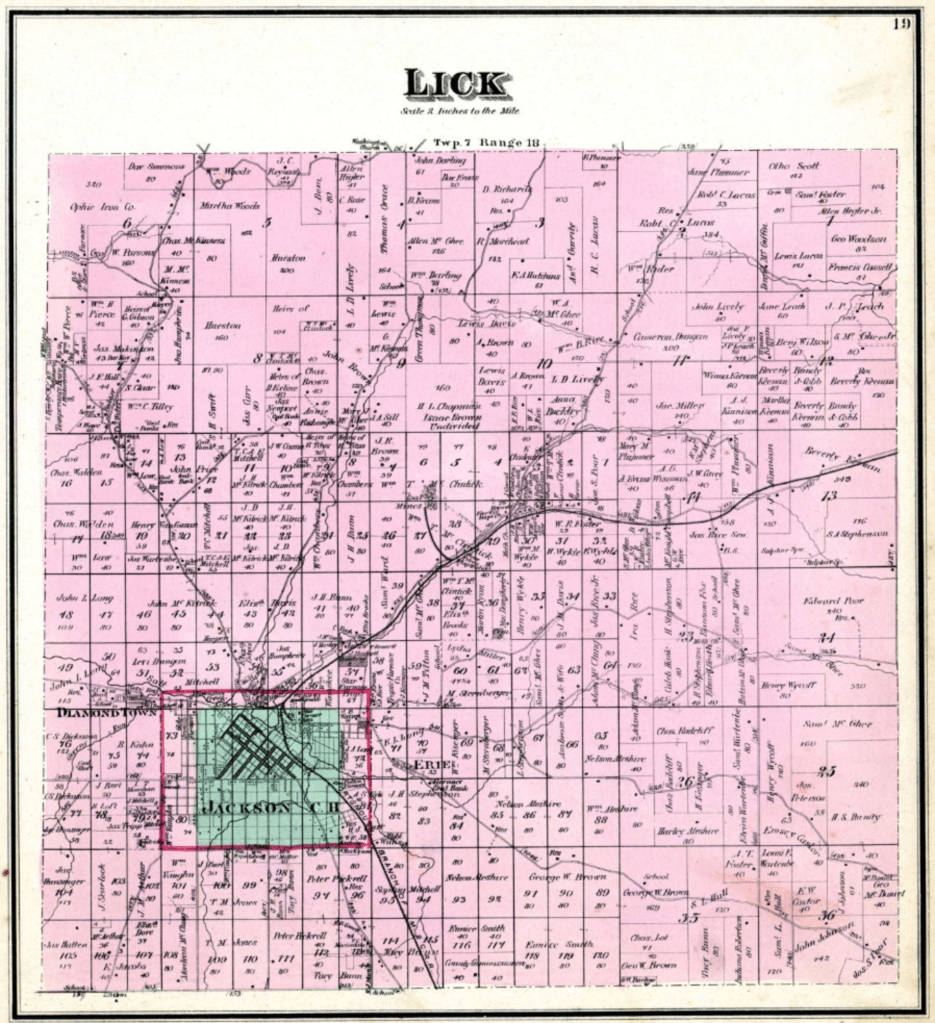
Jonathan Walden died in 1857 “after a protracted illness of some weeks”. He was described as bearing the “consumption of the lungs” with “christian fortitude and resignation”, and “utmost patience”. At the time of his death, he was living in Lick Township of Jackson County, Ohio. He was buried in Mather’s Cemetery which was deeded to the town by W. W. Mather.

Lick Township from the Atlas of Jackson County, Ohio, 1875 | historicmapsworks. org

Follow the road northwest of Jackson to the fork in the road in Section 7. Charles Walden is marked as owning sections of land immediately south of the fork, and Pierce is marked north of the fork. A zoomed in excerpt is shown below. Pierce bought the land from Mather and is the location of the cemetery.


Church Founding

Both W. W. Mather and Jonathan Walden were founding members of the Baptist Church in Jackson County, Ohio.

On July 19, 1841, men met to organize the Regular Baptist Church because “there were a number of persons who had belonged to the denomination elsewhere and taken up their permanent residence here.” Mather was chosen as secretary and served as a part of the committee that wrote the creed. A few days later, the resolution was signed by Jonathan Walden and members of the Mather, Gillespie, and Tyson families.

By 1846, a church and parsonage were built. The church was located at the corner of Church and Pearl Street. The church was moved to another location around 1868 and the old building was repurposed.

Exceprt from Atlas of Jackson County, Ohio 1875, page 25 of Jackson Ohio. | historicmapworks.com
The church is visible in the bottom half of the map, one block south of Broadway.
Old Baptist Church -
The Jackson Standard
Jackson, Ohio
20 Jan 1870, Thu  •  Page 3

Conversion

He became a Baptist when his parents died “when I was quite young and left without earthly parents”. He was living in Virginia (born in Campbell County, Virginia) and “connected himself with the Regular Baptist Church and enjoyed great peace of mind”.


Obituary

Obituary of Jonathan Wladen -
The Jackson Standard
Jackson, Ohio
12 Mar 1857, Thu  •  Page 2

Reminiscence

Walden Boys and fathers death -
The Jackson Standard
Jackson, Ohio
08 Jan 1885, Thu  •  Page 1

Pages 533 & 534 of History of Lower Scioto Valley, Ohio describe the founding of the Baptist Church.

Page 172 & 173 of History of Jackson County describe the Mather Cemetery.

A Quaker marries in a Lutheran Church

On the 16th of March in 1752, William Crookham and Mary Philips were married at the Swedes’ Church (Gloria Dei) in Southwark neighborhood, south of Philadelphia.


Gloria Dei | loc.gov
Photograph shows a bird’s-eye view of the Gloria Dei Church (Old Swedes’) in Philadelphia, Pennsylvania, with the cemetery in the foreground, with the masts of ships visible in the background.

Established near New Sweden, the Gloria Dei is the oldest church in Pennsylvania and the second oldest Swedish Church in the US. The congregation began to meet in the 1600s, and the building was consecrated in 1700. In the 1700s, it was a Swedish Lutheran church.

Map of Philadelphia 1762 showing the location of the church, just north of the D in Delaware River | old-maps.com

Philips is traditionally a Welsh name and several Welsh Quakers settled Pennsylvania. Additionally, in the years following her marriage, Quaker records from Monthly Meetings in the vicinity of Philadelphia lists Mary Crookham and her children, suggesting that Mary was a Quaker.

Crookham is an English Surname, and Crookham is not found in the Quaker records except when listed as the husband of Mary.


In the book “To be Useful to the World: Women in Revolutionary American, 1740-1790”, Gunderson writes about Quakers’ attitudes toward marriage in the mid 1750s.

Quaker’s Womens Meetings were used to select couples for marriage, ensuring parent consent and that the couple were in good standing.

If a women were to go outside of the Quaker religion to marry, they were often disowned; Gunderson writes “these were often women without enough standing to find a match in the limited Quaker marriage pool”.

By the time William and Mary wed, society had shifted in that the individuals often chose each other and sought consent from their parents and church afterward.

Many young people came to Gloria Dei Lutheran Church near Philadelphia to be married without their parents. While the minister would marry a woman over eighteen and a man over twenty-one who were free of indentures, he refused if the family had property.

To be Useful to the World: Women in Revolutionary American, 1740-1790, p 49-50

Claire Lyons writes in her book “Sex Among the Rabble: An Intimate History of Gender and Power in the Age of Revolution, Philadelphia, 1730-1830” that marriages at the Gloria Dei were thought to be lucky and so more marriages were preformed there than any other church in Philadelphia between 1789-1818.


Leaving for France


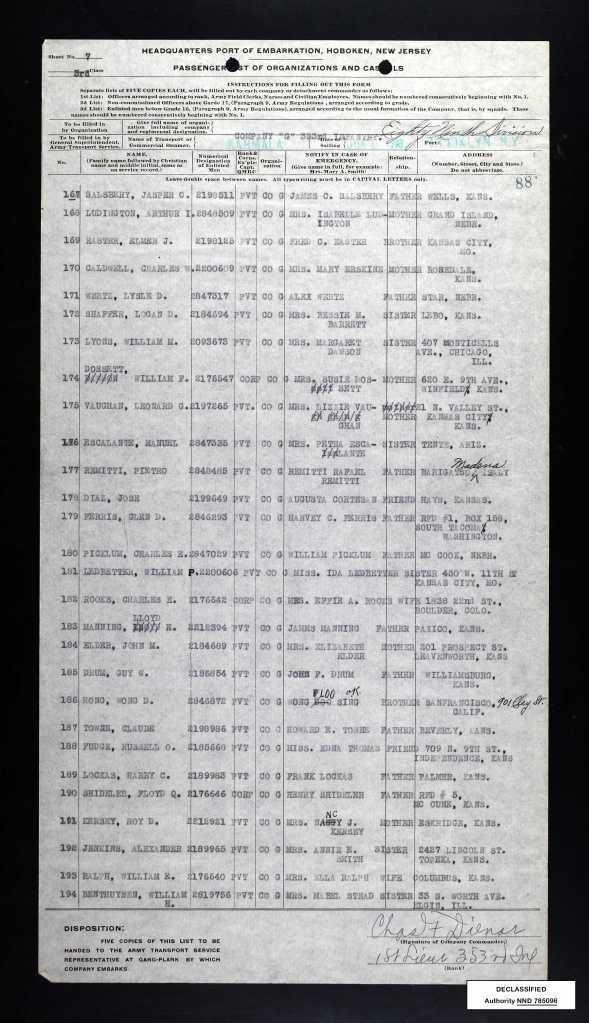
William Earl Relf (1887-1964) served in World War I. He left for France with his company in June 1918 on the HMS Karmala.


  • May 26, 1918

    “It was a cosmopolitan company which boarded the troop train… with Lieutenant Charles F. Dienst as company commander, and started on that “long, long trail.”

    The men traveled in Pullman sleepers for 5 days en route to a camp in Hoboken, enjoying a “luxurious ride”

  • June 4th, 1918

    “The boys bade farewell to the homeland and sailed for Europe.”

    They crossed the ocean in fourteen days in what was described as “Dante’s Inferno with the submarine ague.

    HMS Karmala | kansasww1.org

Passenger List for HMS Karmala from US Army Transport Lists | ancestry.org
Relf’s name is misspelled as Ralph

Quotes are pulled from the Complete History of Company G 353rd Infantry, 89th Division, A.E.F. — Missouri Digital History

Camp Funston


William Earl Relf (1887-1964) served in World War I. He trained at Camp Funston before shipping out to France.


Panoramic view of Camp Funston | kshs.org

Camp Funston, located near Fort Riley and Junction City, was a US Army Training Base created for training American troops for participation in World War I.


353rd Infantry Company G | fold3.com

William E Relf was a member of Company G, 353rd Infantry. In the panoramic, he is seated on the far right in the second row from bottom and second from the end.

Company “G” was soon a full-grown All-Kansas company, full of fight and pep. A winter of intensive training and camp routine put the boys in fighting trim, and there were no losses of life through the accidental discharges of their hand-carved, soft pine rifles.

Complete History of Company G 353rd Infantry, 89th Division, AEF

Serenaded at a Wedding


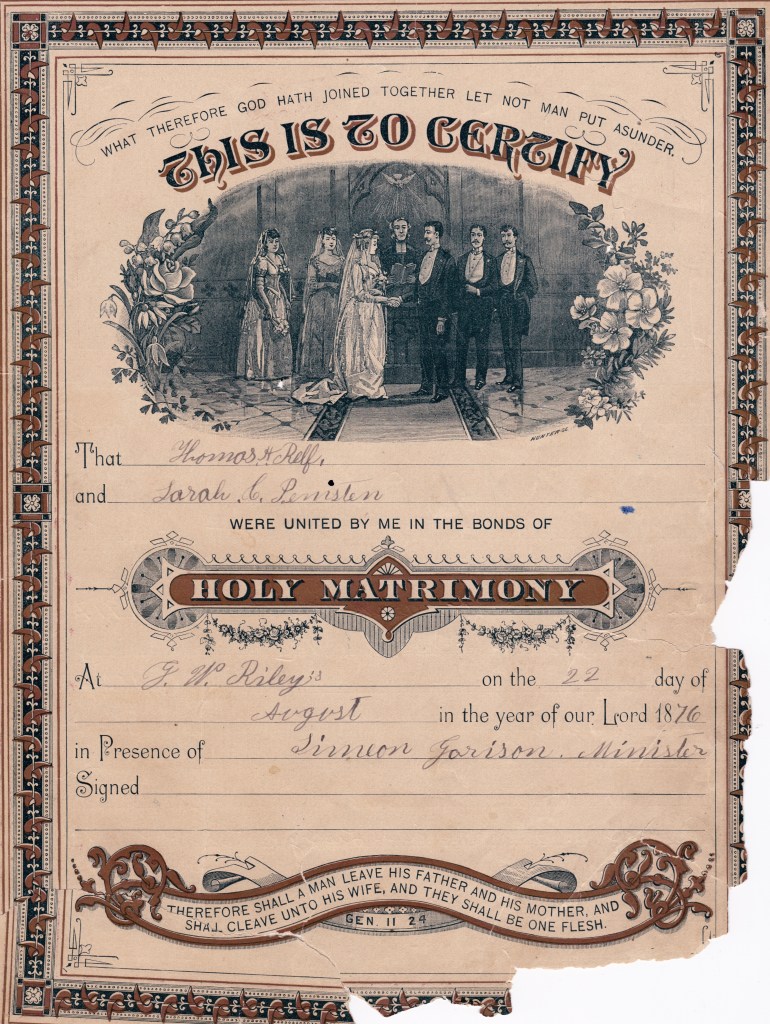
Thomas Relf and Sarah C Penisten were married in 1876.


At the residence of G. W. Riley, on Tuesday 22nd, at 7 p.m. Mr. Thomas Relf to Miss Sarah Peniston. The ceremonies were preformed by Rev. S Garrison. Many friends of both parties were present and witnessed the ceremonies, and partook of the elegant supper prepared by Mrs. Riley. The serenaders came in about 9 o’clock and furnished music for the evening. The music consisted of shooting of guns, ringing of bells, blowing horns, beating plows, gingling of tin-ware and a good deal of vocal music mixed in. It was enjoyed by both participants and hearers. Mr. and Mrs. Riley will please accept the thanks of the serenaders for the kindess which they bestowed.

Anderson Democrat | 25 Aug 1876
“Marriages Gleaned from Madison County, Indiana 1840-1880” by Zook
Most Likely a page from the Relf Family Bible as the style matches other pages left by my grandmother