William Earl Relf (1887-1964) served in World War I. He was drafted in Sept 1917, trained at Camp Funston in the first half of 1918, and set sail in June 1918. He returned to the US in 1919.
Registration
The US officially entered World War I in April 1917. The Selective Service Act of 1917 was enacted in May 18, 1917, to conscript or draft men for a national army. Roughly 24 million men (between the ages of 18 and 45) completed a Registration Card for the draft.
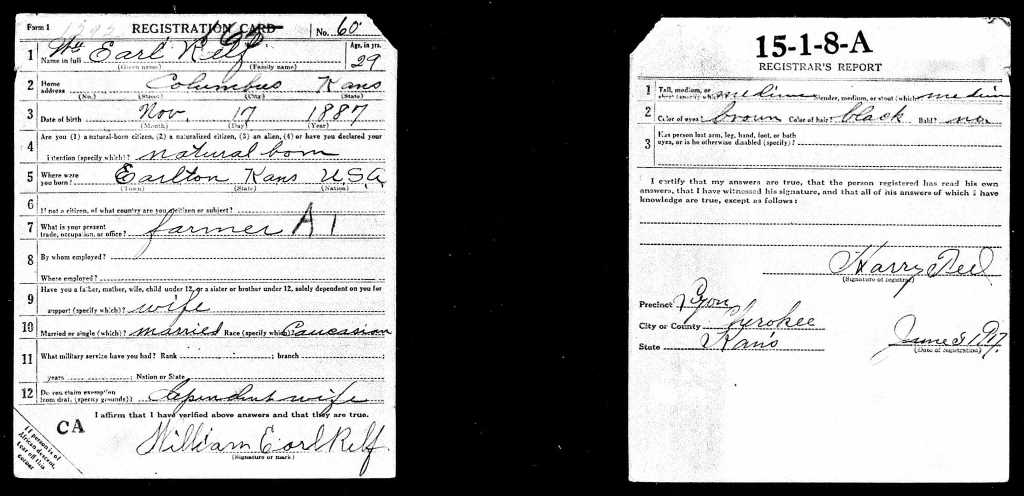
William Earl Relf WWI Draft Registration Card | ancestry.com
The draft consisted of three stages. The first stage was completed on June 5, 1917 for men between the ages of 21 and 31. Relf completed his registration during the first stage.
The Columbus Daily Advocate Columbus, Kansas 05 Jun 1917, Tue • Page 1
The Columbus Daily Advocate wrote on June 14, 1917 that the Cherokee County registered 2890 names of men between the ages of 21 and 31 and that there was a “Big Job for Clerk” as Masterson had to copy the list three times: once for public posting, once for the War Department and once for publication.
As far as it is known, every man in the county between the ages of 21 and 31 registered, at least if there are any slackers they have not been found.
Columbus Daily Advocate, Columbus, Kansas, June 14, 1917, page 1
Exemption Claimed for Dependency
Relf claimed a dependent wife and was granted a a temporary exemption until November 15.
In the Sept 1, 1917 edition of the Topeka Daily Capital, the paper reported that local exemption boards were failing in their duty because “it is one continual fight with the local boards to get them to ‘come across’ with the necessary information in regard to appeal dependency claims.”
Enlistment
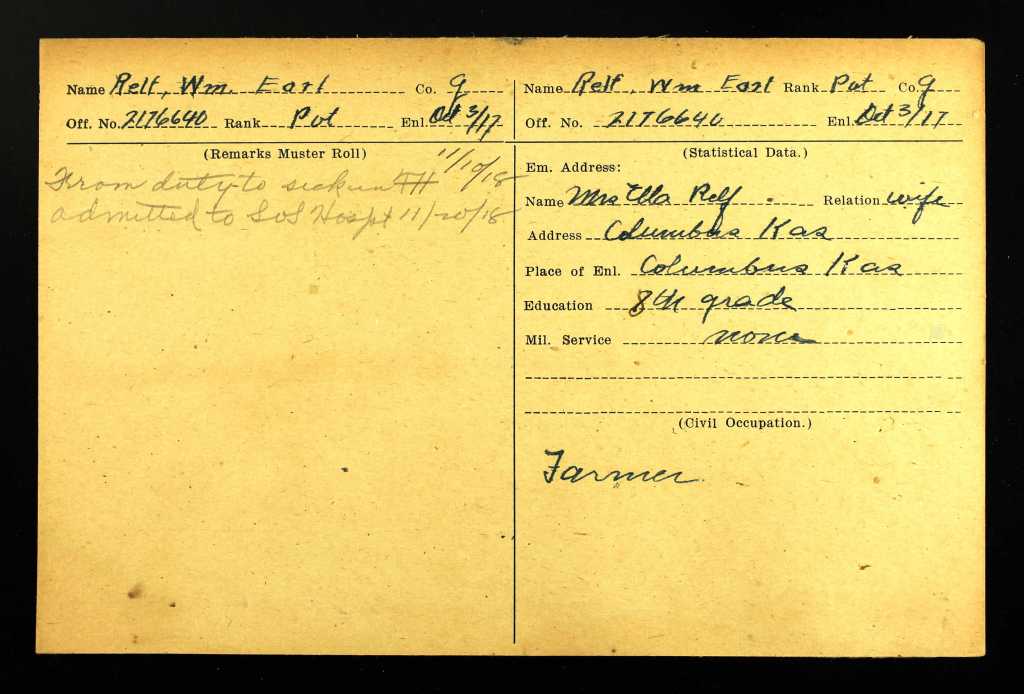
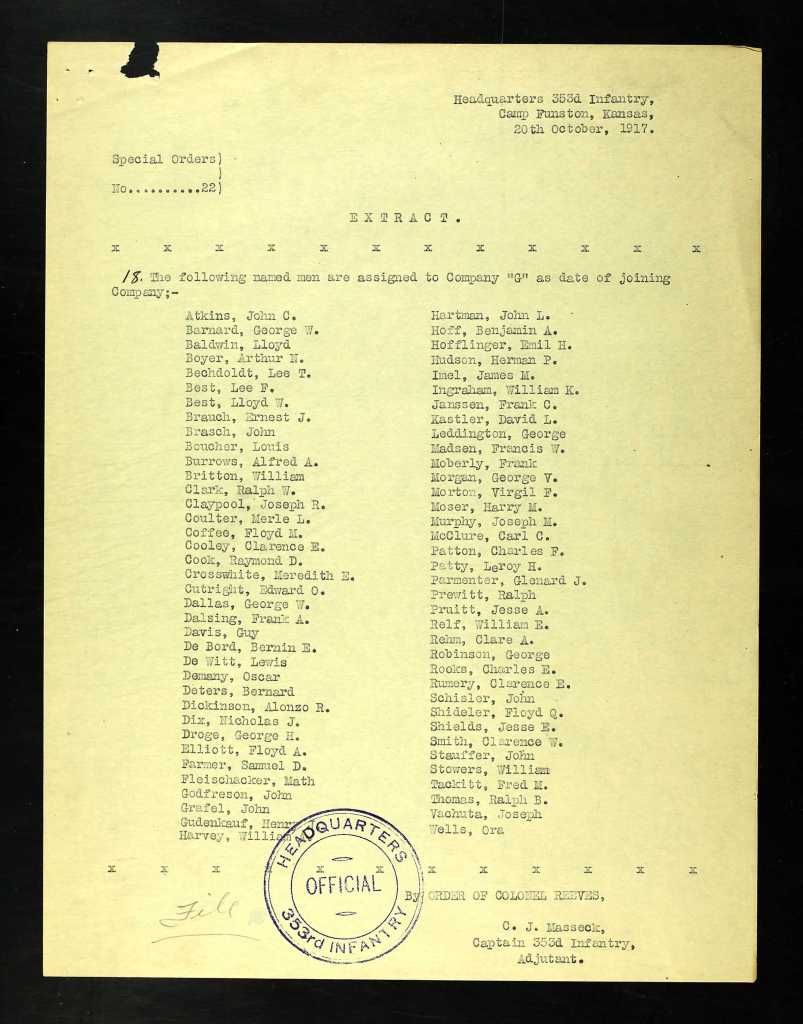
89th Division, 353rd Infantry, Personnel Records
Despite the temporary exemption, Relf enlisted in early October of 1917 and was present on the roll by October 20, 1917 at Camp Funston
William Earl Relf (1887-1964) served in World War I. He was drafted in Sept 1917, trained at Camp Funston in the first half of 1918, and set sail in June 1918. He returned to the US in 1919. One of his letters home was published in the local newspaper.
“Say, tell all the folks to take time and write; they will live just as long. They all have writing desks or tables to write on, and it is much easier than writing on a board on your knees in the trench. We boys read each other’s letters, we are so glad to hear from home. ”
From W.E. Relf’s letter published in the Modern Light, a local newspaper, for Columbus, Kansas on 17 October 1918, page 11
Picture is of William E Relf and his wife, Ella Crookham, dated 1918.
Letter transcribed:
From Wm. E. Relf
August 21, 1918
Mr. Thomas Relf, Columbus Kansas
Dear Father and Mother and Homefolks:
I received your letter with Ella’s and was glad to get word from home once more. This leaves me well and hope it will find you the same. Yes, Dad, I see Rooks and Larson and lots of the Cherokee county boys. They are in the same company and battalion with me. But I am working in the offers’ mess hall and the other boys are on the line. I am in the trench helping cook. I suppose you can see me carrying “chow”. I am have some experience over here, and lots of shells bursting around me. One bumped me on the elbow, something more than a mule kick. It was a “dud.” It never burst. It came down through the mess hall and spoiled the officers mess. Ha, ha! I get upon the parapet and watch the shells burst in the air, and then jump in my dugout before the pieces fall.
The Huns are on the run; they don’t like the way the Americans fight. They say they shoot to kill. Guess the Americans are a little rough with them, but who started the row. Guess they don’t think of that.
I see air raids every day from where I am.
I saw Dick Chase’s letter in The Modern Light, and from other boys I know. I like to get the papers from home. I like to see what the neighbors are doing. How are Ben and Charley making it? Tell Charley he ought to have this kind of a thresher that two men turn by hand and one feeds it. Some thresher.
This is an awfully rough country. Mountains rather than hills.
Say, tell all the folks to take time and write; they will live just as long. They all have writing desks or tables to write on, and it is much easier than writing on a board on your knees in the trench. We boys read each other’s letters, we are so glad to hear from home.
Give all the “kids” my address and let me hear from you all. Good-bye.
W.E. Relf
Rooks & the Cherokee County Boys
Company G, Relf’s company, made their “debut in the froont line trenches” on August 15th, according to the Company History, digitized at Missouri Digital History. The company historian recorded the events after their arrival, naming Rooks, who is most likely the same Rooks mentioned by Relf in his letter:
Sims tried to wing a fox early one morning with his automatic rifle, and Rooks tried to kill the rats of No-Man’s-Land with hand-grenades, but otherwise nothing of importance happened except the barrage of the morning of August 19th, which the Germans threw over in a vain attempt to cut off the patrol which the company had out that night.
page 3
The “duds” kicking like a mule
The training season for Company “G” came to an end at last, and in the first week of August they were taken to the front in motor trucks…. In the Lucey section of the Toul sector Company “G” received its first baptism of fire. On the morning of August 7th reveille was sounded, not by the blast of the bugle but by the discordant whining of German shells. This was in the Bois de St. Pierremont, to the left of the little village of St. Jean….Dodging anti-aircract “duds” furnished much harmless sport for the boys.
In 1851, Chloe Lake, age 82 years, swore on oath the following declaration in order to obtain the benefits due the widow of a war veteran. She was denied a pension as she did not provide details of his service.
She is the widow of Asa Lake, deceased, who was a private in the army of the war of the Revolution.
She was married to said Asa Lake in Hampshire County in the state of Virginia by a Baptist Clergyman the name of Cropley in the month of September in the year AD 1788.
Sworn Testimony ratified by the Justice of the Peace in Hancock County, Ohio
Asa Lake (1764-1844) lived in Mason County, Kentucky around 1790 at the same time that Colonel Simon Kenton and Daniel Boone had established the community of Maysville, Kentucky.
Lake Family
The Lake family lived in and around Mason County, Kentucky until 1799 when they left Kentucky for Ohio near Scioto River, where they settled near the Scioto Salt Works. Joseph Conklin, a former resident of Mason County had gone there previously in 1795.
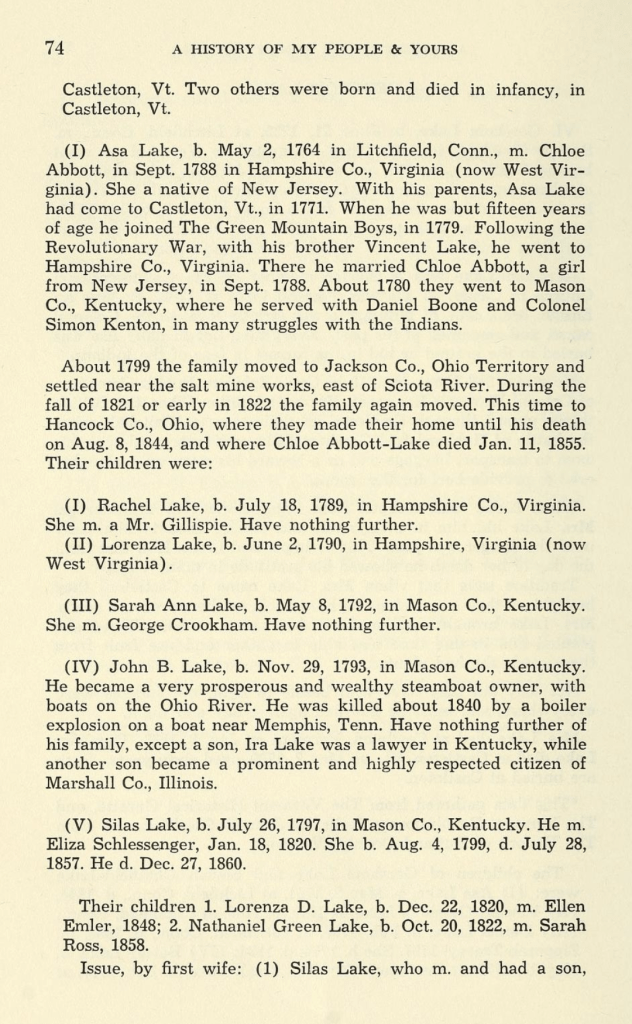
Page 74 details the Lake’s Family movements within Kentucky. The author wrote that Asa Lake and Chloe Abbot had been married Hampshire County, Virginia in 1788 and then in “1780 they went to Mason County, Kentukcy, where [Asa Lake] served with Daniel Boone and Colonel Simon Kenton in the many struggles with the Indians.” Based on the later birthdates of the children and the marriage date, it seems that 1780 is a typo, and that in fact, the family went to Mason County around 1790.
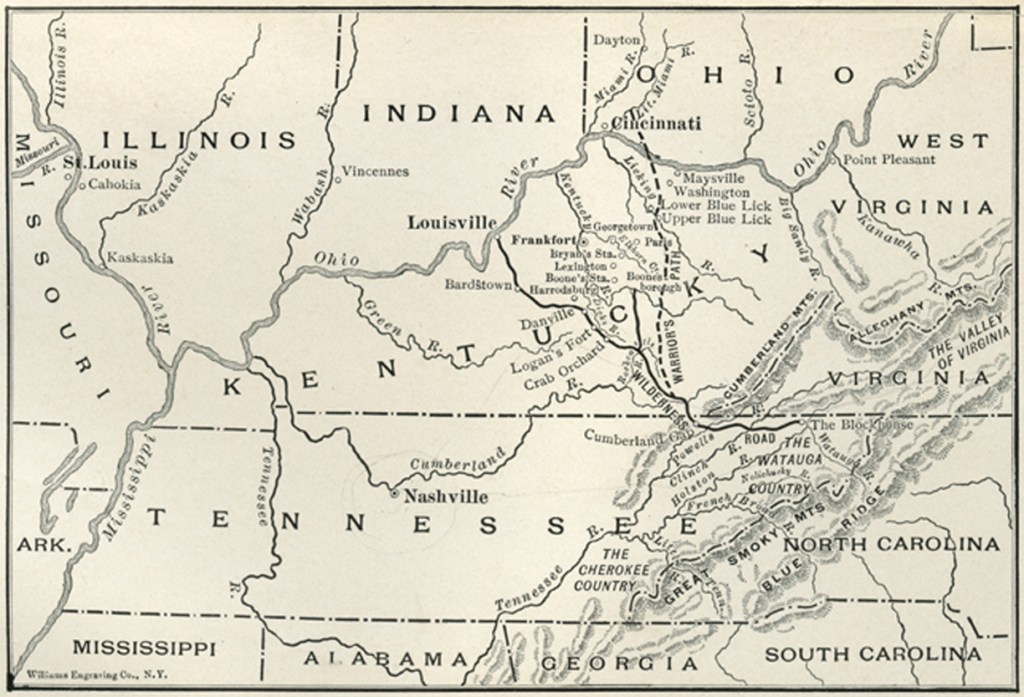
Map of the Wilderness Road showing connecting roads Lewis-Genealogy.org
On the Ohio River and within Mason County, is a town called Maysville which has connections to both Kenton and Boone.
“Limestone [Maysville] is considered the Landing place or Port of Kentucky. Goods are landed there for Danville, Lexington, etc. etc. A small town founded six years ago at a distance of 4 miles on the Lexington Road, is called Washington and is very flourishing being situate in very fertile land.”
From the journal of Andre Michaux as recorded in the History of Maysville and Mason County, p 117
Lord Dunmore’s War
In 1774, Euro-American trappers, traders, and speculators fought Shawnee and Mingo American Indian nations for land west of the Allegheny mountains in now West Virginia, Kentucky and Ohio. Militias were raised from Augusta, Botetourt, Fincastle, Bedford, Culpeper, Dunmore and Kentucky Counties.
Both Simon Kenton and Daniel Boone fought in the war before joining Patriot forces in the Revolutionary War.
Simon Kenton
At the end of Dunmore’s war, Kenton returned to the area around Mason County, Kentucky on the Ohio River in order to explore the land himself. He spent many years in this region exploring it during and after the Revolutionary War.
In 1784, Simon Kenton built a station, or frontier fort, near what would become Maysville, Kentucky, in Mason County. He had traveled by flat-boat down the Ohio River with other settlers. Kenton’s Station was intended to keep the Euro-American settlers safe from Native Americans. In 1785, even more stations were built as even more settlers came to the Kentucky frontier.
“They were one-storied, one roomed structures, with no widows ‘for pesky Indians to climb through’. Barring the doors at night was not enough for these isolated dwellings. In the morning, the head of house first climbed a ladder, always leaning against the left side of the door, and looked through the cracks for Indians.”
History of Maysville and Mason County, page 49 | Photo by Greg Hume
By the spring of 1789, great flatboats were arriving “at a rate of thirty” each day. Kenton remained in his role a guardian and protector of the Euro-American settlers. The settlement of the Ohio River Valley was daily warfare and conquest and today the battles are known as the Northwest Indian War, the Ohio War, and Little Turtle’s War.
Flatboat in foreground | wikipedia.rog
Daniel Boone
In 1787, Daniel Boone acquired land and become vested in the town of Limestone, which became Maysville. He built a tavern and trading post. Many of his family came as well, including Jacob and Edward Boone. Some of his family settled in the nearby Bourbon County.
During this time Daniel Boone was trying his hand at land speculation. He invested in real estate, yet through careless record keeping and extra-legal deals, he was unable to profit from his ventures. By the late 1790s, he left Kentucky for Missouri.
George Lennox Crookham was an early salt boiler at the Scioto Salt Licks in Jackson County, Ohio. He came to the area in 1799, having moved from Pennsylvania. Asa Lake, Crookham’s father-in-law, owned one of the salt-furnaces. His salt furnace was located “not far from where the bridge crosses Salt creek on the Chillicothe road”.
One of the earliest Euro-American settlements in the Northwest Territory was near Jackson, Ohio in 1795, due to its proximity to salt, a critical mineral used for preserving meat and seasoning food. This became the location of the Scioto Salt Works along the Salt Lick Creek. Prior to the Euro-American settlements, animals since pre-historic times and Native Americans established trails to the salt licks.
Euro-American Settlements
Throughout the last half of the 18th Century, there were multiple conflicts between European Colonist and Native American tribes over the lands in the Ohio River Valley. The Ohio River was a shifting border between the land taken by the colonist and the lands reserved for the Native Americans.
The Treaty of Greenville in 1795 redefined the border between the Native Americans and the Euro-Americans once again and the land north of the Ohio River now included settlements of Euro-Americans.
The period from the Treaty to 1803, when Ohio became a state, was called “Squatter Sovereignity” as individuals and families came to the salt licks. The land was reserved by the US Government, so it could not be purchased and there were no means to lease it.
The majority of the salt boilers of this period were forced to transients. They came in the summer, made salt for a few months, and when the waters rose in the fall, flooding the bottoms, they returned to their homes.
History of Jackson County, page 67
Boiling Salt
Early salt production used single kettles to produce salt. Later salt production included the creation of salt furnances that held 50-60 salt kettles. They would boil 3,600 gallons of brine water to produce 8 bushels of salt in a 24 hour period.
Harper’s Weekly Jan 1865 This picture is of a salt furnace in Saltville, VA during the Civil War
The salt industry required a great amount of wood, and the land was stripped of its forests in order to feed the demand of the salt furnaces.
By the 1820s, the salt furnaces were no longer profitable and Asa Lake moved his family to Hancock, Ohio. George Crookham stayed in Jackson, Ohio and was a teacher and geologist.
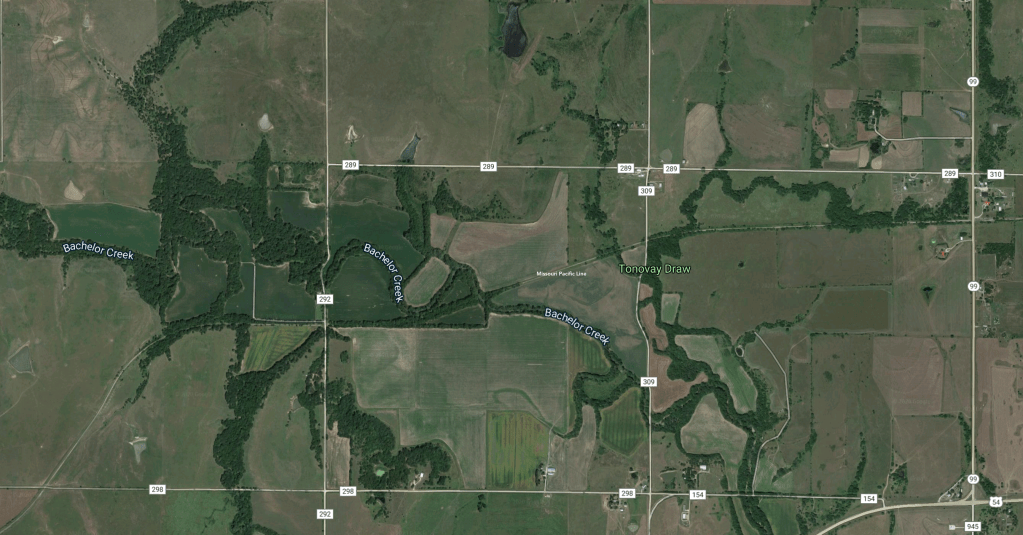
Oliver C. Crookham (1854-1890) owned land in Bachelor Township along the Missouri Pacific Railroad line. His shooting accident happened near both the railroad line and Bachelor Creek.
Plat Book of Greenwood County | page 27 | kansasmemory.org
In the southern part of the township, the Missouri Pacific line travels east west. From the east, it travels through the town of Tonovay before it goes through the Crookham land to join the Atchison Topeka railroad into Eureka.
Screenshot from Google Maps showing the parcel of land immediately west of Tonovay
Oliver C. Crookham (1854-1890) was laid to rest after a fatal gun shot wound in the Eureka Cemetery. “The large number of people, more than two hundred, who were present at the services fully attest to the esteem and regard entertained for the noble dead. ” (Eureka Herald and Greenwood County Repubican, 14 Nov 1890, page 4)
Details of the Service
Crookham was buried on a Friday afternoon. The services were conducted by Rev. William Sparr at the Crookham home.
The newspapers claimed that “it was a cold day, but the funeral process was the largest seen in the this community for years.” (Greenwood County Republican, 12 Nov 1890, page 1)
There were fifty-seven carriages, buggies and wagons in the O.C. Crookham funeral procession last Friday.
Eureka Herald and Greenwood County Republican | 14 Nov 1890 | page 4
Loss of a Man
Upon his death, the newspapers were filled with resolutions of respect and statements of character of O.C. Crookham:
“He had no enemies. All were his fiends. He went about doing good to all with whom he come in contact. ‘ He loved his neighbor as himself.’ … There is not a man in Bachelor Township who is not mourning this good man’s death. They will miss him as a business man, and as a neighbor and a friend.” (EHAGCR, 14 Nov 1890, page 4)
Eureka Herald and Greenwood County Republican | 14 Nov 1890 | page 4
“As a business man his dealing were always honest, square, and liberal. Probably no man in Greenwood County had more friends or fewer enemies.” (Democratic Messenger, 07 Nov 1890, page 3)
Oliver Cromwell Crookham (1854-1890) died from a gun shot wound that he received while hunting rabbits in Greenwood County, Kansas. The quotes below are from page one of the Greenwood County Repubican on 12 Nov 1890.
Details of the Accident
“Mr. Crookham had just returned from Eureka where he had been to learn of the election news. He ate his dinner and took his gun and went out in his field to kill some rabbits. As had been his custom he walked onto a larger pile of hedge brush to frighten the rabbits out. He had killed one, and was probably striking the brush with his gun to frighten another out when the hammer struck a limb which causes the discharge of the load.”
Description of the Injury
“The contents [of the load] entered his abdomen about two inches above the navel and lodged in his stomach. Notwithstanding the fatal shot, the unfortunate man had the presence of mind and the vitality to crawl to the creek, a distance of probably 50 yards, where he extinguished the fire which was burning his clothes, after which he crawled about 30 rods to the railroad.”
Railroad Rescue
” About halfway between where the accident occured he found a falt stone, upon which he wrote: “I was here at 1:00 o’clock! (this stone was found by A.P. Loveland the next day.). When he reached the railroad he took a slip of paper from his pocket and wrote the particulars of the accident as above state, and said he was shot at 12:30,. About 4:00 o’clock the east bound passenger train found him lying close to the track. He signaled it to stop, which was down and backed down to where he lay, and Messrs A.P. Loveland and John Sherman, of Neal, got off the train and took him home.”
Last Hours
“At this time, after four hours after he had been hurt, he was very weak from loss of blood, but had sufficient vitality to converse with his friends A carriage was sent for and the poor dying man was conveyed to his home, where he was met by his now almost distracted wife and five sorrowing children. He seemed to realize from the first that he could not survive. When Dr. Pierce and Dr. Watson arrived, Mr. Crookham enquired of Dr. Pierce if he could live? The doctor answered in the negative, but the answer did not seem to disturb his mind in the least. Ira P. Nye arrived at the house in the evening when the dying man, in a business like way gave him a detailed statement of the condition of his business affairs, and but a short time before he breathed his last, he told Robert Wiggins and Orr Henderson that he trusted in the Lord and was perfectly reconciled to die, and then requested Mr. Wiggins to wash him and dress him for burial after he was dead. He breathed his last at 1:25 Thursday morning surrounded by his family and friends. “
Robert Lewis (1856-1935) had around 35 acres of strawberry fields on his farm in Newton County, Missouri.
In the Nov 24, 1929 issue of the Joplin Globe, the Chamber of Commerce ran an article describing Joplin as the “Center of a Rich Farm Belt” and that during the season, “solid trainloads” of Ozark strawberries are shipped out for the markets. The article valued that the strawberry crop alone was worth between $3.5 and $6 million dollars annually — thats about $90 million dollars in 2020.
Strawberry Special Leaving Sarcoxie, Mo | frisco.org
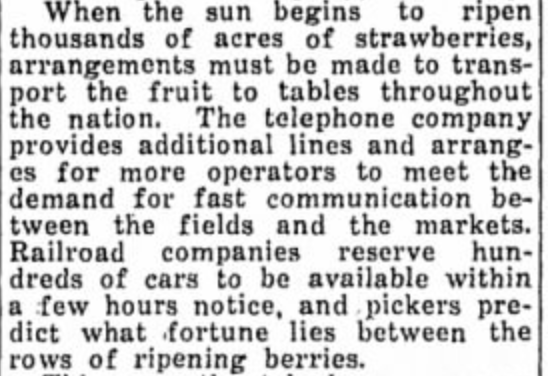
Strawberries, being a highly perishable crop, inspired the use of technology to ensure they were sold at markets. Both the railroads and telephone companies adapted their practices to the strawberry harvest.
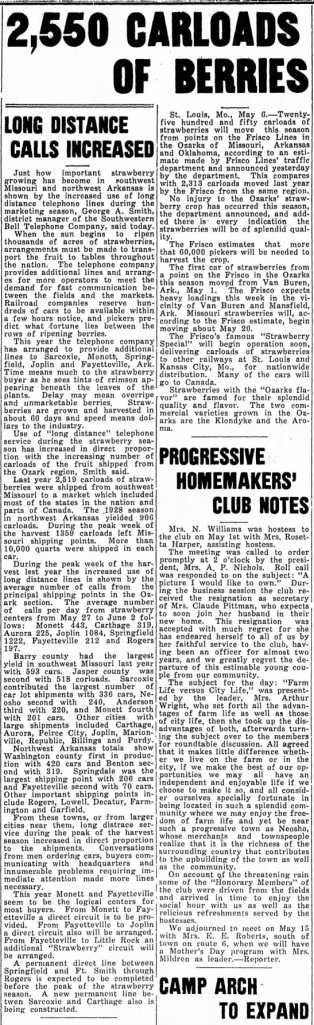
In Railway Age (Volume 85, 1928) the magazine estimated that the St. Louis-San Francisco rail line handled 2,400 refrigerated cars of strawberries from southwestern Missouri and northwestern Arkansas. The refrigerated cars were organized by co-operatives in order to get the fruit shipped to their markets before they perished.
The Neosho Daily News Neosho, Missouri 07 May 1929, Tue • Page 1
Long before the early morning dew was gone from the ground and vegetation, the pickers gathered…
Lest We Forget, Jewell Campbell, page 29
The men and children would pick the strawberries, often earning two cents for the quart, and the women worked in the shed, sorting and culling them, preparing them for shipment to the railroad shipping point. The photos below, while not the Lewis farm, are of berry pickers in the Ozarks in the early 1900s.
D. McNallie Berry Farm | State Historical Society of Missouri
The only jobs I every had before I graduated from HS were working for my dad and picking strawberries for a neighbor… We had an old pony which I’d ride the one or three miles accordion to which neighbor I was picking for. The years Geo. [her younger brother] picked also, we’d ride double carrying our lunches in paper sacks.
The berries were usually ready to pick soon after school was out in May. If there was a heavy dew you couldn’t start picking very early in the morning because of the heavy foliage and weeks. The rows often grew together and you had to be very careful where you stepped and where you set the wooden tray on legs which contains usually 6 qt. boxes in which to put the berries. There was a wooden hand for carrying the ray. Strawberries bruised easily so they must be picked carefully being sure to break off a short stem and not pull the “cap” from the berries.
Most years, we were paid 3 cents a quart. When we took our full trays to the shed to exchange for empty ones, we were given a ticket for each quart we had picked. These were redeemed at the end of the season. I was not a fast picker but think I may have made between $5 and $10 a season depending on how good the berries were that is– how bg and how easy to find among the foliage to pick.
I usually wore overalls and a long sleeved shirt and straw hat.
From Irene Vanslyke’s handwritten autobiography. Irene Vanslyke was the grand-daughter of Robert Lewis. Born in 1920, she was raised in Newton County, near her grandparents.
Wyman Farm | State Historical Society of Missouri
The Neosho Daily News Neosho, Missouri 07 May 1929, Tue • Page 1
Cader Edwards (1705-1782) moved from Baltimore to the land along the Allegheny Mountains beginning in 1755. First, he moved across the mountains into what is now West Virginia, and then back across the mountain lines in 1764 onto the headwaters of the New River, “a wild region of high hills and narrow valleys, lying between the Blue Ridge and the main ridge of the Alleghanies”. Then he moved across the mountain divide to the Shelby settlement on the Holston River in what is now Sullivan County, Tennessee in the early 1770s
Great Indian Warpath
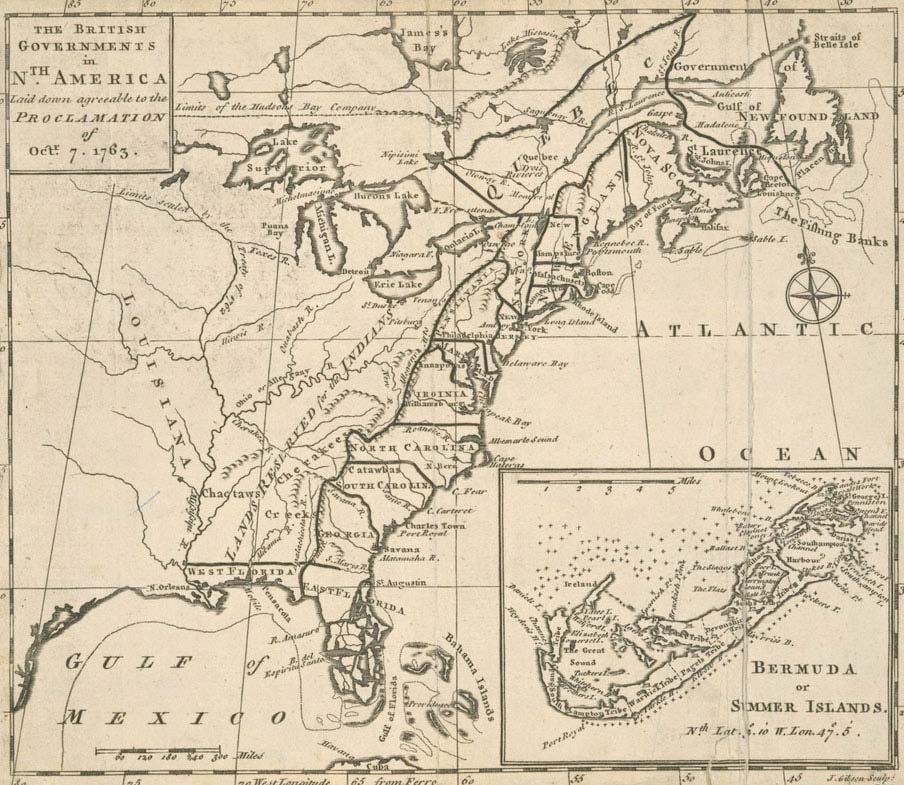
Stretching from upper New York to the South, the Great Indian Warpath was a series of footpaths used for thousands of years by the Native Americans to trade. The trail became the western border for the colonies following the French and Indian War. King George II’s proclaimed in 1763 that European Colonists must reside on the eastern side of the path, leaving the west for the Native American nations. In time, it became the Great Wagon Road, as Euro-Americans moved west out of the colonial lands into the interior lands held in reserve for the Native Americans.
history.org
Cader Edwards had settled on land described as “on the headwaters of the James River” and in what is now considered to be Greenbrier County, West Virginia prior to the proclamation on land had been the historic hunting grounds of the Shawnee and Cherokee Indians. With the proclamation, he had been ordered by his King to return to colonial lands. In 1764, he left this area for land on the other side of the line.
Here he remained until the spring of 1764 when he went with several families of his neighborhood, to found a new settlement.
page 12
Squabble State
The Edwards family did not stay in the new neighborhood for more than a few years, and by the early 1770s, had moved to a new Shelby settlement on the Holston, in what is now Sullivan County, Tennessee.
Then, it was land claimed by both North Carolina, Virginia and the Cherokee Indians.
The border between North Carolina and Virginia had not been surveyed that far and Euro-American settlers moving along the Great Indian Warpath south from Virginia into what would become Tennessee long believed that they were still part of Virginia even though North Carolina claimed them.
In 1778, both colonies named and empowered teams of surveyors to determine the border. It was not until 1802 that a compromise was reached between the states.
Holston Settlement
The Holston Settlement, along the Holston River, is considered to be one of the earliest European colonial settlements in Tennessee. Most of the individuals came from Virginia, traveling down the Shenandoah Valley into the Tennessee River Valley. The mountains blocked access from North Carolina.
Evan Shelby, an Indian fighter, settled in the region, establishing a general store, tavern and inn near what would become Bristol, TN. His son, Issac Shelby, came with him to the settlement and together they fought the Cherokee Indians who were trying to keep the European settlers from invading further west. He and his father had fought in Lord Dunmore’s War, which had been a battle over territory near the Ohio River with multiple Native American tribes.
A few years later the Old Captain again moved southwestward, crossing the mountain divide to the new Shelby settlement on the Holston…as he was well acquainted with the Shelby family and with many of the other settlers, it did not seem this time like moving among strangers.
page 12
Chickamauga
In 1776, several Cherokee Indian tribes no longer were intent on conflict with the Euro-Americans due to military setbacks. Some tribes continued to fight against the colonists, following a leader named Dragging Canoe and in conjunction with the British continued to attack colonists who had come into the Tennessee River Valley.
The Indians, incited by the British and the Tories, about this time determined to exterminate the settlers on the Holston… the fury of the storm, coming up the Tennessee and French Rivers, wer met and held back by men of the Robertson, Sevier and Shelby settlements on the Holston and Nolichucky.
page 16
The Edwards family joined the war against the Cherokee and other tribes in order to take Native Americans’ land.









 Finding the Yellow Bricks