In the biography of James Crookham’s grandson, he recounts that his grandfather made arms for George Washington during the war. War records indicate that he served in the Pennsylvania Regiment of Artillery and Artificers near Carlisle, PA at Washingtonburg. He enlisted in November of 1778. Capt. Thos. Wylie certified his attendance on the muster roll in April 1780. Records indicate he deserted in April 1781.
Washingtonburg
In January, 1777, George Washington wrote a letter to Benjamin Flowers to establish a “laboratory” for “the preparation of fixed Ammunition of every Species” to supply the Continental Army. Washington specified at least forty blacksmiths in his letter. Colonel Flower, Commissary General of Military Stored, requested additional men from Yorktown (in York County, PA) the he might “have from Yorktown tradesmen from the works of Carlisle, Carpenters, Farriers, Gun Smiths, Tinmen, Saddlers, Showmakers.” In this context, laboratory is a munitions factory.
Recruitment Advertisement from a New Jersey newspaper
Carlisle, April 18, 1778.
Wanted immediately,
A number of good TRADESMEN, that are single, such as Carpenters, Smiths, of all branches, Armourers, Gun- stockers or Wheelwrights. Any of the above Tradesmen that are willing to serve themselves and country, shall, by applying to Cap. Wylie, at the grand Continental works at the above-mentioned place, receive twenty-dollars bounty, thirty dollars each man per month pay, one suit of clothes per year, and a ration and a half each man per day, and good quarters.
THOMAS WYLIE, Capt. Art. Artific.
Documents Relating to the Revolutionary History of the State of New Jersey. (1903). United States: John L. Murphy Publishing Company.
A depot had been established near Carlisle during the French and Indian War, and at that time, it was known as Washingtonburg. It was on this site that Congress chose to create the ammunition laboratory for the duration of the war starting in 1777. Positioned near the frontier, it had the mountains to the west and was along transportation routes long-established by Native Americans.
Washingtonburg, during the Revolutionary War, became “a very busy place, and it must have been of considerable extent, for there were workshops in which were manufactured military supplies of the most varied character for the Continental Army; the artificers were numbered by hundred, and had there their lodging and boarding houses.” The meat bill in 1781 consists of 150 head of beef cattle.
By 1780, morale had plummeted at the barracks. The British and their Native American allies had disrupted the supply chain with raids, and continental currency had undergone inflatation, further limiting the amount of goods the Army was able to procure for the artificers and artillery at Washingtonburg. In 1781, a commanding officer wrote to Washington claiming that the men were subsisting on flour and whiskey.
Additionally, in a letter to George Washington, dated 1780, Flowers described the effect of low pay on the men who were beginning to reach the duration of their enlistment, as many of the men enlisted for three years, and their term of service were beginning to occur in 1780, 1781, and 1782. George Washington offered a bounty of $100 for the continued enlistment of men, and Flowers replied that this would have little effect on the artificers as they were “tradesmen and could effect $30 or $40 dollars” a day in trade.
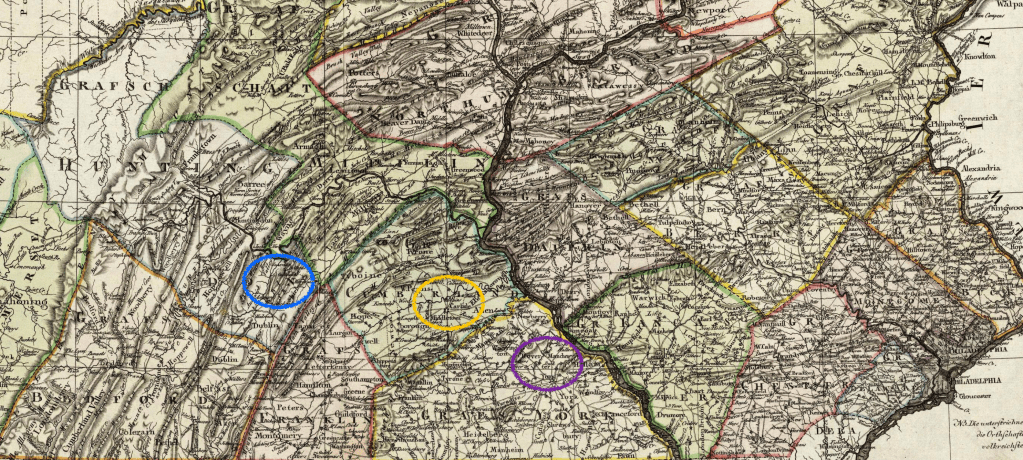
The yellow circle, Carlisle, and the blue circle, Shirley, Huntingdon PA, where Crookham lived after the war.
Map of Pennsylvania. 1792. | David Rumsey Collection
Deserters
The Pennsylvania Packet, a daily advertiser newspaper established in 1771 was used by the leadership at Washingtonburg and other military installations to advertise for deserters. Below is an advertisement for three deserters that Captain Thomas Wylie ran in the summer of 1779.

Another from 1779:


A search does not return an advertisement for James Crookham. This omission has suggests two possibilities:
- No advertisement exists
- Crookham was discharged, and did not desert the army.
The Army was still using the Pennsylvania Packet in spring of 1781 to put the call out for gunners and were still identifying deserters as evidenced by this advertisement placed in March 1781, one month prior to the date recorded for Crookham:
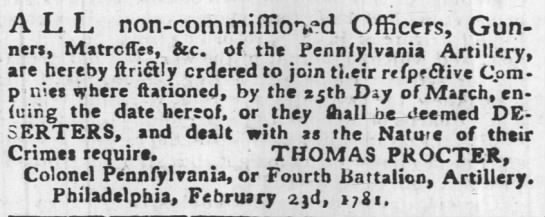
And again in August 1781:

This suggests that the advertisement does not exist. The Pennsylvania Packet was published and digitized for the timeframe that we would expect an advertisement to run for Crookham’s return.
As no advertisement was likely run, it seems possible that Crookham did not actually desert. Crookham enlisted in 1778, and the typical enlistment was for three years. His term of service would have been up in 1781; desertion close to his discharge seems imprudent. In 1782, he is living in the next county over from Carlisle, and Washingtonburg. If he deserted, he did not run very far way. Seven years after his recorded desertion, in 1788, he served in a local militia in Huntingdon. As desertion was a serious crime and at times punishable by death, it seems unlikely that the militia would accept a known deserter.
Sources
Historic Carlisle Barracks | https://www.armywarcollege.edu/history.cfm
Humrich, Christian Philip, Jr. Washingtonburg. [Carlisle? Pa, 1907] Web.. https://lccn.loc.gov/07036285.
Washington: Revolutionary War Arsenal at Carlisle |. 1992 Winter, Volume 9, Issue 2
Pennsylvania Packet | newspapers.com
 Finding the Yellow Bricks