William Goff | Cape May Connections

William Goff, a native of Ireland, who came to America during the colonial days preceding the Revolution, and during the war was employed by the government as a ship carpenter. Shortly after coming to this county, he married Prudence Passenger, a courageous colonial maid… John Goff [his son] was born in New Jersey previous to the time his family located to Hamilton County.

History of Franklin County, Indiana by August Jacob Reifdel

Some variation of this is told in multiple county histories for the great-grandchildren of William Goff: He emigrated from Ireland to New Jersey, married Prudence Passenger, served as a ship carpenter, and moved to Hamilton County, OH around 1804 where he lived his life as a farmer.

Many researchers have concluded from this that because William was an Irish Immigrant during the wave of Scots-Irish immigrants who came during the 1770s that he must have come from Ulster, a reasonable conclusion given that two-thirds of Irish immigrants during this time came from Ulster and were Presbyterians.

In contrast to this, I think it is reasonable to believe that he may have immigrated from Wexford County, Ireland, one of the southern colonies, and that he emigrated to join family members who had already established themselves in the colonies in the Upper Township area of the County of Cape May.

Evidence from Ohio

The histories of the counties in Ohio and Indiana state that William Goff immigrated from New Jersey to Ohio around 1804. He purchased land and settled as a farmer for the rest of his life. His son’s wife, Lucy(Johnson) Goff, raised sheep and flax to make clothing for the family and as a cottage industry.

The Deed Index for Hamilton County, Ohio lists William Goff purchasing land from D. Van Gilder (L 125) between the years of 1812-1814, the same years William Goff of Hamilton County, OH received a Credit Volume Patent for land purchased on credit from the US Government in Franklin County, IN. (hcgsohio.org; glorecords.blm.gov)

The name D. Van Gilder appears again in Ohio connected with William Goff. When Goff’s will was presented for probate in 1821, David Van Gilder and William Ruth served as witnesses as to the authenticity of the will, and in the 1820 Census, David Van Gilder is enumerated on the same page as William Goff, in close proximity. (ancestry.com)

David Van Gilder was from Cape May County in New Jersey. He immigrated to Ohio around 1812, leaving behind the Upper Township of Cape May and Cedar Swamp. The Van Gilders were Dutch immigrants who had lived in Long Island prior to sailing to New Jersey in the mid-1700s and settling near Cedar Swamp near present-day Petersburg. (Source 1; Source 2)

Nearby, near the Tuckahoe River to the northwest, lived the Goff Family. In fact, both a John Goff and Isaac Vangilder witnessed a will that was probated in 1796 in County of Cape May, suggesting they were neighbor or relatives. Additional connections are suggested by the surnames of married couples. David Vangilder married Ann Shaw in 1795. Both Hannah Goff (1770) and Nathan Goff (1780), also married a Shaw, Thomas and Mary respectively.

Cape May, New Jersey

John Goff is the earliest recorded Goff in the County of Cape May (ear-mark in 1710) and it is likely that he immigrated with other families from Long Island and New England to Cape May. The Quaker families settled primarily the Upper Township area where the Goffs and the Van Gilders lived. A Friend’s Meeting House was established in Tuckahoe. Over the course of the 1700s, Quakerism declined and was replaced by Methodism.

The Goff family was one of the early converts to Methodism, converting in the 1770s; by the late 1790s, at least two Goffs were Methodist Ministers. In Ohio, John Goff, the son of William Goff, was an active Methodist, as well. (Source 1; Source 2; Source 3; Source 4)

The Biographical, Genealogical and Descriptive History of the First Congressional District of New Jersey details the family of David Goff, naming five sons, one of whom was “William, who went west”. In 1793, David Goff, Sr. will was presented for probate, and it details land given to him by an old mill and his brothers William, John, and David.

It is as likely possible that William was the “William who went west” and/or William arrived from Ireland to join the Goffs in Cape May, as a relative from the old country.

Irish Immigration

The article, Irish Immigration to the Delaware Valley before the American Revolution, describes Irish Immigrants as having easy access to seaports with established links between the Irish and the overseas locations through personal connections. This provided Irish Immigrants with a wealth information about prospective places for immigration. As such, it is likely that William Goff had connections with New Jersey prior to leaving Ireland and one likely connection was related Goffs who had had already settled in Cape May.

The Goffs in Cape May were part of a maritime economy that exported livestock and timber as well as the cottage industry of producing woolen mittens and stockings. Many of the men living in Cape May were full or part-time mariners. When either the British government (during the French and Indian War) or the American Continental Congress (during the Revolutionary War) hired privateers, many of the Cape May families invested in privateer ships and outfitted them for raids. This suggests that the Goffs were engaged in trade with connections to Ireland.

Which poses the question: where did William Goff sail from in Ireland? Did he sail from the north, where two-thirds of the immigrants said from? Ulster Presbyterians made up the bulk up of the immigrants to Pennsylvania in the year prior to the war. However, due to the connections with Cape May (Vangilden Family) and with the religious make-up of the county (Quakerism and Methodism), it seems more likely that William Goff came from a region of Ireland with tighter ties to Quakerism rather than Presbyterianism. The southern counties, Wexford and Waterford pop up in the 1850 Irish Surname Distribution map as a place where Goffs lived in Ireland and they pop up when the name Goff is searched in findmypast.com. Many of the records returned are from the Society of Friends.

This suggests that William Goff is not a Scots-Irish immigrant from Ulster, rather a Quaker/Methodist from the southern colonies of Ireland. His migration with the Vangilder family from Cape May, coupled with the connection to Methodism in both Cape May and the Northwest Territory suggests this alternate origin story.

Sources:

Ohio. Probate Court (Hamilton County); Wills, Vol 25-26, 1823-1884, ancestry.com

1820 U S Census; Colerain, Hamilton, Ohio; Page: 345; NARA Roll: M33_87; Image: 286, ancestry.com

Cape May County, New JerseyThe Making of an American Resort Community

History of the Ten Villages of Upper Township: Petersburg, Part 1

Biographical, Genealogical and Descriptive History of the First Congressional District of New Jersey

Geology of the County of Cape May of the State of New Jersey

The Cape May Navy: Delaware Bay Privateers in the American Revolution

Wokeck, Marianne S. “Irish Immigration to the Delaware Valley before the American Revolution.” Proceedings of the Royal Irish Academy. Section C: Archaeology, Celtic Studies, History, Linguistics, Literature, vol. 96C, no. 5, Royal Irish Academy, 1996, pp. 103–35, http://www.jstor.org/stable/25516172.
Levi Garrison | Symmes Purchase

After the Revolutionary War, Levi Garrison emigrated from New Jersey into Pennsylvania and into Ohio. In 1798, he received 108 acres from John Cleves Symmes in the Colerain Township as part of the Symmes Purchase in southwest Ohio (C1, 4)

Symmes Purchase

John Cleves Symmes was the father-in-law of William Henry Harrison (9th President in 1840). During the war, he was active in Sussex County, New Jersey and was a representative in the Continental Congress. After the war, he petitioned Congress for a million acres in the Northwest Territory, and was signed over approximately 300,000 acres. He paid about 66 cents for an acre.

The land is located in southwest Ohio, between the Miami and Little Miama Rivers. As a result, the land surveyed was often called “Between the Miami” and his purchase was at times called the Miami Purchase and at times called the Symmes Purchase.

The methods used to survey the land resulted in multiple errors and created disputes among settlers, as land was sold twice and those who purchase land from Symmes became squatters.

Colerain Township

In 1789, The US government built Fort Washington in what is now Cincinnati, Ohio, to allow Euro-Americans to settle the Miami River Valley which was already occupied by Indigenous People.

Many of the tribes in this area refused to sign or recognize treaties proposed by Euro-Americans. During the Revolutionary War, many had allied themselves with Britain to prevent settlers from taking their homes and lands.

Symmes explicitly petitioned for the erection of fortifications. He was worried that Shawnee defense of their lands would prevent further Euro-American migration and prevent his profit from land sales.

Multiple expeditions and attacks against Miami and Shawnee tribes were launched from Fort Washington in the 1790s. The fort was abandoned in 1803.

19th Century Wood Engraving of Fort Washington | loc.gov

Symmes enlisted John Dunlap to survey land as part of his purchase, and Dunlap traveled along the Miami River in 1790. He settled along a great bend in the river and named the area Coleraine as it reminded him of his home in Ireland. It’s along the border between current Hamilton and Butler County. He established Dunlap’s station in order to fortify the Euro-American incursions into Indigenous People’s lands. The station was involved in multiple attacks and Dunlap and the families abandoned it for a different station that was better fortified. Euro-Americans used retellings of the attacks to fuel anti-Indian sentiments among the settlers. The area was established as a township in 1794 the same year as the Treaty of Grenville which forced the Indigenous People to leave. They were relocated to the northwest corner of Ohio State.

It is after this that the Garrison family arrived. They purchased the land from Symmes in 1798 and an 1817 tax list includes a Levi Garrison, Sr. who is residing in Range 1, Township 2, Section 6 of Colerain, Hamilton county (familysearch.org, Ohio Tax Records, 1800-1850,” database with images). A township map from Hamilton Country Recorder’s Office, suggests that the Garrison family lived in the vicinity of what is now the intersection of 1-275 and Pippin Road, near Tripple Creek Park.

James Crookham | Artificer

In the biography of James Crookham’s grandson, he recounts that his grandfather made arms for George Washington during the war. War records indicate that he served in the Pennsylvania Regiment of Artillery and Artificers near Carlisle, PA at Washingtonburg. He enlisted in November of 1778. Capt. Thos. Wylie certified his attendance on the muster roll in April 1780. Records indicate he deserted in April 1781.


Washingtonburg

In January, 1777, George Washington wrote a letter to Benjamin Flowers to establish a “laboratory” for “the preparation of fixed Ammunition of every Species” to supply the Continental Army. Washington specified at least forty blacksmiths in his letter. Colonel Flower, Commissary General of Military Stored, requested additional men from Yorktown (in York County, PA) the he might “have from Yorktown tradesmen from the works of Carlisle, Carpenters, Farriers, Gun Smiths, Tinmen, Saddlers, Showmakers.” In this context, laboratory is a munitions factory.

Recruitment Advertisement from a New Jersey newspaper

Carlisle, April 18, 1778. 

Wanted immediately,

A number of good TRADESMEN, that are single, such as Carpenters, Smiths, of all branches, Armourers, Gun- stockers or Wheelwrights. Any of the above Tradesmen that are willing to serve themselves and country, shall, by applying to Cap. Wylie, at the grand Continental works at the above-mentioned place, receive twenty-dollars bounty, thirty dollars each man per month pay, one suit of clothes per year, and a ration and a half each man per day, and good quarters.

THOMAS WYLIE, Capt. Art. Artific.

Documents Relating to the Revolutionary History of the State of New Jersey. (1903). United States: John L. Murphy Publishing Company.

A depot had been established near Carlisle during the French and Indian War, and at that time, it was known as Washingtonburg. It was on this site that Congress chose to create the ammunition laboratory for the duration of the war starting in 1777. Positioned near the frontier, it had the mountains to the west and was along transportation routes long-established by Native Americans.

Washingtonburg, during the Revolutionary War, became “a very busy place, and it must have been of considerable extent, for there were workshops in which were manufactured military supplies of the most varied character for the Continental Army; the artificers were numbered by hundred, and had there their lodging and boarding houses.” The meat bill in 1781 consists of 150 head of beef cattle.

By 1780, morale had plummeted at the barracks. The British and their Native American allies had disrupted the supply chain with raids, and continental currency had undergone inflatation, further limiting the amount of goods the Army was able to procure for the artificers and artillery at Washingtonburg. In 1781, a commanding officer wrote to Washington claiming that the men were subsisting on flour and whiskey.

Additionally, in a letter to George Washington, dated 1780, Flowers described the effect of low pay on the men who were beginning to reach the duration of their enlistment, as many of the men enlisted for three years, and their term of service were beginning to occur in 1780, 1781, and 1782. George Washington offered a bounty of $100 for the continued enlistment of men, and Flowers replied that this would have little effect on the artificers as they were “tradesmen and could effect $30 or $40 dollars” a day in trade.

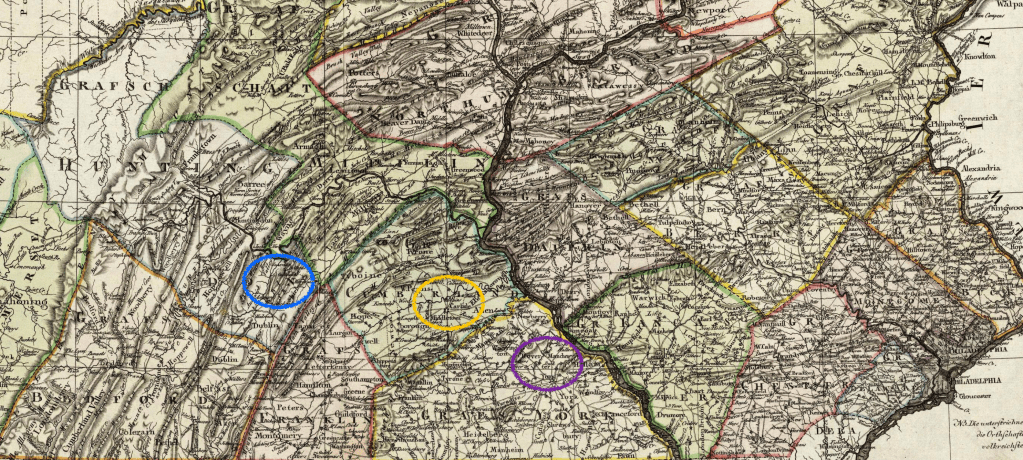
The purple circle shows the location of Warrington Monthly Meeting, Crookham’s residence prior to the war.
The yellow circle, Carlisle, and the blue circle, Shirley, Huntingdon PA, where Crookham lived after the war.
Map of Pennsylvania. 1792. | David Rumsey Collection

Deserters

The Pennsylvania Packet, a daily advertiser newspaper established in 1771 was used by the leadership at Washingtonburg and other military installations to advertise for deserters. Below is an advertisement for three deserters that Captain Thomas Wylie ran in the summer of 1779.

Jul 20, 1779

Another from 1779:

09 Feb 1779
25 Apr 1780

A search does not return an advertisement for James Crookham. This omission has suggests two possibilities:

  1. No advertisement exists
  2. Crookham was discharged, and did not desert the army.

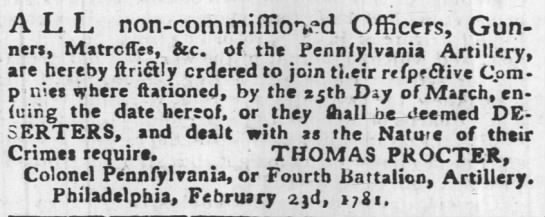
The Army was still using the Pennsylvania Packet in spring of 1781 to put the call out for gunners and were still identifying deserters as evidenced by this advertisement placed in March 1781, one month prior to the date recorded for Crookham:

06 Mar 1781

And again in August 1781:

09 Aug 1781

This suggests that the advertisement does not exist. The Pennsylvania Packet was published and digitized for the timeframe that we would expect an advertisement to run for Crookham’s return.

As no advertisement was likely run, it seems possible that Crookham did not actually desert. Crookham enlisted in 1778, and the typical enlistment was for three years. His term of service would have been up in 1781; desertion close to his discharge seems imprudent. In 1782, he is living in the next county over from Carlisle, and Washingtonburg. If he deserted, he did not run very far way. Seven years after his recorded desertion, in 1788, he served in a local militia in Huntingdon. As desertion was a serious crime and at times punishable by death, it seems unlikely that the militia would accept a known deserter.

Sources

Historic Carlisle Barracks | https://www.armywarcollege.edu/history.cfm

Humrich, Christian Philip, Jr. Washingtonburg. [Carlisle? Pa, 1907] Web.. https://lccn.loc.gov/07036285.

Washington: Revolutionary War Arsenal at Carlisle |. 1992 Winter, Volume 9, Issue 2

Pennsylvania Packet | newspapers.com

Crookham | Scots-Irish?

William Crookham married Mary Philips in 1752 in the Old Swede’s Church (Swedish Lutheran) in Philadelphia, a multi-cultural colonial city.

Mary Philips was likely a Welsh Quaker who married outside of her religion. Mary Crookham can be found in the Quaker Meeting Records for the Chester and Goshen Monthly Meetings, both in Chester County west of Philadelphia, which was part of the Welsh Tract and Philips, during 18th Century Pennsylvania was a Welsh surname.

Thomas Holmes 1687 Map of Pennsylvania | wikipedia.com

Where William Crookham was from is a murkier question as there are little to no additional records found for William outside of the Quaker records which reference him as the husband of Mary Crookham.

Settlers of Pennsylvania

The proprietor of Pennsylvania, William Penn aggressively advertised his tract of land across England, Ireland and on the continent and succeeded in attracting both Germans and the Scots-Irish settlers, who migrated shortly after the first wave of Quakers.

The Germans arrived first, mostly from the Palatinate, and they formed the foundation of what would become the Pennsylvania Dutch.

The Scots-Irish arrived to Pennsylvania second, beginning in 1717. They originally came from the borderlands of England and Scotland before following James I call to colonize Ulster County in Ireland the previous century. In 1752, the same year that Crookham married Mary Philips, the governor of Pennsylvania complained that “it looked like Ireland was sending all of its inhabitants to this country.”

Of these two groups, I chose to explore the Scots-Irish as the possible origin for the Crookham family for this post. This choice is based on my own DNA Results which suggests very little German heritage, and a greater proportion of British Isles heritage.

The Scots-Irish originally came to North America along the contested border between Maryland and Pennsylvania. Landing near Lewes, New Castle, they travelled north into Chester County, before migrating west into Lancaster County. Several Presbyterian Churches were established in the Susquehanna River valley. They moved into what would become Cumberland County, which included Carlisle Pennsylvania, before moving into the Juanita River Valley near Bedford County. When the 1796 treaty was signed with local Native American tribes, several moved across the Allegheny Mountains into Allegheny County, Westmoreland and Washington Counties.

A Map Of The State Of Pennsylvania. 1792 | David Rumsey Collection

Crookhams in Colonial Pennsylvania

In 1758, Mary Crookham applied for admittance into the Goshen Monthly Meeting in Chester County with her three children: James, Deborah, and John. In 1763, Mary is moving between monthly meetings and requests admittance on behalf of her two younger children, Deborah and John, suggesting that James is no longer living with the family.

In the 1780s, James Crookham is working as a blacksmith, suggesting that his teenage years were spent living with a blacksmith as an apprentice. Apprenticeships usually started when a boy was a pre-teen or teenager. If James were born shortly after the marriage of William and Mary, this would make him 10 years old in 1763, and one possible explanation for his omission is that he would have started his apprenticeship. As an apprentice, he would have lived with the blacksmith, rather than family, who would have provided his room and board.

He would have served for about seven years learning the trade before his release. Upon being released, he would work as a journeyman, traveling around working with other blacksmiths to learn a broader range of skills before establishing his own shop as master craftsman. His release from his apprenticeship and start as a journeyman would have been in the early 1770s prior to the outbreak of the Revolutionary War.

In 1770, James Crookham applies for a removal to the Warrington Monthly Meeting in York County, suggesting that he is released from his apprenticeship and beginning the journeyman stage of his career. In 1775, the Quaker meeting in Warrington recorded that he left the area with unpaid debts and a forged pass from the magistrate. As a journeyman, he would have been an employee for a short periods of time, suggesting that his employment was never guaranteed.

No records have been located documenting his apprencticeship and its location. It could have possibly been in Chester County, where his family lived when he started his apprenticeship, or in York County, farther west across the Susquehanna River, where the Warrington Monthly Meeting was located.

The Warrington Monthly Meeting is located about 20 miles southeast of Carlisle, PA, where, during the war, Crookham served as an artificer and bombardier. After the war he settled in the north part of Bedford County which became Huntingdon County, near the Juanita River. He lived here, marked in the Septennial Census as a Blacksmith, and purchasing 300 and 400 acres of land through Land Warrants as a result of his service in the Revolutionary War. By 1810, he is recorded as living in Allegheny, PA.

The path of James Crookham’s life: youth in Chester County, young adulthood in York County, military in Cumberland, adulthood in Huntingdon, and seniority in Allegheny County is the same path as the Scots-Irish frontiersman, although admittedly, a decade or two after the colonizing Scots-Irish cut the path into the frontier.

This affinity for following the path of the Scots-Irish suggests the possibility that William Crookham had been a Scots-Irish immigrant who married a Welsh Quaker girl that he met in Chester County, PA and that his son left his mother’s Quaker community and followed in the footsteps of his father’s community.

Lancashire, England

A basic search of the surname in the British Isles during the 18th Century returns multiple Crookham records from Lancashire England. Lancashire is in Northwest England, and contains both Manchester and Liverpool. Lancashire is one of the five English counties considered part of the Anglo-Scottish borderlands. Lancaster County, PA was named for Lancashire County, England. Lancaster County in Pennsylvania is between York and Chester Counties. This reinforces the idea that the Crookhams were a Scots-Irish family that originated from the borderlands of Scotland and England.

What is unusual is that while the Scots-Irish usually travelled with extended families along their migration path, William Crookham appears to have travelled alone and his children, James and John went their separate paths. James followed the Scots-Irish into Western Pennsylvania, as detailed above, while John Crookham moved to Pasquotank County, North Carolina, where another large community of Quakers lived.

Sources:

Schaeffer, Anne D. “EARLY SCOTCH-IRISH SETTLEMENTS IN PENNSYLVANIA.” Pennsylvania History: A Journal of Mid-Atlantic Studies, vol. 10, no. 2, 1943, pp. 141–147. JSTOR, http://www.jstor.org/stable/27766559. Accessed 24 July 2021.

U.S., Quaker Meeting Records, 1681-1935 | ancestry.com

James Crookham | Huntingdon, PA

The Continental Army recorded the desertion of James Crookham in April 1780. He had been listed as a bombardier, matross, and artificer stationed at Carlisle, PA during the war.

He appears shortly after the war in the tax records of Bedford and Huntingdon County, Pennsylvania. Huntingdon County was formed from Bedford County in 1787. Both counties are situated along the central mountain region of Pennsylvania. Huntingdon became the north half of Bedford County.

Excerpt from Pennsylvania. 1797. Sotzmann, Daniel Friedrich | David Rumsey Collection

In 1782, he appears in the Tax List for Shirley, Bedford County, which is before Huntingdon was carved out of Bedford. Shirley is located in the part that would become Huntingdon County, on the eastern side of the mountains. On the tax list, he is listed as “poor” with no property or animals listed.

In 1783, he appears in the Tax List for Shirley, Bedford County, and he is reported as paying 17 shillings in tax as he has acquired a horse.

1788, he appears again in the Tax List for Shirley, Huntingdon County, and like in 1783, he pays tax on a single horse.

The next year, in 1789, he appears on the Tax List for Shirley, Huntingdon County and he has acquired a cow in addition to the horse.

In 1795, he made two applications for land. The first was for 400 acres in Huntingdon in conjunction with William Wright. The second was for 300 acres lying to the west of Jack’s Mountain.

In 1798, he appears on a Tax Lists which describes the buildings of those taxed. Jas. Crookham is listed as the owner of one house (no barn, outbuildings) on 200 acres of land in the counties of Huntingdon and Somerset. He is living near a Samuel Cornelius. In the list of the tax collector, he records collecting 25 cents from James for 200 acres in Springfield next to Peter Cornelius.

In the same year, James Crookham is recorded as having land, nearly 330 acres, near Hopewell in the same counties. It is listed as near the waters of Little Trough Creek and Haystown Branch.

He is listed in the Septennial Census of Pennsylvania as living in Springfield as a blacksmith next to the Cornelius family.


Sources:

Pennsylvania, Land Warrants and Applications, 1733-1952 | ancestry.com

Pennsylvania, Septennial Census, 1779-1863 | ancestry.com

Pennsylvania, Tax and Exoneration, 1768-1801 | ancestry.com

Pennsylvania, U.S. Direct Tax Lists, 1798 | ancestry.com

William Crookham | South Ward

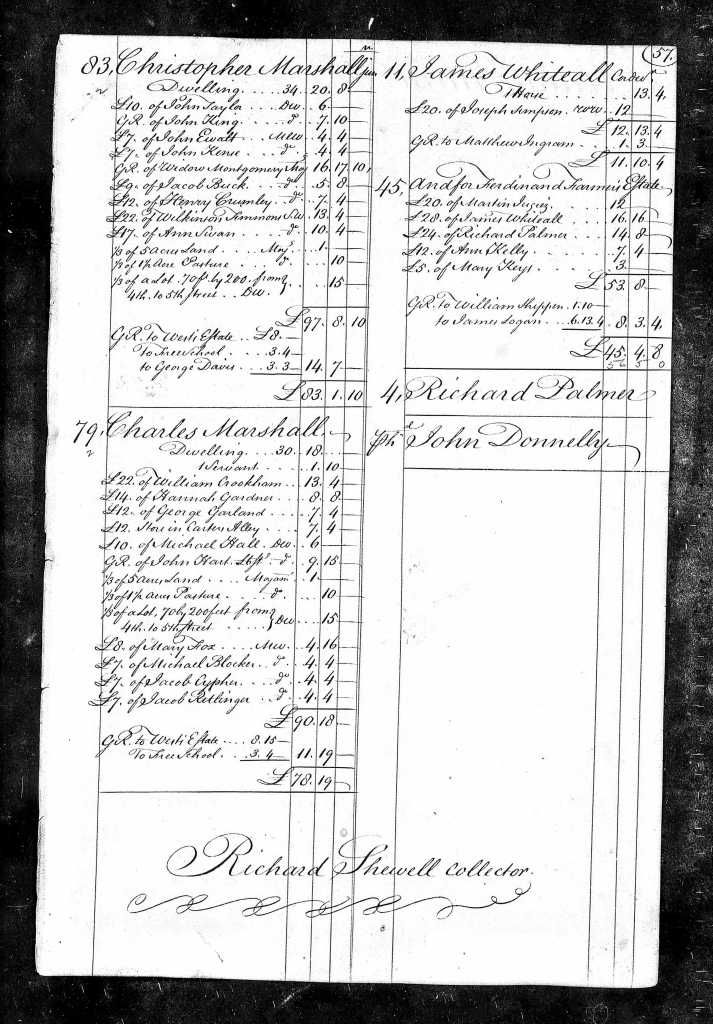
William Crookham is included in the 1774 Tax List for the South Ward of Philadelphia.

Pennsylvania Historical & Museum Commission; Records of the Office of the Comptroller General, RG-4; Tax & Exoneration Lists, 1762-1794; Microfilm Roll: 332 | ancestry.com

It is unclear how he is included, in that he seems to appear as a sub-item for the taxes of Charles Marshall who owed approximately 79 pounds.

South Ward, Philadelphia

Philadelphia. 1802. Charles P. Vance | David Rumsey Collection

The South Ward was bordered by Water and Chestnut Streets, between 4th Street and the western edge of the city. In the Vance map, this was colored a lime green. It was directly south of the pink ward.

The South was described as a a wealthy ward prior to 1785, as a residential and shopping district. The eastern end of the ward was wealthier than the western end of the ward.

William Crookham appears to have lived on the property of Charles Marshall, which was valued at 79 pounds. This placed the Marshall property in the midrange of the estates taxed. There were outliers like Israel Pemberton’s estate at 900 and several of the larger estates were in the 100-300 range. Charles Marshall ran an apothecary shop and set it up among the wealthy.

Prior to 1776, single men in Pennsylvania who did not own property paid taxes; additionally, because they did not owe taxes, they were prohibited from voting. This suggests that William Crookham was an unmarried man living in Philadelphia prior to a possible marriage and prior to owing property.

The purpose of the tax was twofold: to encourage marriage to increase the population and to discourage immoral living. Quakers, who ran the governing bodies in Philadelphia prior to the Revolutionary War, valued families and used the tax to assert its values in the community.

It is likely that this William Crookham is not the William Crookham who married Mary Philips at the Swedes’ Church, rather a son or nephew. Additionally, this may have been the William Crookham who married an Anna and lived in York County after the Revolutionary War.

Sources

Gentry, Thomas Samuel. Specialized residential and business districts : Philadelphia in an age of change, 1785-1800. Thesis. Montana State University. 1988

McCurdy, John Gilbert. “Taxation and Representation: Pennsylvania Bachelors and the American Revolution.” The Pennsylvania Magazine of History and Biography, vol. 129, no. 3, 2005, pp. 283–315. JSTOR, http://www.jstor.org/stable/20093800.

Asa Lake | Prisoner of War

In his grandson’s biography, a few sentences describe the role of Asa Lake in the Revolutionary War.

The maternal grandfather was taken prisoner at the Battle of Long Island , when seventeen years of age, and was given to the Indians by the English, and carried to the Western Reserve, in Western Ohio. He was liked and adopted by the chief, and was sent out hunting, and escaped after about a year’s captivity, footing it back. In 1820, forty years later, he took a claim where the Indian wigwam was, and the spring out of which he formally drank was on this claim. He died on it in 1843.

In a previous post, I recount the land purchases Asa Lake made after the war in northwest Ohio on the Lanape land; the Lanape, or Delaware Indians, had been removed by the US Government to Kansas and Oklahoma.

This post explores his account of his status as a prisoner of war.

Battle of Long Island

The Battle of Long Island took place a month after the Declaration of Independence in August of 1776. New York was an important harbor which the British could use to divide the colonies, isolation the New England colonies. George Washington commanded 10,000 Continentals to 20,000 British troops. As a result of strategic errors, Washington lost the battle and over a 1,000 men were captured.

If the birth year of Asa Lake is 1764, as stated in family histories and published in SAR Membership Applications, then Asa would have been 12 during the Battle of Long Island, making it unlikely that he participated in that particular battle.

Revolutionary War Service Records

Chloe Lake’s pension application and the Revolutionary War Service records list his earliest participation in the war as 1779 when he joined militias associated with the Green Mountain Boys. The Green Mountain Boys had begun a decade earlier, prior to the Revolutionary War, . Claims for Vermont were disputed, with New Yorkers and others claiming the land. The Green Mountain Boys fought New Yorkers prior to fighting the British in the Revolution.

In 1779, he served 109 days in Capt Parmelee Allen’s Company serving in the position of Fife. According to a page published by the US Army on the Fife, Drum and Bugle During the Revolutionary War, “most of the musicians would have been boys that were too young to fight in the war but were following their fathers who were fighting.” This is consistent with what we see of Asa Lake’s service mirroring that of his father’s (Gershom Lake) service in the War.

In later service records, he is no longer listed as a fifer and in 1782, he is no longer serving with his father. None of the records indicate that he was taken prisoner by the British.

Summary of Service

Date RangeServiceRoleName
1 May 1779 to 3 Dec 1779
8 days
Capt. Ephraim BueIl’s CompanyScouting
Ensign
Gershom Lake
1 May 1779 to 3 Dec 1779
5 days
Capt. Ephraim BueIl’s CompanyScoutingAsa Lake
1 Aug 1779 to 11 Nov 1779
109 days
Capt. Parmelee Allen’s Company of RangersFiferAsa Lake
21 Mar 1780 to 27 Mar 1780
7 days
Capt. Ephraim Buell’s CompanyScouting
Ensign
Gershom Lake
24 Mar 1780 to 27 Mar 1780
4 days
Capt. Ephraim Buell’s CompanyScoutingAsa Lake
29 May 1780 to 5 Jun 1780
8 days
Capt. Ephraim Buell’s CompanyEnsignGershom Lake*
October 1780
26 days
Capt. Isaac Clark’s Company
(Included Ephraim Buel)
Gershom Lake
?sa Lake
21 Oct 1781 to 30 Oct 1781
10 days
Capt. Nathaniel Blanchard’s Company of Militia in Col. Thomas Lee’s RegimentGershom Lake
Asa Lake
October 1781
10 Days
Detachment of Men from Blanchard’s Company under Capt. Israel HurlburtAsa Lake
1782
No month given
5 days
Capt Israel Hurlburt’s Company on an expedition to NorthwardAsa Lake

Indian Raids during the Revolutionary War

In 1777, the British army began to recruit and arm Indigenous peoples so as to perform raids on colonial settlements on the western frontier. The British operated out of Detroit and Quebec for these raids. The raids escalated in 1780. In Vermont, the committee elected to build forts at Pittsford and Castleton. Both Gershom and Asa Lake were stationed at Castleton in Oct 1781. These raids were described in article entitled “Indian and Tory raids of Otter Creek 1777-1782”. It is possible Asa Lake was captured during one of these raids while stationed at Castleton. This date is consistent with Asa Lake’s dates of services, his age, and explains the gap between the 1781 service and the 1782 service.

So where did the Battle of Long Island come into the story?

There are at least two possible theories for this.

The first theory is that Asa Lake was taken prisoner during the war, during his stint at Castleton. Some British prisoners of war were taken to Quebec, others were taken to New York. He could have been taken to New York prior to being traded and from there taken West. This seems improbable as many of the stories relate the prisoners and raiders going west and north rather than south and east.

The second theory is that Crookham, the grandson, confused the stories of his grandparents. Returning to the biography, here is a larger excerpt:

The father of George L and the grandfather of the Judge [James Crookham] was at the time of the Revolutionary War taken prisoner and held for about eight months on the Western Reserve in Ohio, and forty years later, when the Indian lands were put on the market, he returned to that county, bought the land, and located on the same spot where he had been held prisoner, and died there. He was a blacksmith and made arms for Gen. Washington during the Revolutionary war.

The material grandfather was taken prisoner at the Battle of Long Island , when seventeen years of age, and was given to the Indians by the English, and carried to the Western Reserve, in Western Ohio. He was liked and adopted by the chief, and was sent out hunting, and escaped after about a year’s captivity, footing it back. In 1820, forty years later, he took a claim where the Indian wigwam was, and the spring out of which he formally drank was on this claim. He died on it in 1843.

Note the similarities of the tales: both grandfathers were taken prisoner, both returned forty years after their release and both died where they had been held captive. James Crookham was a blacksmith and a matross ( a soldier who assists artillery gunners in loading, firing, sponging and moving the guns) who served in western Pennsylvania, near Carlisle. Service records indicated he deserted in 1781. It is possible that he was taken prisoner without his regiment knowing. By 1782, he had returned to Bedford, Pennsylvania which is consistent with the year’s worth of captivity. By 1810, he had moved to Allegheny County, Pennsylvania, along the border of Ohio.

A John Crookham served in the Pennsylvania Rifle Regiment who fought at the Battle of Long Island. He and his regiment was encamped near King’s Bridge. Another John Crookham served in Capt. John Clark’s Company near Fort Island in 1777, as part of the 8th Pennsylvania Regiment. Due to the way names were abbreviated in records, it is probably that Jas. and John Crookham are the same person. They both hale from Bedford and Huntingdon County. James Crookham’s records were misfiled in under Joshua Crookham, for example. This would account for the family tale that a grandfather fought in the Battle of Long Island and was at some point taken prisoner and given to the Indians.

Sources

McMillan, C. N. (1956). A history of my people and yours: Including the families of Nicholas Lake [and others]. Place of publication not identified.

Fife, Drum, and Bugle During the Revolutionary War

Wilbur, L. F. (2002). Early history of Vermont. Salem, Mass: Higginson Book Co.

Underwood, W. (January 01, 1947). Indian and Tory raids on the Otter Valley, 1777-1782. Vermont Quarterly.

Goodrich, J. E. (1904). The state of Vermont: Rolls of the soldiers in the Revolutionary war, 1775 to 1783. Rutland, Vt: Tuttle Co. | ancestry.com

Linn, J. B., & Egle, W. H. (2009). Pennsylvania in the War of the Revolution: Battalions and line, 1775-1783.

Asa Lake | Western Reserve of Ohio


Asa Lake (d. 1843) lived in Vermont during the Revolutionary War, migrated to Ohio around 1800, first in southeastern Ohio in Jackson County, before traveling to Hancock County in northwestern Ohio, where he died.

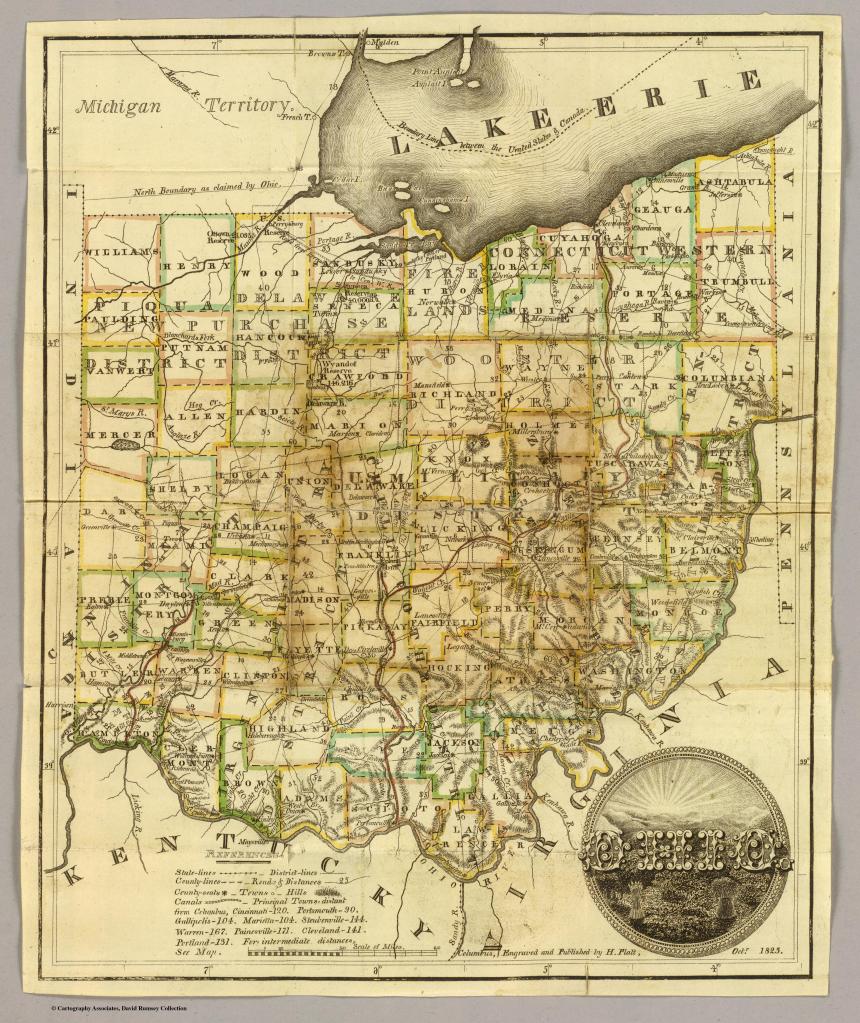
Ohio. Hiram Platt. 1826 | David Rumsey Collection

In the History of Hancock County, Asa Lake was recorded as the first settler in Delaware Township, purchasing land in Section 1 in 1821, and recorded as laying out 53 lots for Mt. Blanchard in the late 1830s.

Delaware Township in Hancock County, excerpt from Hancock County 1863, Cowles & Titus, 1863 | historicmapworks.com

Family Legend

The grandson of Asa Lake, Judge J. A. L. Crookham, paid for the inclusion of his biography in the Portrait and Biographical History of Mahaska County, Iowa. In the biographical sketch of Crookham, it included these sentences about his maternal grandfather:

The maternal grandfather was taken prisoner at the Battle of Long Island , when seventeen years of age, and was given to the Indians by the English, and carried to the Western Reserve, in Western Ohio. He was liked and adopted by the chief, and was sent out hunting, and escaped after about a year’s captivity, footing it back. In 1820, forty years later, he took a claim where the Indian wigwam was, and the spring out of which he formally drank was on this claim. He died on it in 1843.

Western Reserve of Ohio

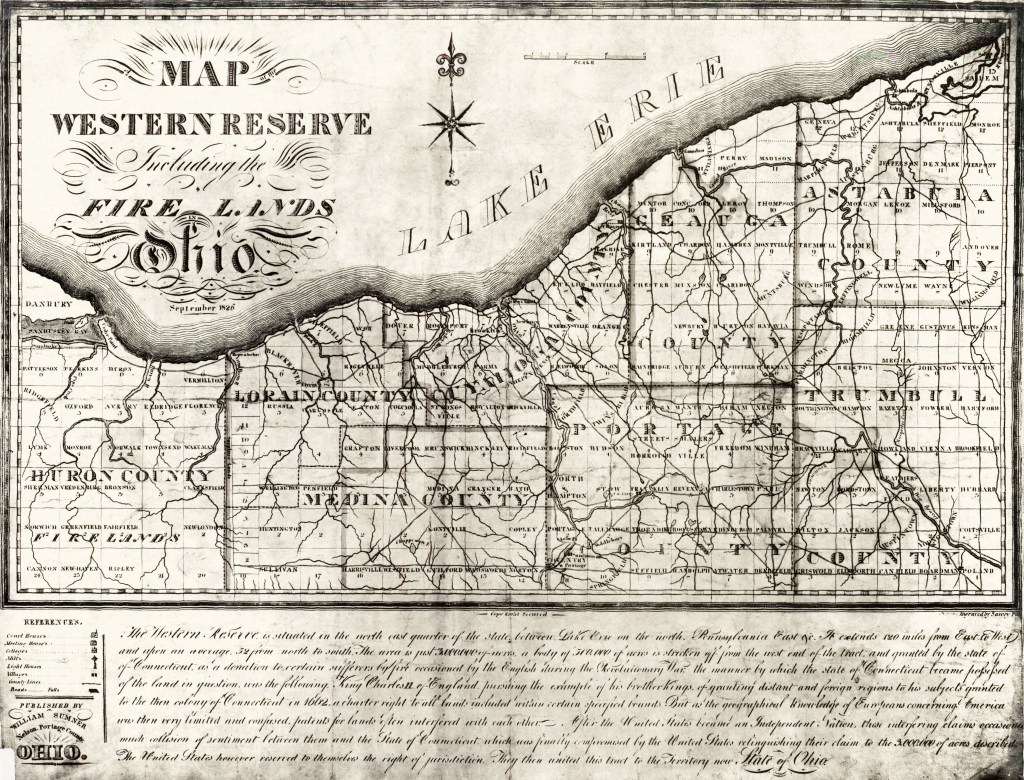
The Western Reserve of Ohio was territory in northeast Ohio that had been claimed by Connecticut prior to the Revolutionary War. While other land in Ohio had been claimed by Connecticut, it relinquished claims to those lands to the US government, reserving the lands of the Western Reserve for itself. This land was divided into two parts. The western third was called Fire Lands, as it was given to Patriots whose homes had been burned during the Revolutionary War. The eastern two-thirds was sold to land speculators.

Map of the Connecticut Western Reserve in Ohio, 1826 | Wikipedia.

Hancock County, where the Lake family settled, is not part of the Western Reserve of Ohio. It is, however, in the territory immediately west of the Fire Lands, in land also claimed by Connecticut prior to the war.

Delaware Purchase

Excerpt from Ohio Map by Hiram Platt 1826 | David Rumsey Collection

On the 1826 map of Ohio, the mapmaker marked the quartet of counties, including Hancock County, the Delaware Purchase. The Lenape, known to Euro-Americans as the Delaware Indians, lived here, having been pushed here by previous Euro-American settlements and colonies farther east. Prior to European colonization, they had lived on the land in what became the state of New Jersey. Here in Ohio, they struggled with the Iroquois, and as the Europeans and Euro-Americans struggled for power, they formed alliances with the British and the French, trying to stop further Euro-American encroachment on their lands. Treaties in the early 1800s forced the Lenape out of Ohio and into what would become Kansas and Oklahoma.

The Lake Family arrived in the Delaware territory while the US government was creating treaties with the Lanape tribes and forcing them west. The township they lived in was named for the Indigenous people from whom they stole the land.

Sources

Spaythe, Jacob A.; History of Hancock County, Ohio: geographical and statistical (Toledo: The B.F. Wade Printing Co., 1903)

Portrait and biographical album of Mahaska County, Iowa: Containing full page portraits and biographical sketches of prominent and representative citizens of the county, together with portraits and biographies of all the governors of Iowa, and of the presidents of the United States. (1996). Salem, Mass: Higginson Book Co.

James Brown | First Wife


Who was his wife prior to Rachel Pearse?

James Brown died in 1867 while visiting his daughter, Elizabeth Anderson, in Greenwood County, KS. His probate records report that he died intestate with a widow and children living in Fulton County, Illinois.

Petition Page 9 of Probate File | Kansas, U.S., Wills and Probate Records, 1803-1987 | ancestry.com

Elizabeth Anderson, his daughter, had married Devine Anderson in Fulton County in 1847 and moved to Greenwood County in 1866. The year 1867 was a difficult year, as Elizabeth lost her son, James H Anderson in July, and both her husband and father within a week of each other in September.

What we know about the Widow Brown

James Brown left behind his widow and children in Fulton County, Illinois. In the 1860 Census, he is recorded as the head of the household, with his wife, Rachel, age 50, and children, including Woodson and Swepston Brown. In 1870, Rachel is the head of household with her son, Swepston, working on the farm, and her neighbor is Woodson Brown.

The census records list the birthplaces of the households, suggesting a migration path for the family. Of the household, James is listed as born in Virginia, while his wife Rachel and the older children are listed as born in Ohio, and his two youngest, Woodson and Swepston were born in Illinois.

Information gathered from the Civil War service records of William and Thomas Brown (both living in Fulton County at mustering) show a Belmont County origin for the Brown Family. In 1840, James Brown was recorded as living in Belmont County, Ohio with a household of eight children: three boys and five girls.

1840 CensusNameLifeNotes from other Sources
1 male under 5William Brown1837-1863born in Lloydsville, Belmont Co., OH

1 male under 10 Thomas Brown1834-1911born in LLoydsville, Belmont Co., OH
1 male 15-19Hamilton Brown1824-1857born in Virginia
1 female under 5Ruth Brown1838-both in Ohio
1 female under 5
1 female under 10 Tabitha Brown1830-1844unknown
1 female under 10Lucy Brown1828-1842unknown
1 female under 15-19Elizabeth Brown1825-1886born in Virginia

In 1832, James Brown and Rachel Pearse filed for marriage while living in Belmont County, Ohio.

Their 1832 marriage is several years after the birth of Hamilton and Elizabeth Brown, who were recorded as being born in Virginia. This suggests that James Brown married another woman prior to Rachel Pearse, in Virginia, prior to moving to Ohio.

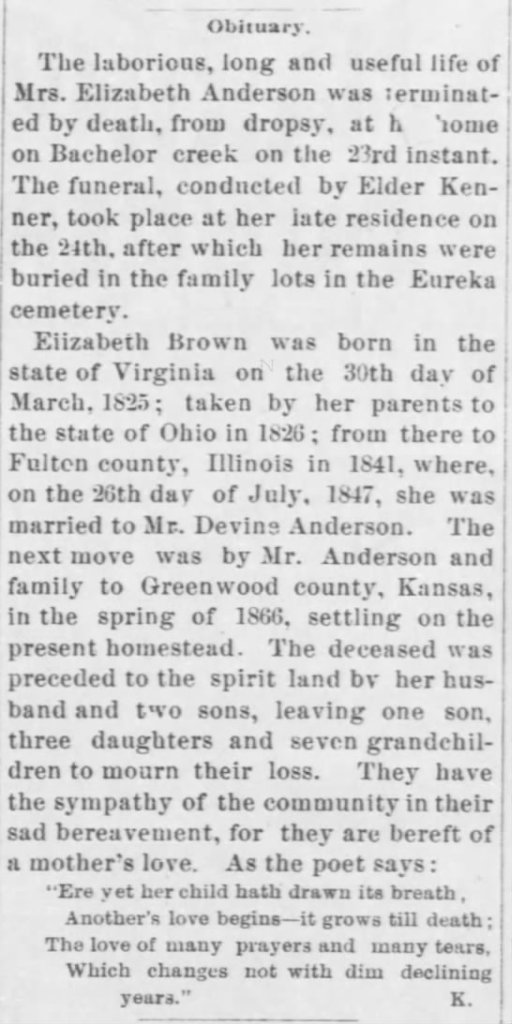
Elizabeth’s Obituary

The obituary of Elizabeth Anderson nee Brown confirms the migration path from Virginia to Ohio to Illinois and provides a rough timeline of the journey.

  • 1825 | Born in Virginia

  • 1826 | Moved to Ohio

  • 1841 | Moved to Illinois

  • 1847 | Married Devine Anderson

  • 1866 | Moved to Kansas

Search Parameters

Based on James Brown age in the 1860 and 1850 Census (56 and 49 respectively), he was born shortly after 1800 in Virginia. He would have been about 25 when his daughter Elizabeth was born, suggesting he was married between 1815 and 1825, most likely with a marriage date between 1820-1825.

The bulk of migration from Virginia in the early 1800s went to Tennessee and Kentucky, not Ohio. For the Brown family to have migrated to Ohio, it suggests that they lived in the northern part of Virginia, either in what would become West Virginia or the northern Shenandoah Valley.

Virginia, U.S., Compiled Marriages, 1740-1850

Search Results using 1820 +/- 5 years for James Brown

BrideDateCountyRelated Sources Beyond Marriage
Peggy Boyd9 Feb 1815Augustafindagrave record
Elizabeth Jones22 Aug 1816Augustano related sources
Eliza Bartlett6 Nov 1820Frederickfindagrave record
Mynta Tasker30 Nov 1820Hampshireno related sources
Jane Allison1 Mar 1821Augusta1850 Census Record
Sarah Carrell6 Mar 1823Greenbrierno related sources
Elizabeth Bane12 Feb 1824Ohiofindagrave record

The table shows the list of brides who were returned from the database of Virginia Marriages. Of the seven names who were listed in a county in the northwest portion of what was then Virginia, four can be ruled out due to documented family histories in related sources identified by ancestry.com and findagrave.com, leaving three possibilities.

Of these three possibilities, Mynta Tasker is the closest geographically, though that may not be significant. Hampshire County is south of the Maryland border, at the north end of the Shenandoah Valley. It would have been a relatively easy migration from Hampshire county to Belmont County in 1826.

Another possibility is Elizabeth Jones as her name is the same as Elizabeth, the eldest daughter. While Elizabeth is and was a common name, it’s possible that it signifies a family connection. Elizabeth Anderson named one of her daughters Tabitha presumably after her younger sister, and one of her sons after her father, James. The year is on the earlier end, suggesting a young James Brown and Elizabeth Jones were married, if is our James Brown, born between 1800-1805.

Further Research

Identify more records for the James Brown in the three localities that may tie one of them to the James Brown of Belmont County, Ohio.

Jethro New | Battle of Cowpens

Jethro New enlisted in the 2nd Delaware Regiment and fought in the Battle of Cowpens (Jan 1781). The battle was turning point in the Southern Campaign of the Revolutionary War, as it was a decisive victory for the Continental Army.

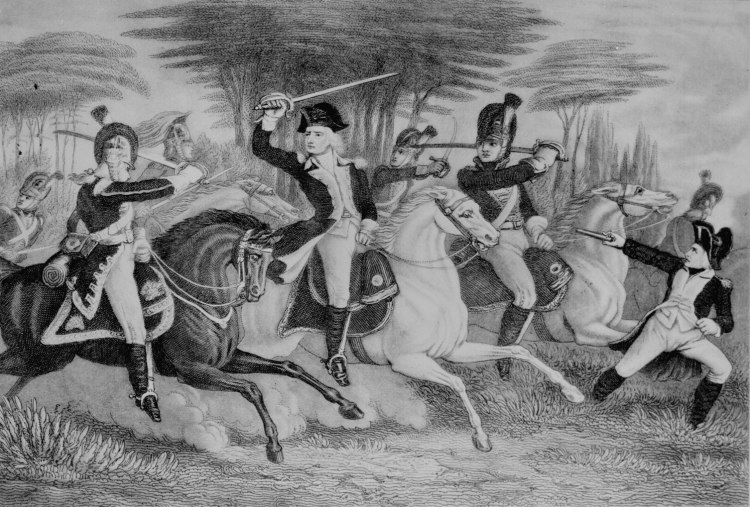
Colonel [William Augustine] Washington at the Battle of Cowpens. January 1781. Copy of print by S. H. Gimber

Battle of
Cowpens


Cowpens is located near the border between the Carolinas in the backcountry of South Carolina. In the Southern Campaign of the war, Gen. Nathaniel Green sent Daniel Morgan and his men to harass the British outposts, to forage for food, and rally the colonists in the backcountry. Cowpens, itself, was a large meadow where Morgan was able to allow his horses to forage.

British Forces at the Battle of Cowpens were led by Banastre Tarleton, the third son of a wealthy merchant from Liverpool in England. He purchased his commission in the dragoons. Rapidly rising through the ranks, he acquired the nicknames “Bloody Ban”, “Butcher” and “Green Dragoon”.

While he had won other battles earlier in the war, the Battle of Cowpens left his forces defeated and he had been forced to escape, retreating back to Cornwallis.

In the family histories of Jethro New, they claim that at one point New had been captured by the British, one specifically naming the “Butcher Tarleton” and that New had been tied to a British horse and forced to walk sixteen miles behind it, barefoot. It is unclear if this happened after the Battle of Cowpens, where both are said to have been. Reports of the battle claim 500 British men were captured but only number a handful of wounded or killed Continentals.

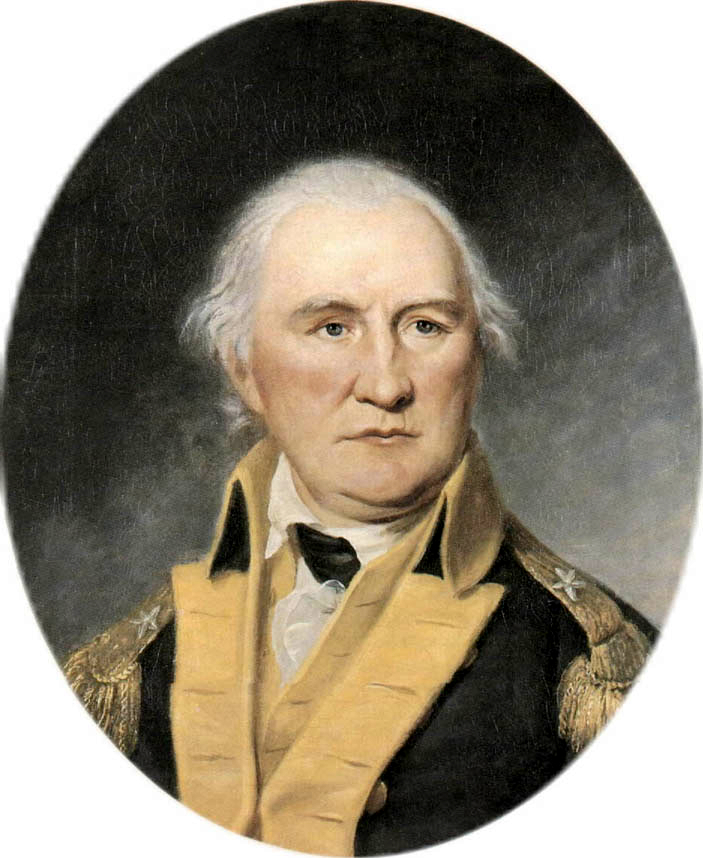
American Forces at the Battle of Cowpens were led by Daniel Morgan, a retired battlefield tactician who returned to the Revolutionary War after the Battle of Camden which had been a disaster for the Continental Army. The Delaware Regiment had been reduced to two companies as a result of the Battle of Camden.

The Battle of Cowpens is said to be a rare example of a successful double envelopment, as Morgan deployed his men into three rows.

He placed the riflemen first, then the miltia, and then the regular army in the third row. This eased the British army into complacency while the Americans continued the onslaught during the battle. William Washington and his calvary emerged as the second line retreated into the third, finishing the onslaught. Morgan received awards for his strategy during the Battle.

As a member of the 2nd Delaware Regiment, Jethro New would have been in Morgan’s third line, as the Continental Regulars were used to finish off the British. After the Battle, the American forces went to Guilford Courthouse, where they again faced battle, though the outcome was not as decisive.

Map by John Fawkes | britishbattles.com